How to Choose a Safari Lodge for Travelers With Limited Mobility
Choosing a safari lodge for a traveler with limited mobility requires more than finding a room described as accessible. The strongest choice is a lodge that can explain the entire guest journey, from the airport or airstrip transfer to the room, dining areas, wildlife activities, and departure, in precise and measurable terms.
Accessibility varies widely among destinations, and a ramp at reception does not guarantee an accessible bathroom, manageable pathways, or a workable safari vehicle. Before paying a deposit, ask the lodge to confirm arrangements in writing and compare its answers with the traveler’s actual transfer ability, walking range, mobility aid, and support needs.
Quick answer: what to confirm before booking
- Step-free movement: Verify every part of the route between arrival, the assigned room, dining areas, viewing spaces, and safari departure points.
- Exact room measurements: Request doorway widths, bed height, turning space, shower access, grab-bar positions, and the toilet transfer space.
- Vehicle access: Establish whether the traveler must climb into a raised vehicle and what assistance or equipment is available.
- Suitable transfers: Confirm how the traveler and mobility aid will travel between the airport, airstrip, and lodge.
- A named contact: Ask one staff member to coordinate accessibility arrangements and record the agreed details.
Begin with the traveler’s functional requirements
Limited mobility is not a single set of needs. One traveler may walk short distances with a cane but struggle with steps. Another may use a manual wheelchair and transfer independently. Someone using a power chair may require step-free vehicle access, dependable charging, and enough cargo capacity for a heavy mobility aid.
Prepare a short requirements note before contacting lodges. Include the mobility device’s folded and unfolded dimensions, weight, battery type if applicable, the traveler’s maximum comfortable walking distance, ability to manage steps, transfer method, and whether a companion can provide physical assistance. Mention any portable equipment that must fit beside the bed or in the transfer vehicle.
This information gives the lodge a concrete basis for answering. It also reduces the risk of relying on broad labels such as accessible, elderly-friendly, or suitable for wheelchairs, which can mean very different things in different countries and properties.
Trace the complete route through the lodge
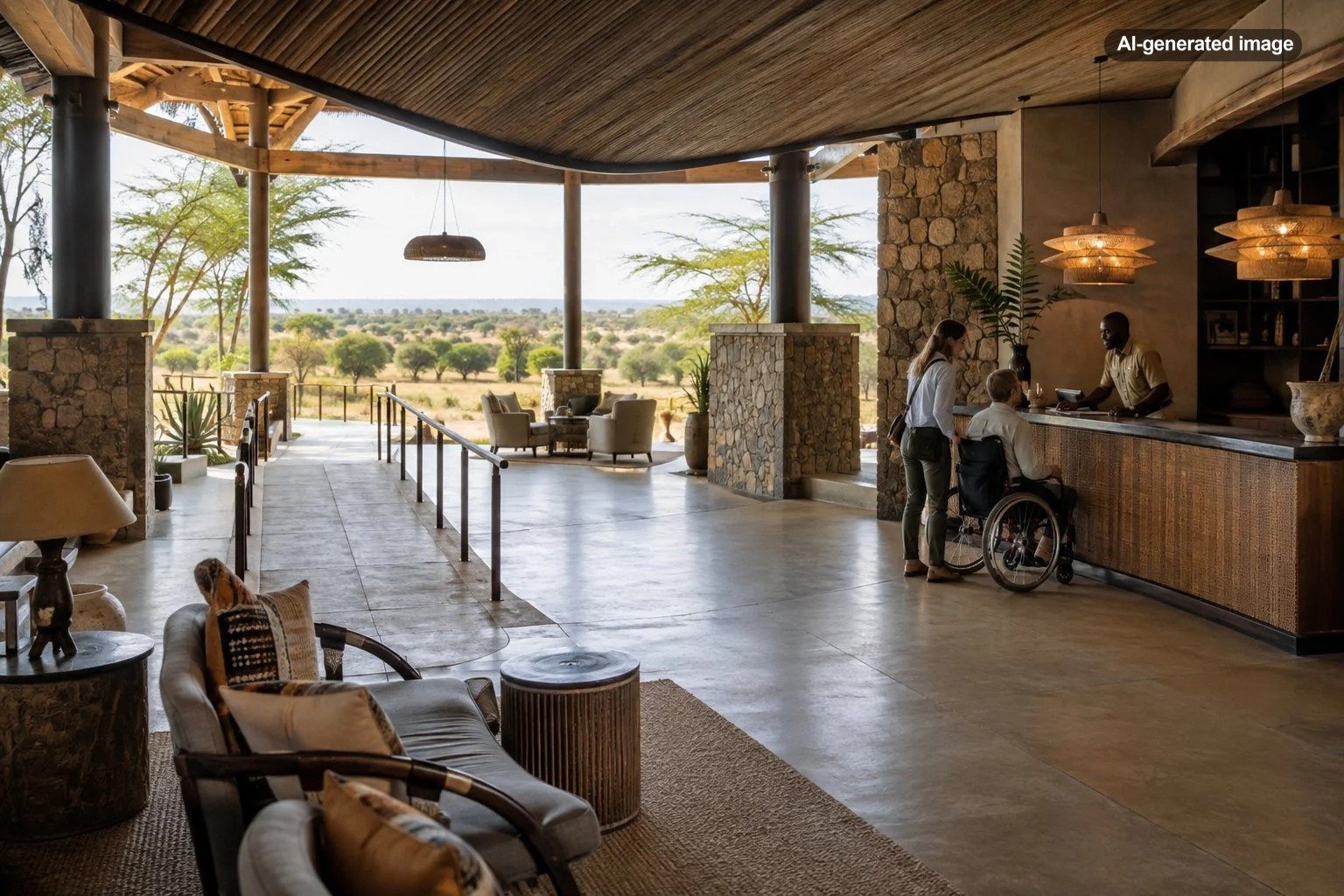
A lodge may have an adapted guest room while still presenting difficult gravel, sand, steep slopes, raised boardwalk thresholds, or long distances elsewhere. Ask the property to describe the surface, gradient, distance, steps, and lighting along each essential route. Relevant points include reception, the assigned room, restaurant, lounge, restroom, pool deck or viewing area, and the place where game drives depart.
Natural settings create legitimate design constraints, but those constraints should be explained clearly. A room close to the central lodge may reduce distance while bringing more evening activity or operational noise. A secluded tent may feel private but require a longer route over uneven ground. For many travelers, dependable access is more valuable than the most scenic or remote room category.
Photographs or a short video of the actual route can clarify details that a checklist misses. Request current images of thresholds, ramps, paths, and bathroom layouts, preferably with a measuring tape visible when dimensions are important.
Inspect the assigned room, not merely the room category
Ask whether the accessible features belong to the exact room being held. Two units marketed under the same category may have different entrances, bathroom configurations, or distances from shared facilities.
Bedroom questions
- Is the entrance step-free, including any deck or threshold?
- What is the clear width of the narrowest doorway?
- Is there maneuvering space on the traveler’s preferred side of the bed?
- What is the mattress height from the floor?
- Can furniture be repositioned before arrival?
- Are switches, outlets, curtains, and storage reachable?
Bathroom questions
- Is the shower level-entry, and does it have a fixed or portable seat?
- Where are the grab bars positioned?
- Is there enough clear space beside the toilet for the required transfer?
- Can a wheelchair roll beneath the sink?
- Is the floor likely to become slippery when wet?
- Can staff provide equipment such as a shower chair, or must the traveler bring it?
A bathtub with grab bars is not equivalent to a roll-in shower. Likewise, a bathroom can have a wide entrance yet lack the turning or lateral transfer space a wheelchair user needs.
Examine game-drive vehicle access carefully
The wildlife experience often presents the most consequential tradeoff. Traditional safari vehicles can have high steps, narrow openings, and elevated seats. Ask for the height and number of steps, the location and strength of handholds, the width of the entry, and whether a stable transfer step is used.
Determine whether the lodge has a lift-equipped or otherwise adapted vehicle, whether a wheelchair can remain secured during the drive, and whether that vehicle must be reserved in advance. If staff propose lifting the traveler manually, the traveler should decide whether that method is comfortable and appropriate; neither party should assume that lifting is acceptable.
Also ask about drive duration, restroom access, typical opportunities to leave the vehicle, and whether shorter or private outings can be arranged. A shared drive may offer a sociable atmosphere, while a private vehicle can provide greater flexibility for transfers, seating, comfort breaks, and an earlier return. Availability and charges can change, so obtain current terms directly from the lodge.
Verify airport, airstrip, and luggage transfers
The lodge’s internal accessibility matters little if the arrival transfer is unworkable. Identify every vehicle and aircraft segment, including any change between a commercial airport, light aircraft, road vehicle, boat, or lodge vehicle.
For road transfers, confirm step height, door width, seating configuration, wheelchair securement, and cargo space. Ask whether the mobility aid must be folded or dismantled and who will handle it. For a power chair or scooter, provide its weight and battery information to the relevant transportation providers well before travel.
Small aircraft and remote airstrips may introduce different boarding, baggage, and mobility-aid constraints. These details depend on the carrier, aircraft, route, and local operation. They should be verified with both the transportation provider and lodge rather than inferred from the lodge’s general accessibility description.
Consider power, equipment, and medical logistics
Travelers using powered mobility equipment should ask about outlet type, voltage, charging location, power reliability, and backup arrangements. A lodge may have electricity only during certain operating periods or may restrict high-draw equipment. Confirm requirements before bringing a charger, converter, or battery.
Ask how far the lodge is from appropriate medical assistance, how staff communicate during an emergency, and what happens if the traveler cannot use the property’s usual evacuation method. This is planning, not a guarantee of care or response time. Travelers should also review current destination guidance and obtain insurance suitable for their circumstances and planned activities.
Compare evidence instead of accessibility labels
| Decision area | Weak answer | Useful evidence |
|---|---|---|
| Guest room | Wheelchair-friendly | Measurements and current images of the assigned unit |
| Pathways | Mostly level | Surfaces, slopes, distances, thresholds, and alternate routes |
| Game drives | Staff can assist | Vehicle photographs, step heights, transfer method, and equipment |
| Transfers | Transport available | Vehicle type, securement, loading method, and mobility-aid capacity |
Detailed answers are often a better indicator of fit than polished marketing language. As a practical example, South African National Parks publishes camp-specific information for visitors with mobility challenges, demonstrating why access should be evaluated facility by facility rather than assumed across an entire destination.
What travelers often overlook
- Nighttime routes: Wildlife-area rules may limit independent movement after dark or require an escort between buildings.
- Temporary changes: Weather, maintenance, vehicle substitutions, or room reassignment can affect an otherwise workable plan.
- Companion responsibilities: Establish which assistance staff can provide and what remains the companion’s responsibility.
- Backup arrangements: Ask what happens if the adapted room, vehicle, lift, or transfer service becomes unavailable.
- Written records: Keep measurements, images, equipment requests, and transfer arrangements with the reservation confirmation.
Frequently asked questions
Does an accessible room guarantee an accessible safari?
No. The room may be suitable while pathways, transfers, dining areas, or game-drive vehicles are not. Evaluate the full journey as a connected chain.
Should a traveler book through a specialist?
A specialist accessible-travel advisor can be valuable when the itinerary includes multiple transfers, small aircraft, powered equipment, or substantial personal assistance. Direct written confirmation from each provider remains important.
Is a private game-drive vehicle always necessary?
No. A shared vehicle may work well for someone who can manage its entry and typical schedule. A private vehicle may be preferable when transfers take longer or the traveler needs flexible timing and comfort breaks.
How early should accessibility arrangements be made?
As early as practical. Adapted rooms, appropriate vehicles, and trained transfer services may be limited. Reconfirm the arrangements before final payment and again shortly before departure.