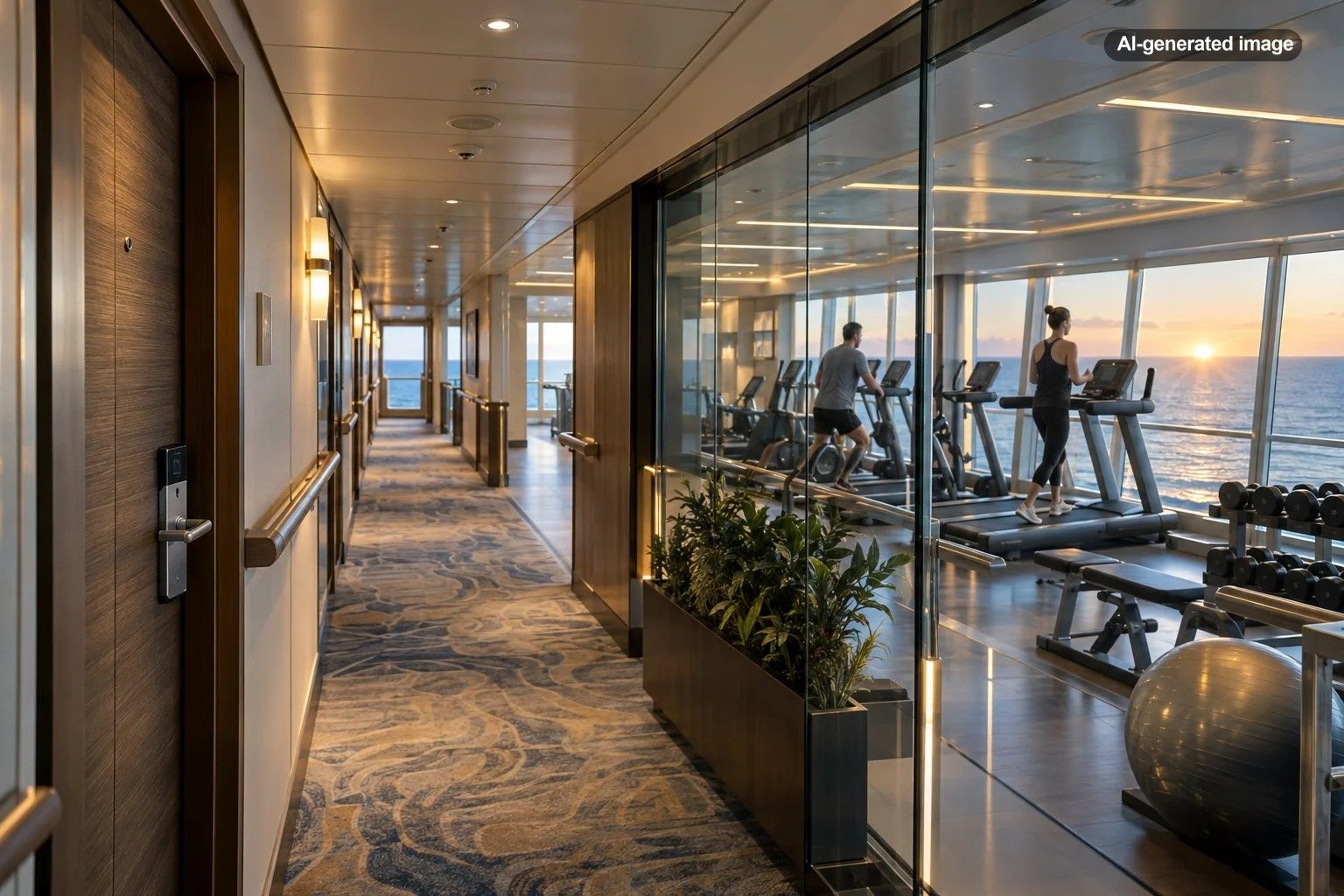
Are Cruise Cabins Near the Gym Noisy Early in the Morning?
Cruise cabins near a gym can be noisy early in the morning, but the amount of disturbance depends heavily on where the cabin sits in relation to the fitness center. A cabin directly below a gym floor is generally more vulnerable to thumping, dropped weights, treadmill vibration, and equipment movement than a cabin merely located on the same deck nearby.
For light sleepers, the important distinction is not simply whether a cabin is described as being “near the gym.” What matters more is whether the cabin shares a wall, ceiling, or floor with an active exercise area and what type of activity takes place immediately above or beside it.
Quick answer: how much noise should you expect?
- Cabins directly below the gym can be the riskiest. Impact noise and vibration can travel through the deck structure.
- Cabins beside the gym are often less exposed than cabins underneath it. Doors, corridors, storage areas, and changing rooms can create useful separation.
- Early morning use is the main concern for sleepers. Some passengers exercise soon after the fitness center opens or whenever access is permitted.
- Cardio equipment and free weights create different kinds of sound. Treadmills can produce repetitive vibration, while weights can create sharper impacts.
- Travelers who wake easily should favor cabins surrounded by other passenger cabins. This is usually a more predictable arrangement than being beneath a major public space.
Why a gym can create more noise than its location suggests
Noise on a cruise ship does not always travel in the way it would in a house or hotel. A fitness center may have padded flooring and modern equipment, yet movement can still create low-frequency vibration that passes through the ship’s structure.
A treadmill is a good example. The sound inside the gym may seem modest, but the repeated impact of running can create a rhythmic vibration noticeable in a room below. Rowing machines, exercise bikes, and elliptical machines are usually less associated with heavy impact, although mechanical vibration may still be perceptible depending on installation and construction.
Free-weight areas can create a different problem. Even when passengers are expected to place weights down carefully, an occasional dropped dumbbell can produce a sudden thud. Moving benches, adjusting equipment, or conducting an exercise class can also generate short periods of activity that are more noticeable than constant background sound.
Cabins directly below the gym deserve the closest look
If sleep is a priority, focus on the deck plan rather than relying on a broad description such as “near the fitness center.” A cabin located one deck beneath the gym may sit under very different areas of the room.
One cabin could be beneath treadmills, while another might be below a reception area, stretching space, spa corridor, or relatively quiet corner. Those positions can produce very different experiences even though both cabins appear equally close to the gym on a deck map.
When comparing cabins, align the deck plans above and below your proposed room. Look at the actual footprint of the fitness center and estimate what part of it overlaps your cabin. Deck plans are not engineering diagrams, so this cannot guarantee a quiet room, but it gives you more useful information than simply measuring distance from the gym entrance.
Being on the same deck as the gym is not automatically a problem
A cabin down the corridor from the gym can be quieter than a cabin directly underneath it. Horizontal distance, intervening rooms, doors, hallways, and service spaces may reduce the amount of sound reaching the cabin.
The main issue on the same deck may instead be passenger traffic. Early risers could walk through the corridor in workout clothes, and fitness-center doors may open and close regularly. That type of noise is usually different from structural thumping. It may be brief and intermittent rather than repetitive.
A cabin sharing a wall with the gym deserves more scrutiny, especially if that wall borders active equipment rather than a low-traffic portion of the facility.
Morning noise matters most for travelers who sleep late
The practical question is not whether the gym ever makes noise. It is whether that noise is likely to occur while you are trying to sleep.
Passengers who routinely wake early may find the location perfectly acceptable. If you are usually awake and preparing for breakfast when other guests begin exercising, occasional treadmill or corridor noise may have little effect on the trip.
The calculation changes for travelers who enjoy sleeping late, frequently return to the cabin after late-night entertainment, or are especially sensitive to repetitive sounds. For them, avoiding cabins beneath public recreation areas is a sensible precaution.
Gym noise is only one part of the deck-location decision
A cabin farther from the gym is not necessarily quieter overall. Moving to another part of the ship could place you below a pool deck, buffet, theater, lounge, galley, or another busy public area.
This is why cabin selection works best as a comparison rather than a single-rule decision. Look at what is above, below, and beside the cabin. A room surrounded vertically and horizontally by passenger accommodations generally offers fewer obvious sources of public-space noise.
However, even cabins in residential sections can experience hallway conversations, closing doors, neighboring televisions, children, housekeeping activity, or normal ship sounds. No location provides complete silence.
Who should avoid a cabin near the gym?
A different cabin location may be preferable if you are a very light sleeper, expect to sleep well into the morning, are traveling with a baby or young child who naps in the cabin, or strongly dislike repetitive vibration.
It may also make sense to choose another area if your proposed room is clearly positioned directly beneath a large cardio or weight-training section. When several comparable cabins are available, there is little advantage in accepting an obvious potential noise source unless the location offers another benefit that matters to you.
Who may be comfortable staying nearby?
Being near the fitness center can be convenient for passengers who exercise daily. Someone who wakes early, visits the gym before breakfast, and spends relatively little daytime in the cabin may consider the location an advantage rather than a drawback.
The same can be true when a cabin is technically close to the gym but separated from it by corridors or other spaces. Proximity alone should not automatically eliminate an otherwise suitable cabin.
What travelers often overlook when reading deck plans
Deck plans encourage passengers to think in two dimensions, but noise is a three-dimensional issue. The room above your cabin can matter just as much as the rooms beside it.
It is also useful to distinguish between the entrance to a public space and the active portion of that space. The gym entrance may be several yards from the equipment that actually creates vibration. Conversely, a cabin that appears distant from the entrance could still sit directly underneath treadmills or weights.
Another overlooked factor is that ship layouts and operating practices differ. A quiet cabin location on one vessel does not establish that an apparently similar position will behave the same way on another. Even ships within the same cruise line can have different deck arrangements.
How to choose a quieter cabin before booking
Start by identifying several acceptable cabins rather than focusing immediately on one room number. Compare each candidate with the deck above and below it. Give preference to rooms surrounded by other cabins when minimizing noise is more important than immediate access to pools, dining, entertainment, or fitness facilities.
If your preferred room is beneath the gym, examine which portion of the fitness center appears to overlap it. If alternatives are available at a similar location and cabin category, moving a few rooms forward or aft may place you beneath a less active space.
Travelers should also remember that deck plans can change and may not reveal exact equipment placement. Treat them as a planning tool rather than a promise of acoustic conditions.
FAQ
Are cabins directly under a cruise ship gym usually noisy?
They can be, particularly when positioned beneath treadmills, free weights, or other areas that create impact and vibration. The experience varies by ship and exact cabin location.
Is it better to be beside the gym or below it?
For noise-sensitive travelers, a cabin nearby on the same deck may be preferable to one directly underneath active exercise equipment. Structural vibration can travel downward even when the gym itself does not seem especially loud.
Can you hear treadmills from a cruise cabin?
It is possible in cabins located directly beneath or very close to a fitness center. Running can produce repetitive impact that may be perceived as thumping or vibration rather than ordinary airborne sound.
What is the safest cabin choice for a light sleeper?
A useful general strategy is to choose a cabin with passenger cabins above, below, and on both sides whenever possible. This reduces exposure to obvious public-space noise sources, although it cannot guarantee silence.
Should you reject every cabin near the gym?
No. Proximity does not automatically mean a cabin will be noisy. The exact relationship between the room and active gym areas matters more. For early risers and regular gym users, a nearby cabin may even be particularly convenient.
Ultimately, cruise cabins near the gym range from perfectly reasonable to potentially disruptive. The cabins worth examining most carefully are those directly beneath cardio machines or free-weight areas. If quiet mornings matter to you, comparing adjoining decks before choosing a cabin is one of the simplest ways to reduce an avoidable source of noise.