Chefchaouen vs. Essaouira: Which Morocco Side Trip Is Better?
If you are choosing between Chefchaouen and Essaouira for a Morocco side trip, the better destination depends less on which city is more famous and more on what your itinerary is missing. Choose Chefchaouen for a compact mountain medina, blue-painted streets, photography, and access to the Rif landscape. Choose Essaouira for an Atlantic setting, fortified historic architecture, a broader mix of medina and waterfront experiences, and a more relaxed coastal rhythm.
Both can work well as short additions to a longer Morocco trip, but they create very different experiences. Chefchaouen feels inward-looking and intimate, tucked into the mountains. Essaouira feels outward-looking, with ramparts, port scenery, open beaches, and ocean air shaping much of the visit.
Quick answer: Chefchaouen or Essaouira?
- Best for mountain scenery and distinctive streets: Chefchaouen.
- Best for ocean views and coastal atmosphere: Essaouira.
- Best for photographers focused on architecture and color: Chefchaouen.
- Best for travelers who want more variety in a short stay: Essaouira.
- Best choice overall: Essaouira for a more varied standalone side trip; Chefchaouen when its location fits naturally into a northern Morocco itinerary.
At a glance: how the two side trips differ
| Consideration | Chefchaouen | Essaouira |
|---|---|---|
| Setting | Rif Mountains | Atlantic coast |
| Signature experience | Blue medina streets and mountain surroundings | Fortified medina, ramparts, port, and beach |
| Trip feel | Compact, atmospheric, photography-oriented | Relaxed, breezy, varied, coastal |
| Outdoor appeal | Walking and nearby mountain excursions | Beach walks and water-oriented activities |
| Best itinerary fit | Northern Morocco | Atlantic and central Morocco routes |
Chefchaouen is better for atmosphere, color, and mountain scenery
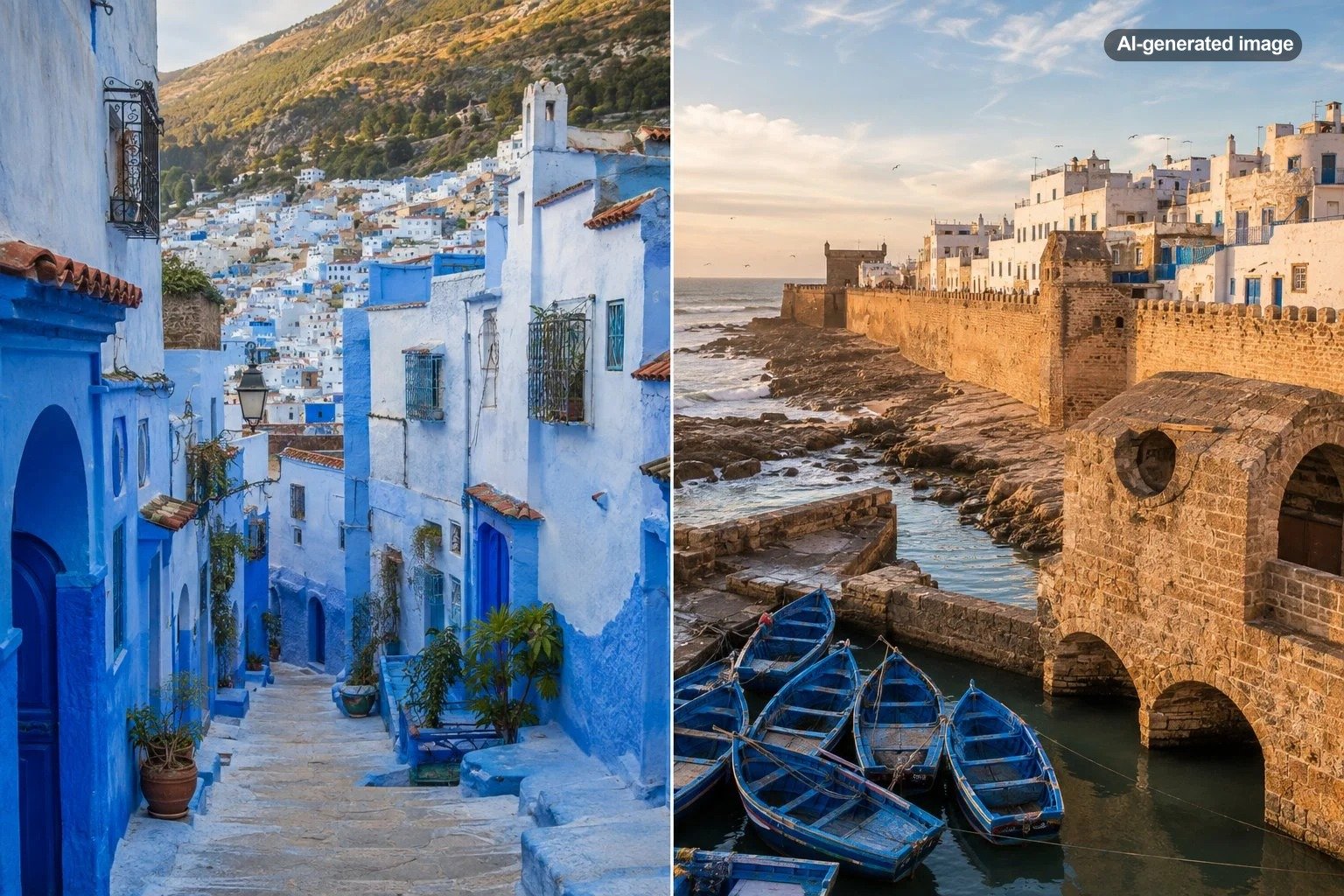
Chefchaouen’s strongest argument is immediately visible. Its medina climbs a mountainside in the Rif region, with narrow lanes, stairways, small squares, whitewashed walls, and the blue tones for which the city is known. The Moroccan National Tourist Office highlights the medina, kasbah, handicrafts, and surrounding mountain landscape as central parts of the experience.
The city works particularly well for travelers who enjoy exploring on foot without needing a long checklist of attractions. Much of the appeal comes from moving slowly through the old quarter, observing architecture, browsing shops, stopping for food, and seeing how the mountain setting changes the views as streets rise and fall.
Chefchaouen also has a stronger nature component than its photographs sometimes suggest. The nearby Rif landscape and Talassemtane area make it relevant to travelers interested in walking and mountain excursions rather than medina sightseeing alone.
Who should choose Chefchaouen?
Chefchaouen is an especially good fit for photographers, couples, solo travelers who enjoy wandering, and visitors already traveling through northern Morocco. It can also suit travelers who prefer a smaller destination where the atmosphere itself is the main attraction.
The tradeoff is variety. If you are not particularly interested in photography, architecture, shopping, or walking through the medina, you may feel you have absorbed the central experience relatively quickly. That does not make the city less worthwhile, but it matters when deciding how many nights to allocate.
Essaouira is better for variety and a coastal change of pace
Essaouira offers a more layered contrast with Morocco’s inland cities. Its historic medina sits beside the Atlantic, while fortified walls, port scenery, galleries, shops, and a broad beach create several distinct environments within one destination.
The medina is also historically significant. UNESCO lists the Medina of Essaouira, formerly Mogador, as a World Heritage property and describes it as an exceptional example of a fortified late-18th-century seaport town combining European military planning influences with a North African setting.
That history gives Essaouira a visual identity quite different from Chefchaouen. Instead of blue stairways rising into mountain neighborhoods, the defining elements include ramparts, stone fortifications, sea views, port activity, and wide Atlantic horizons.
Who should choose Essaouira?
Essaouira is a strong choice for travelers who want a break from intensive city sightseeing. It suits couples, solo travelers, families comfortable with a walking-oriented historic center, and anyone who values the option to alternate between medina exploration and time near the ocean.
Its coastal setting also creates opportunities beyond traditional sightseeing. The Moroccan tourism office emphasizes beaches around Essaouira and the region’s appeal for surfing and other wind-oriented activities. Even travelers with no interest in water sports may appreciate having a beach available for a long walk after spending time in the medina.
The principal tradeoff is the Atlantic weather. Wind is part of Essaouira’s character, and travelers imagining a consistently still, warm beach-resort experience may find the reality different. It is better approached as a historic coastal city with a beach than as a conventional resort escape.
Which destination has the better medina?
This is largely a question of what you want from a medina. Chefchaouen’s old quarter is the more visually distinctive choice if your priority is color, intimate lanes, stairways, and architectural photography. The mountain topography makes even a simple walk feel visually varied.
Essaouira’s medina is stronger for travelers interested in the relationship between urban history and the sea. Its fortified character, gates, ramparts, galleries, commercial streets, and proximity to the port give it a broader historical context.
Neither should be treated as a miniature version of Marrakech or Fez. Each has its own scale and rhythm, and that difference is precisely why either can work well as a side trip.
Which is better for a short stay?
Chefchaouen is excellent when you want a focused short stay. A traveler primarily interested in the medina can experience much of the city’s visual character without constructing a complicated itinerary. Adding mountain-oriented activities can justify a longer stay.
Essaouira generally rewards a little more unstructured time. Its appeal comes from switching between environments: medina streets, ramparts, the port area, cafes, galleries, and the beach. A rushed visit can technically cover major areas, but a slower pace better matches the destination.
Think about geography before choosing
The most overlooked factor in the Chefchaouen versus Essaouira decision is not scenery. It is route efficiency.
Chefchaouen fits most naturally into itineraries focused on northern Morocco. Morocco’s national tourism office places it within relatively easy reach of Tetouan and Tangier and also connects it geographically with Fez. Travelers already moving through that part of the country can add Chefchaouen without completely changing the direction of a trip.
Essaouira belongs to a different geographic pattern. It is on Morocco’s Atlantic side and pairs more naturally with itineraries moving through western or central parts of the country. If adding one destination requires a major detour while the other sits naturally along your route, that logistical difference should carry significant weight.
A beautiful side trip can become less appealing if it consumes too much of a short vacation in transfers. Before committing, compare your actual arrival city, next destination, transportation options, and the amount of usable sightseeing time left after travel.
Which is better for different types of travelers?
For photographers
Chefchaouen has the edge. Its blue streets, layered alleys, stairs, doors, walls, and mountain backdrop produce an unusually recognizable visual environment. Essaouira is also highly photogenic, but its imagery is more varied rather than dominated by one signature aesthetic.
For couples
Either can work. Chefchaouen feels intimate and atmospheric, while Essaouira offers more opportunities to divide the day between sightseeing, dining, waterfront walks, and time near the beach. Couples who like variety may prefer Essaouira; those prioritizing a compact, scenic retreat may prefer Chefchaouen.
For outdoor travelers
Choose according to terrain. Chefchaouen is the better base for travelers drawn to mountain landscapes and walking in the Rif region. Essaouira is better for travelers interested in the Atlantic coast, beaches, and wind-oriented water activities.
For travelers who dislike feeling rushed
Essaouira may have the advantage because its pleasures lend themselves to an intentionally slower schedule. However, Chefchaouen can also feel relaxed once you stop treating every blue street as a photograph that must be captured.
What travelers often overlook
The experience is more important than the checklist. Neither destination needs an aggressively scheduled itinerary. Their strongest qualities come from setting and atmosphere rather than a long collection of major monuments.
Your starting point matters. The better destination on paper may be the worse addition to your particular route. Compare transportation before deciding.
Do not expect the same weather. Chefchaouen’s mountain location and Essaouira’s Atlantic exposure create different conditions. Check the forecast close to your trip rather than packing for Morocco as though every destination has the same climate.
Allow room for walking. Both destinations reward exploration on foot. Comfortable footwear matters more than an elaborate sightseeing plan.
So, which Morocco side trip is better?
Essaouira is the stronger all-around choice for travelers who want the most varied side trip. Its combination of UNESCO-recognized historic fabric, Atlantic scenery, fortifications, medina streets, port character, and beach access gives it several distinct dimensions.
Chefchaouen is the better choice when visual atmosphere, mountain scenery, and a compact medina are the priorities. It is particularly compelling when the rest of your trip already brings you through northern Morocco.
If both fit your itinerary equally well, ask one final question: does your Morocco trip need mountains and intimate streets, or ocean air and a broader change of pace? The answer usually makes the choice straightforward.
FAQ
Is Chefchaouen worth visiting if I am not interested in photography?
Yes, particularly if you enjoy small medinas, handicrafts, walking, and mountain scenery. Photography is a major part of the city’s appeal for many visitors, but it is not the only reason to go.
Is Essaouira mainly a beach destination?
No. The beach is only one part of the experience. The historic medina, fortifications, port setting, cultural spaces, shopping streets, and Atlantic atmosphere are equally important to the destination’s identity.
Which is better for a first trip to Morocco?
Either can complement a first trip, but Essaouira often provides the greater contrast if the itinerary already includes a major inland city. Chefchaouen makes more sense when the route already includes northern Morocco.
Should you visit both Chefchaouen and Essaouira?
They are different enough that visiting both is not repetitive. The question is whether your itinerary has enough time to include them without creating excessive transportation days. On a shorter trip, choosing the one that fits your route usually produces a better experience than trying to force both into the schedule.