How to Avoid a Cruise Cabin Near Crew Service Doors
A cabin beside a crew service door is not automatically a bad cabin, but it can be a poor choice for travelers who are sensitive to hallway noise. Crew passageways, service pantries, utility spaces, and staff elevators may generate more activity than a normal stretch of passenger corridor, sometimes at hours when most guests are sleeping.
The challenge is that these areas are not always clearly labeled on public deck plans. The safest strategy is to examine the spaces beside, behind, above, and below a prospective cabin, pay attention to unexplained gaps in rows of staterooms, and favor cabins surrounded by other passenger accommodations whenever quiet is a priority.
Quick answer: how to reduce the risk
- Look for cabins with passenger staterooms on both sides and across the corridor.
- Be cautious about blank, gray, unusually shaped, or unlabeled spaces beside a cabin.
- Check the deck directly above and below, not just the cabin’s own deck.
- Use stairwells and elevator banks as reference points when comparing decks because printed plans may not align perfectly.
- If quiet matters more than convenience, give yourself a buffer of several cabins from obvious service or high-traffic areas when possible.
Why crew service doors can matter
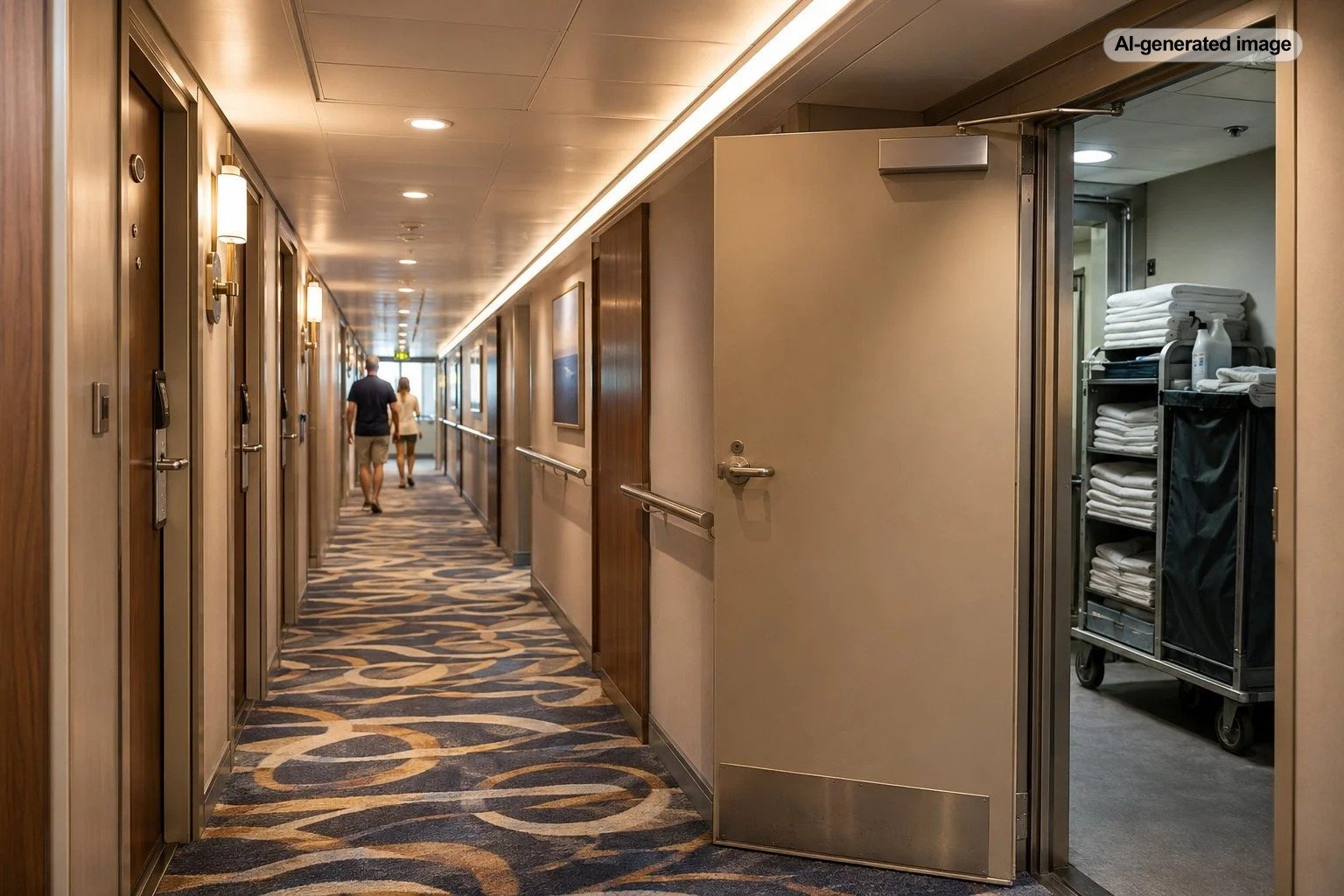
Cruise ships function around the clock. While passengers see restaurants, lounges, cabins, and promenades, much of the ship’s operation takes place through service corridors hidden behind guest-facing walls. Crew members may use these routes for housekeeping, food service, maintenance, linen movement, supplies, and other routine operations.
The issue is usually not a single door opening occasionally. It is the combination of repeated door movement, conversations, carts, equipment, and traffic through a concentrated access point. A traveler who sleeps deeply may barely notice. Someone who wakes easily when a latch closes or wheels move along a corridor may have a very different experience.
That distinction matters when comparing cabins. Being near a passenger elevator could be convenient and still acceptable to some travelers. Being beside an unidentified service access point offers less obvious benefit, so light sleepers generally have more reason to choose another cabin when comparable options are available.
Study the gaps between cabins on the deck plan
Start by finding your cabin category on the cruise line’s official deck plan. Then study the pattern of nearby staterooms. Passenger cabins normally create fairly regular rows. An abrupt blank section, gray block, recessed area, or unusual break in that pattern deserves a closer look.
Such spaces are not necessarily problematic, and they should not automatically be assumed to be crew areas. They can represent structural elements, equipment, stairs, storage, technical spaces, or other facilities. The important point is that an unlabeled area should be treated as an unknown rather than as empty space.
If two otherwise similar cabins are available and one shares a wall with an unexplained area while the other is surrounded by passenger cabins, the second cabin is usually the more conservative choice for someone prioritizing quiet.
Look across the hallway as carefully as you look next door
Travelers often inspect what is beside their cabin but ignore the opposite side of the corridor. That can be a mistake. A crew access door directly across from a stateroom may create repeated sound even though the cabin itself does not share a wall with the service space.
Look for irregular corridor shapes, door symbols, open spaces, or breaks in the line of cabins opposite your room. If the deck plan is highly simplified, enlarge the online version or compare it with another official rendering of the same ship when available.
A cabin several doors farther down the same hallway can sometimes provide essentially the same location while avoiding the unknown space altogether.
Check one deck above and one deck below
A quiet-looking corridor does not guarantee a quiet cabin. Operational noise may originate above or below the room. Pool decks, restaurants, galleys, theaters, fitness facilities, entertainment spaces, and other active areas can matter as much as the hallway outside your door.
For travelers focused on sleep, one of the most useful cabin-selection patterns is a stateroom with passenger cabins above, passenger cabins below, and passenger cabins on either side. This does not guarantee silence, but it creates a buffer from many obvious sources of operational or entertainment noise.
When comparing decks, do not assume that rooms shown directly above one another on separate images actually align perfectly. Cruise ship decks taper and change shape. Use fixed elements such as stairwells and elevator banks to help judge how one deck overlaps another.
Do not assume every unlabeled door is a problem
It is useful to distinguish caution from certainty. A symbol or blank area on a deck plan does not tell you how frequently a particular door is used, what happens behind it, or how much sound reaches an adjacent cabin. Ship design, door construction, operating procedures, and the exact location can all affect what passengers hear.
That means cabin selection should be based on relative risk rather than an attempt to identify a universally bad cabin. If you are a heavy sleeper and the cabin offers an otherwise ideal location, a nearby service space may not outweigh its advantages. If you are a light sleeper, have an early excursion schedule, or simply value a quiet room more than proximity to elevators and public areas, it makes sense to be more selective.
Select a specific cabin when location matters
If avoiding crew doors is important, having control over your exact cabin is more useful than simply choosing a cabin category. Some fares or booking arrangements may involve cabin assignment later, which can reduce your ability to avoid locations you consider less desirable.
Affiliate disclosure: HotelInfo.com may earn a commission when you book or purchase through links on this page. This does not affect the price you pay. Learn more.
If you are still deciding on a ship or sailing, you can compare available sailings and then examine the specific ship’s current deck plans before making a cabin choice. Cabin inventory, fares, itineraries, and booking conditions vary, so confirm the details shown during booking.
When several acceptable cabins remain, compare them one by one instead of relying only on labels such as midship, forward, or balcony. Moving a few doors can change what is behind your wall or across your corridor without materially changing your access to the rest of the ship.
Balance quiet against convenience
The quietest possible location is not necessarily the best location for every traveler. A cabin near central elevators can reduce walking, which may be valuable on a large ship or for someone with mobility concerns. A cabin farther along the corridor may provide a quieter setting but require more walking several times a day.
Travelers prone to motion may also weigh ship position differently. Moving away from a questionable service area is useful only if the alternative still suits your needs for motion tolerance, accessibility, cabin type, and proximity to the places you expect to use most.
The goal is therefore not to eliminate every possible source of noise. It is to avoid preventable compromises. If two cabins meet your other requirements, choosing the one insulated by more passenger cabins is a simple way to reduce uncertainty.
What travelers often overlook
A service door is only one part of the noise picture. A cabin that appears safely removed from crew areas may still sit beneath a pool deck, beside a stair landing, close to a busy passenger elevator, near a laundry, or above an entertainment venue. Connecting cabin doors can also affect how much neighboring sound is noticeable.
For that reason, perform a full location check rather than focusing on a single symbol. Inspect the same deck, the deck above, and the deck below. Note public spaces, stairs, elevators, unusual blank sections, and connecting-room indicators. If the cabin is surrounded by ordinary staterooms in every direction, you have eliminated several common sources of uncertainty at once.
FAQ
Are cabins next to crew doors always noisy?
No. The amount of activity and sound can vary considerably by ship and by the function of the space behind the door. The location is better viewed as a potential noise factor than a guarantee of disturbance.
How can I identify crew areas on a cruise ship deck plan?
Some plans may show service or staff areas, while others leave operational spaces blank, gray, or unlabeled. Irregular gaps in otherwise continuous rows of cabins are worth investigating, but their purpose should not be assumed without confirmation.
What is the easiest pattern to look for when choosing a quiet cabin?
For noise-sensitive travelers, a useful starting point is a cabin bordered by other passenger cabins on both sides, with cabins across the hall and on the decks directly above and below.
Is being near an elevator worse than being near a crew door?
Not necessarily. Elevator areas can create passenger traffic and conversation, while service doors can create operational traffic. Which matters more depends on the ship, exact location, and your tolerance for different types of sound.
Should I change cabins if I discover a service area nearby?
Consider the alternatives rather than reacting automatically. If another cabin in the same category provides a similar location without the adjacent unknown or service space, switching may be worthwhile for a light sleeper. If alternatives introduce greater motion, longer walks, or other compromises, the original cabin may still suit you better.