Are Swim-Up Hotel Rooms Worth the Extra Cost?
Swim-up hotel rooms can be worth the extra cost when direct pool access will be a central part of your trip. They are especially appealing for couples, relaxed resort vacations, and travelers who expect to spend several hours by the water each day. However, the upgrade is less compelling when the pool is cool, shaded, noisy, crowded, or shared by a long row of rooms.
The important question is not simply whether a room touches the pool. It is whether the room’s location, pool design, privacy level, and daily usability justify the price difference for the way you actually travel.
Quick answer
- Usually worth it: Pool-focused vacations, romantic trips, slow resort stays, and travelers who value convenience over having a view from an upper floor.
- Often not worth it: Sightseeing-heavy trips, short stays, cool-weather travel, or vacations where most days will be spent away from the hotel.
- Check the details: Confirm whether the pool is shared, heated, adults-only, shaded, or accessible during limited hours.
- Compare the location: A swim-up room may be near entertainment and activity, or it may sit on a quieter secondary pool. The difference matters.
- Do not assume privacy: Direct access can feel exclusive without being private.
What a swim-up hotel room actually includes
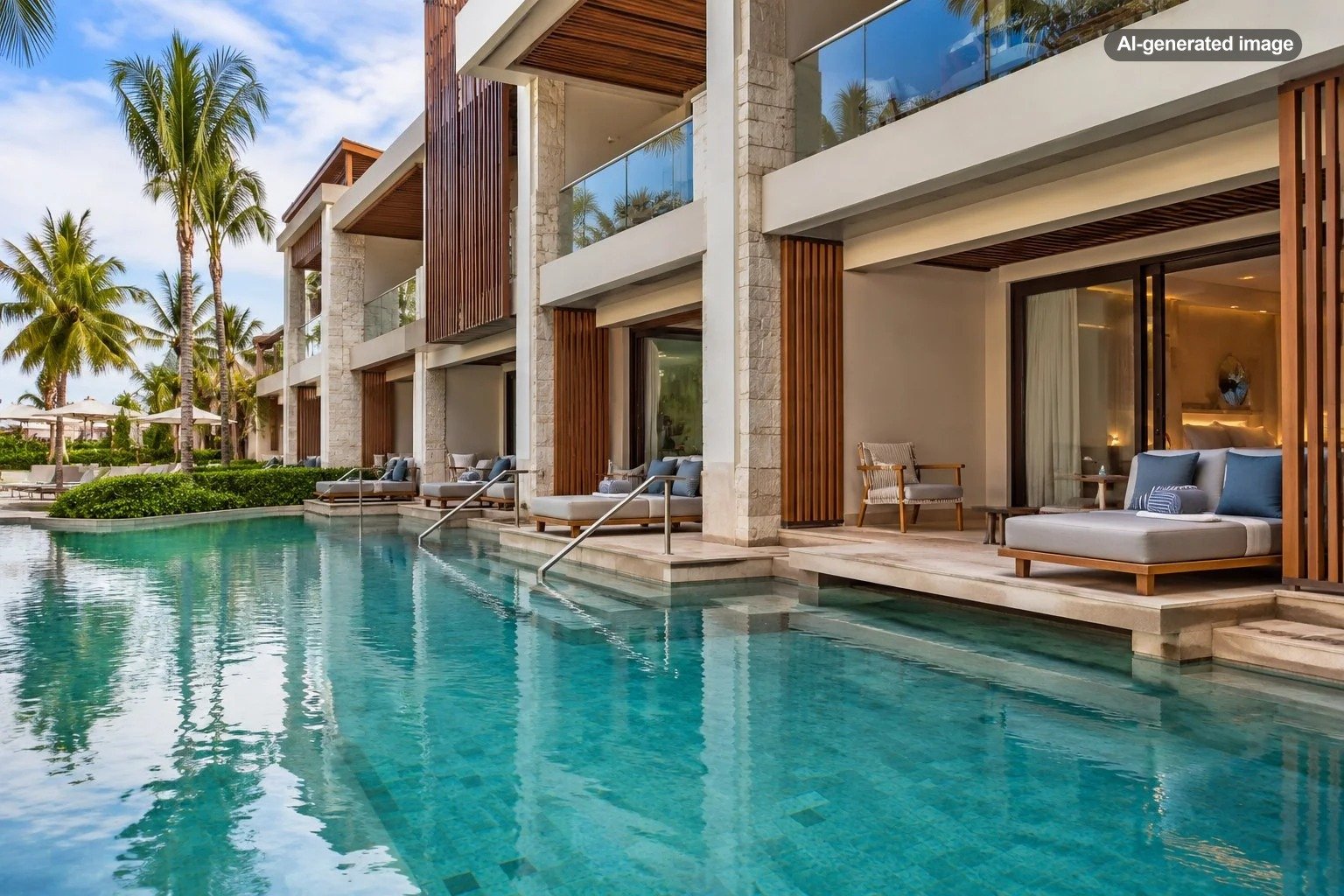
A swim-up room, sometimes called a swim-out room, is generally a ground-floor accommodation with a terrace that opens directly onto a pool. Instead of walking through the resort to reach the water, you can step outside and enter from your room’s patio area.
The term does not guarantee a private pool. Many swim-up rooms share a long pool with neighboring accommodations. Some have a narrow channel that connects to a larger pool, while others face a smaller pool reserved for guests in a particular room category. A private plunge pool is a different arrangement and may offer more seclusion, although it can be smaller and less suitable for actual swimming.
Room descriptions vary among hotels, so study the official floor plan, photographs, and wording carefully. Terms such as swim-up, swim-out, pool access, semi-private pool, and private pool should not automatically be treated as interchangeable.
The strongest reason to upgrade is convenience
The main advantage is simple: the pool becomes an extension of the room. You do not need to pack a day bag, search for an available chair, or make repeated trips through hallways and elevators. It is easy to swim briefly, return indoors, change clothes, or take a break without abandoning the pool area entirely.
This convenience can be valuable for travelers who prefer an unhurried schedule. One person can relax on the terrace while another swims. Couples can move between the room and pool without organizing the day around a central pool deck. Parents may appreciate having snacks, sunscreen, and other supplies nearby, although family suitability depends heavily on the room’s safety features and hotel rules.
Convenience matters less when your itinerary includes full-day excursions, city sightseeing, golf, diving trips, or frequent meals away from the property. Paying for immediate pool access makes little sense when you will rarely be present to use it.
Privacy can be better or worse than expected
Swim-up rooms often look private in carefully framed photographs. In practice, swimmers may pass directly in front of the terrace, neighboring guests may be only a few steps away, and upper-floor balconies may overlook the pool. A terrace can feel personal without being visually secluded.
The most private configurations tend to have landscaping, partitions, generous spacing, or a pool shared by only a small group of rooms. Corner units may receive less passing traffic, but their exact advantages depend on the building layout.
Travelers who want genuine seclusion should compare the swim-up category with rooms featuring enclosed patios or private plunge pools. Those who enjoy a sociable atmosphere may prefer a connected lagoon pool where interaction with neighboring guests is part of the experience.
Location within the resort can change the experience
Not every pool-access room occupies a prime location. Ground-floor placement may reduce the chance of an elevated ocean, garden, or skyline view. Some rooms face internal courtyards, pathways, restaurants, pool bars, or daytime entertainment areas.
A room near the main pool may provide quick access to resort activity but also expose guests to music, announcements, conversations, and early-morning maintenance. A room on a secondary pool may be quieter, though it could be farther from the beach, restaurants, lobby, or other facilities.
Before booking, ask where the room category is located rather than assuming all swim-up rooms occupy the same part of the property. Resort maps can reveal whether the convenience of the pool creates a tradeoff in walking distance, noise, sunlight, or views.
Sunlight and water temperature deserve attention
A beautiful pool is not useful if it remains too cool or shaded for comfortable swimming. Buildings, landscaping, roof overhangs, and the direction of the terrace can limit direct sunlight. This may be welcome in a hot climate but disappointing during a cooler season.
Do not assume a swim-up pool is heated simply because another pool at the hotel is heated. Large interconnected pools can also feel cooler than compact plunge pools. Weather, shade, water depth, and hotel operating practices all influence comfort.
Travelers who consider pool access essential should ask the hotel directly about heating, seasonal operation, daily access hours, and whether the room’s pool receives morning or afternoon sun. These details may change, so verify them close to the booking date.
Consider noise, foot traffic, and nighttime use
Ground-floor rooms typically have more activity outside the windows than upper-level rooms. Guests may swim past the terrace, staff may service the pool area, and conversations can carry across the water. Curtains may need to remain closed more often when the room faces a shared pool or walkway.
Pool access may also be restricted overnight. Even when the terrace remains accessible, swimming hours can be limited for safety, maintenance, or noise control. Travelers imagining a late-night swim should confirm the hotel’s current policy rather than relying on promotional photographs.
Light sleepers should ask whether the room is near entertainment, pool equipment, a bar, or a route used by service carts. The best swim-up room is not necessarily the one closest to the largest pool.
Swim-up rooms require extra safety awareness
Direct water access changes the practical character of a hotel room. There may be little separation between the terrace and pool, and surfaces near the entrance can become wet. This deserves careful consideration for families with young children, nonswimmers, travelers with mobility limitations, or anyone likely to sleepwalk or become disoriented at night.
Families should verify whether the terrace door has a high lock, alarm, barrier, or other protective feature. They should also confirm occupancy rules because some swim-up categories are limited to adults or older children. A room that is convenient for one family may create unnecessary stress for another.
Travelers with mobility concerns should ask about steps, submerged ledges, handrails, terrace thresholds, and the route from the lobby to the room. Direct pool access does not necessarily mean accessible pool entry.
How to decide whether the price difference is justified
Instead of evaluating the upgrade as one large number, consider how often you will use it. Divide the additional room cost by the number of days you expect to spend at the resort and by the number of travelers sharing the room. This does not prove value, but it makes the decision more concrete.
The upgrade is easier to justify when the pool replaces other paid activities, supports a relaxed itinerary, or meaningfully improves the experience for everyone in the room. It is harder to justify when only one traveler plans to swim or when the hotel already has plentiful, comfortable pool seating.
Also compare what you give up. The standard room may offer a better view, quieter placement, more sunlight, or a larger balcony. In some cases, the same budget could purchase a longer stay, a better meal plan, airport transportation, spa treatments, or a more spacious suite without direct pool access.
Who is most likely to enjoy a swim-up room?
Couples planning a resort-centered trip
Couples who expect to spend most of the vacation relaxing at the property are among the strongest candidates. The room provides an easy transition between swimming, reading, dining, and resting. Privacy should still be checked carefully, particularly for honeymoon or anniversary travel.
Travelers who dislike crowded pool decks
A personal terrace can reduce dependence on central seating. This is useful for travelers who want a predictable place to relax, even if the water itself is shared. Confirm whether terrace loungers or chairs are actually included.
Groups booking adjacent rooms
Friends or relatives occupying neighboring swim-up rooms may enjoy a connected social space. The configuration can create a convenient shared setting without requiring everyone to gather inside one room.
Travelers who spend little time off-property
The more time you remain at the resort, the more opportunity you have to benefit from the upgrade. A swim-up room is usually a lifestyle purchase, not merely a different room layout.
Who may be happier with another room category?
Active travelers who leave early and return after sunset may receive little practical value. Guests who prioritize expansive views, complete privacy, silence, or an upper-floor balcony may also prefer a conventional room or suite.
A private plunge-pool room may suit travelers seeking seclusion, while an oceanfront or beachfront room may be more rewarding for those who value scenery. Families concerned about direct water access may feel more comfortable in an upper-floor accommodation near, but not attached to, the pool.
Questions to ask before booking
- Is the pool private, semi-private, or shared with all swim-up rooms?
- Does the pool connect to the main resort pool?
- Is it heated during the dates of the stay?
- How much direct sunlight does the terrace receive?
- Can other guests swim directly past the room?
- Are there privacy screens, landscaping, or terrace partitions?
- What are the pool’s operating hours?
- Is the room near music, entertainment, restaurants, or a pool bar?
- Are children permitted in this room category?
- What safety locks or barriers separate the room from the water?
Frequently asked questions
Is a swim-up room the same as a private-pool room?
No. A swim-up room commonly opens onto a pool shared with other rooms. A private-pool room generally has a pool intended for the occupants of that accommodation, but hotels may use terminology differently. Confirm the arrangement before booking.
Are swim-up rooms always on the ground floor?
They are usually located at ground or pool level because the terrace must connect directly to the water. Some hillside or terraced resorts may use different building configurations.
Are swim-up rooms suitable for children?
Suitability depends on hotel rules, supervision needs, and safety features. Some properties restrict these rooms to adults, while others market them to families. Direct water access requires careful consideration for young children.
Do swim-up rooms have less privacy?
They can. Swimmers, neighboring guests, staff, or people on upper balconies may have a view of the terrace. Layout, landscaping, and the number of rooms sharing the pool determine how private the space feels.
Is the upgrade worth it for a short stay?
It can be when the short stay is entirely resort-focused and you plan to use the pool immediately. For an overnight stop or excursion-heavy visit, a standard room is usually the more practical choice.
The verdict
A swim-up hotel room is worth the extra cost when direct pool access will shape how you spend the vacation, not merely provide an attractive photograph. The strongest candidates are travelers planning slow, pool-centered days who understand the room’s location and sharing arrangement.
Before paying for the upgrade, verify the pool’s privacy, temperature, sunlight, hours, noise exposure, and safety features. When those details align with your priorities, a swim-up room can make a resort stay noticeably more convenient. When they do not, a quieter room with a better view may deliver more lasting value.