How to Choose the Exact Cabin Location to Avoid Engine Noise and Motion
The most reliable cabin location for travelers who want less motion and less mechanical noise is generally a lower or middle deck near the center of the ship, with passenger cabins directly above and below. This position reduces the amplified movement often felt near the bow, stern, and highest decks while creating distance from engines, anchors, theaters, pool decks, and other noisy areas.
That general rule is only a starting point. The exact cabin number matters because two rooms in the same category can have very different surroundings. Before booking, study the deck plan vertically as well as horizontally, paying attention to what sits above, below, beside, and across from the cabin.
The Quick Cabin-Location Formula
- For the least motion: Choose midship on a lower or middle passenger deck.
- For less engine vibration: Avoid cabins at the extreme aft and the lowest decks near machinery areas.
- For quieter nights: Select a cabin surrounded by other cabins rather than public venues.
- For less hallway traffic: Stay several doors away from elevators, stairwells, and corridor intersections.
- For fewer surprises: Compare at least three adjacent decks on the ship’s official deck plan.
Why Midship Usually Feels More Stable
A ship can move in several directions, but passengers often notice pitching most clearly when the bow rises and falls through waves. That movement tends to feel more pronounced toward the front and rear of the vessel. The center of the ship is closer to the vessel’s balance point, so cabins in this area generally experience less dramatic vertical movement.
Travelers who are especially sensitive to motion should combine a midship position with a lower or middle deck. The higher a cabin sits above the waterline, the wider its side-to-side arc can feel when the ship rolls. A high-deck cabin may offer a broader view and convenient access to outdoor areas, but it is not automatically the smoothest choice.
Midship cabins are often in demand and may cost more than comparable cabins toward the bow or stern. Travelers who need a compromise can look just forward or aft of the true center rather than choosing an extreme-end cabin. Moving a modest distance from the center may save money without creating the same motion exposure as a room at the very front or back.
Where Engine Noise and Vibration Are Most Likely
Modern cruise ships are complex, and the location of engines, propulsion systems, generators, ventilation equipment, and service areas varies by vessel. Even so, low-deck cabins near the stern are more likely to experience some combination of humming, vibration, or mechanical sound. These effects can be more noticeable when the ship accelerates, maneuvers, or docks.
An aft cabin is not necessarily a bad cabin. Many travelers deliberately choose stern-facing balconies for wake views and outdoor space. The tradeoff is that an aft location may expose the room to more vibration, propeller-related sensation, or movement than a comparable midship cabin. Anyone who is a light sleeper or highly sensitive to low-frequency sound should weigh that tradeoff carefully.
Do not assume that moving to the bow eliminates mechanical noise. Forward cabins can be affected by bow thrusters, anchor operations, wind, and the impact of the hull meeting rough water. These sounds may be most apparent during early arrivals, departures, or tender-port operations.
Use the Deck Plan as a Vertical Map
Many travelers examine only the cabin’s position along the length of the ship. A better method is to check the same location on the deck above and the deck below. The quietest rooms are commonly sandwiched between passenger-cabin decks.
Be cautious when a cabin is directly beneath a pool deck, buffet, sports court, jogging track, fitness center, or outdoor seating area. Noise may come from footsteps, rolling carts, exercise equipment, chairs being moved, or early-morning cleaning. Likewise, cabins above theaters, nightclubs, casinos, lounges, kitchens, and dining rooms may receive music, bass, voices, or service noise through the structure.
Look for large blank areas on the deck plan as well. These may represent crew corridors, storage rooms, mechanical spaces, galleys, or other operational areas that are not labeled for passengers. A blank area is not proof that a cabin will be noisy, but it is a reason to ask the cruise line or a knowledgeable travel advisor what occupies the space.
How Far Should You Stay From Elevators?
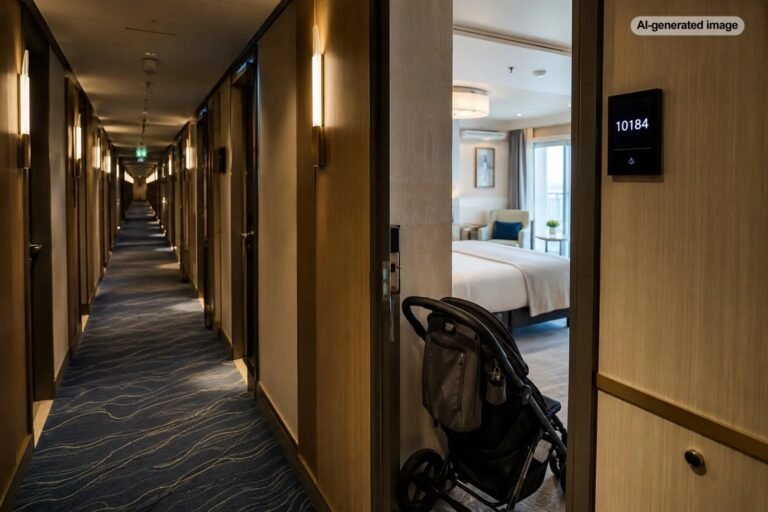
Elevator access is useful, especially on a large ship or for travelers with mobility limitations. The challenge is not usually the elevator machinery itself. It is the concentration of passengers, conversations, chimes, closing doors, and late-night hallway activity around the elevator lobby.
A practical compromise is to choose a cabin several doors down the corridor rather than immediately beside the elevator bank. This keeps the walk manageable while reducing direct exposure to gathering passengers. Avoid cabins facing a major stairwell or positioned where two corridors meet, since these areas can channel more foot traffic.
Travelers who use mobility devices should not automatically prioritize silence over access. A slightly busier location near an elevator may be the better overall choice if it makes dining, entertainment, and emergency routes easier to reach. The best cabin is the one that balances comfort with the traveler’s actual needs.
Check for Connecting Doors and Crew Access
A connecting cabin can be valuable for families and groups, but an unused connecting door may transmit more sound than a solid dividing wall. Light sleepers who do not need a connected room should confirm whether the selected cabin has an interior door to the neighboring stateroom.
Also inspect the hallway around the cabin. Doors marked for crew use, housekeeping closets, service elevators, pantries, and linen-storage areas can create intermittent activity. Crew members generally work to minimize disruption, but carts, doors, supplies, and early service routines may still be audible.
Small symbols on deck plans can be easy to overlook. Review the legend for connecting rooms, accessible cabins, pull-down beds, obstructed views, and other features before finalizing the reservation. A symbol that appears unimportant may explain why a particular cabin has a different layout or more surrounding activity.
Match the Cabin to Your Specific Sensitivity
If motion is the main concern
Prioritize a midship cabin on a lower or middle deck. Avoid the extreme bow, extreme stern, and highest accommodation decks. An ocean-view cabin on a lower deck may provide a useful visual horizon without placing the traveler high above the water.
If mechanical vibration is the main concern
Move away from the lowest aft section of the ship and avoid unexplained machinery spaces. A midship cabin on a passenger-only deck is usually the safer choice. Ask specifically about vibration rather than using the broader word noise, since the two sensations are not the same.
If nighttime noise is the main concern
Choose a cabin with staterooms above, below, and across the hall. Avoid nightlife venues, atriums, promenades, elevators, stairwells, theaters, and late-closing restaurants. Confirm that the room does not have a connecting door unless you need one.
If daytime naps are important
Pay special attention to pool decks, children’s facilities, sports courts, housekeeping areas, and service corridors. A venue that becomes quiet at night may be busiest during the afternoon.
A Step-by-Step Method for Choosing the Exact Cabin
- Find the ship’s current deck plan. Make sure you are viewing the correct vessel and sailing configuration.
- Identify the true midship zone. Do not rely only on category labels such as forward, midship, or aft.
- Select a lower or middle passenger deck. Eliminate decks directly under major recreation areas when possible.
- Check one deck above and below. Favor cabins with other staterooms in both directions.
- Inspect both sides of the hallway. Note elevators, stairs, blank spaces, service doors, and connecting-room symbols.
- Compare nearby cabin numbers. Moving only three or four doors may place the room farther from a stairwell or service area.
- Ask a precise question before booking. Request information about vibration, anchor noise, crew access, or venue operating hours rather than asking whether the cabin is simply quiet.
What Travelers Often Overlook
The itinerary can influence how much motion a cabin experiences. Open-ocean routes, seasonal weather, speed, and sea conditions can matter as much as room placement. No cabin location can guarantee a motion-free sailing, and even a centrally located room may feel movement in rough water.
Travelers also sometimes choose a quiet cabin that is inconveniently far from the places they use most. On a large ship, an extreme forward or aft cabin can require long walks several times a day. A central location may reduce both motion and walking, but it can also place the room closer to popular elevator banks.
Finally, category guarantees and cruise-line-assigned cabins may offer savings but provide less control over location. Travelers with strong noise or motion concerns generally benefit from selecting a specific cabin number instead of allowing the line to assign one later.
Frequently Asked Questions
Is a low deck always quieter?
No. Lower decks can feel less rolling motion, but some low-deck areas are closer to machinery, crew operations, gangways, or tender access. Midship placement and the surrounding spaces remain important.
Are aft cabins noisy?
Some aft cabins may experience more vibration or propulsion-related sound, particularly on lower decks. Others are valued for their wake views and can be comfortable. The experience depends on the ship, deck, and exact cabin position.
Is it noisy near cruise ship elevators?
The primary issue is usually passenger traffic rather than mechanical noise. A cabin a few doors away may provide convenient access without sitting directly beside the busiest part of the lobby.
Which cabin is best for someone prone to seasickness?
A lower or middle-deck cabin near the center of the ship is generally the strongest starting point. Travelers should also consider itinerary conditions and consult a medical professional about appropriate motion-sickness prevention when needed.
Can the cruise line confirm whether a cabin is quiet?
Representatives may be able to clarify nearby venues, connecting doors, service spaces, or known structural features. They cannot guarantee silence, but specific questions can reveal more than a general request for a quiet room.
The Best Overall Choice
For the broadest protection against both motion and noise, choose a specific cabin near midship on a lower-to-middle passenger deck, surrounded vertically and horizontally by other cabins. Stay several doors from elevators, avoid connecting rooms unless needed, and keep clear of unlabeled operational spaces when their purpose cannot be confirmed.
This location may not deliver the most dramatic balcony view or the shortest walk to the pool, but it offers a practical balance of stability, quiet, and convenience. The final decision should come from studying the exact ship rather than relying on a universal cabin number or a category name alone.