Safari Lodge vs. Tented Camp
Choosing between a safari lodge and a tented camp is less about deciding which one is objectively better and more about deciding how you want the wilderness to feel. A lodge generally provides solid walls, more substantial shared facilities, and a stay that resembles a small resort or country hotel. A tented camp usually places you closer to the sounds, temperature changes, and rhythms of the surrounding landscape.
Neither category automatically determines price or quality. A sophisticated tented camp can be more luxurious than a conventional lodge, while a simple lodge may offer fewer comforts than its name suggests. The most useful comparison is therefore not tent versus building alone. It is the specific property’s location, room design, service model, power supply, bathroom setup, activities, and operating season.
Quick answer
- Choose a safari lodge if you value solid construction, stronger separation from outdoor noise, larger common areas, and a broader range of facilities.
- Choose a tented camp if you want a more sensory wilderness experience, a smaller camp atmosphere, and the possibility of staying in a remote or seasonal wildlife area.
- Do not assume tents are basic. Permanent safari tents may have real beds, private bathrooms, raised decks, electricity, and polished service.
- Do not assume lodges are always more convenient. A lodge can still be remote, have limited power, require escorted walks after dark, or follow a fixed safari schedule.
- A split stay can work well. Combining a lodge with a tented camp lets you experience two styles without committing the entire trip to one.
Safari lodge and tented camp comparison
| Consideration | Safari lodge | Tented camp |
|---|---|---|
| Structure | Solid, permanent buildings | Canvas rooms that may be permanent, seasonal, or mobile |
| Atmosphere | More hotel-like and insulated | More exposed to natural sounds and weather |
| Typical scale | Often larger, though intimate lodges exist | Often smaller and more communal |
| Facilities | More likely to have extensive shared amenities | Often prioritizes location and guiding over facilities |
| Best fit | Travelers prioritizing predictability and physical comfort | Travelers prioritizing immersion and a sense of remoteness |
What staying in a safari lodge is usually like
A safari lodge is built from permanent materials such as stone, timber, concrete, brick, or combinations of these. Guest rooms may be individual cottages, suites connected to a main building, or villas spread across a larger property. Solid construction generally provides greater insulation from wind, dust, insects, and nighttime wildlife sounds, although no wilderness property is completely sealed from its environment.
Lodges are also more likely to have substantial communal spaces. Depending on the property, these may include a large dining room, lounge, swimming pool, spa area, library, gym, shop, or dedicated children’s space. Those facilities should never be assumed from the word lodge alone, but the permanent format makes them easier to provide.
This style can suit first-time safari travelers who are uncertain about sleeping under canvas, guests who appreciate a more conventional hotel layout, and families that want room to spread out between wildlife activities. A lodge may also be preferable for travelers who sleep lightly or feel uneasy when animal calls seem very close.
The tradeoff is that a larger lodge can feel less intimate. More rooms may mean more guests gathering for meals, using shared spaces, or departing on game drives at similar times. Permanent buildings may also be positioned farther from certain wildlife movements than a seasonal camp that can operate in a more strategic area.
What staying in a tented camp is usually like
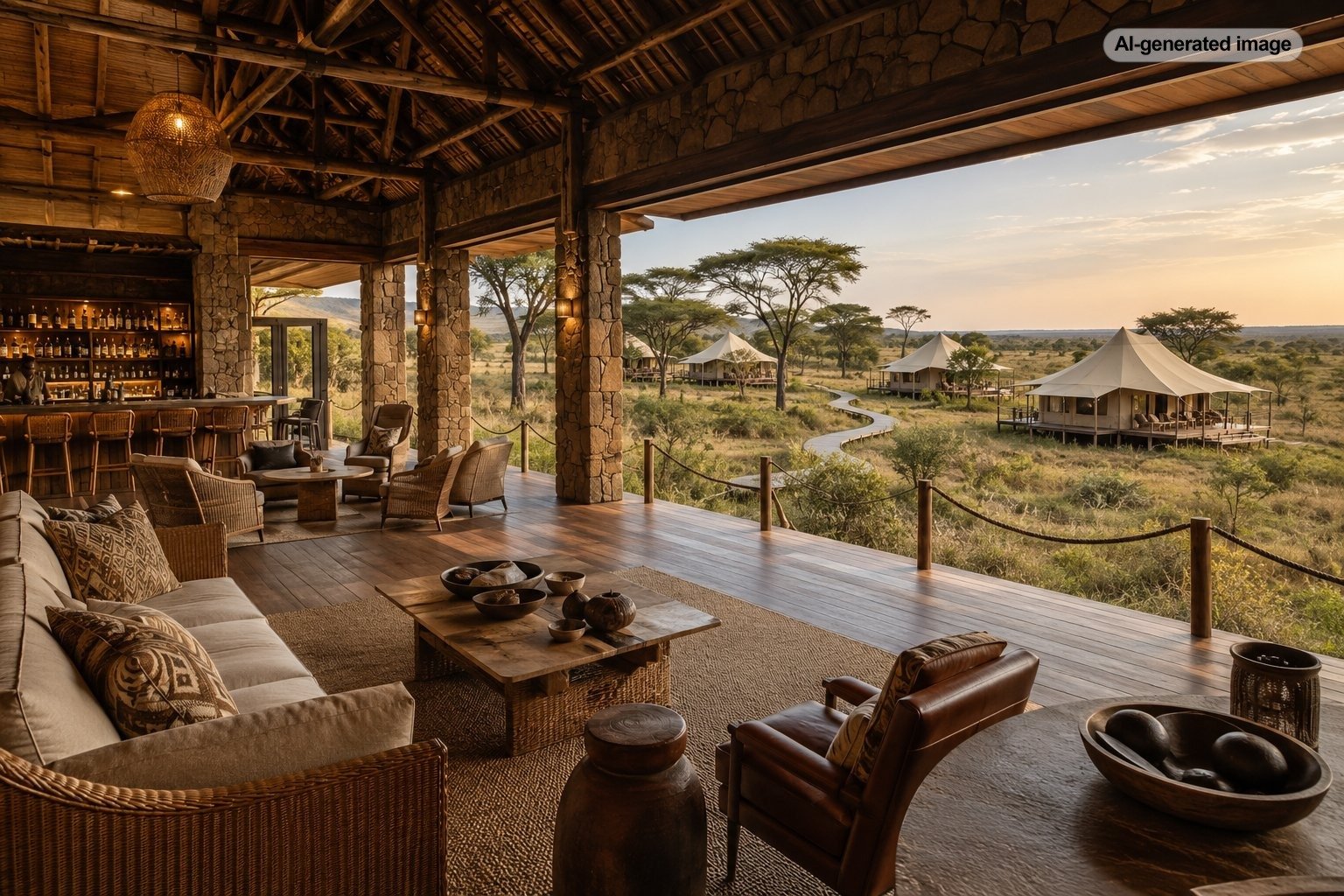
A tented camp is not necessarily a campsite in the everyday sense. Many safari tents are spacious canvas rooms set on wooden platforms or solid bases. They may contain full-size beds, furniture, private verandas, flush toilets, sinks, and hot showers. Some bathrooms are enclosed within the tent, while others occupy a separate canvas or solid-walled section.
The defining difference is the thinner barrier between the room and the surrounding landscape. Wind, rain, birds, insects, and animal calls can sound more immediate through canvas. For many travelers, that sensory connection is the main appeal. For others, especially light sleepers, it can be the principal disadvantage.
Tented camps also vary significantly in permanence. A permanent camp remains in one location and may feel nearly as established as a lodge. A seasonal camp is assembled for a particular part of the year, often to place guests near changing wildlife concentrations. A mobile camp may relocate between areas, using a lighter setup and offering fewer fixed facilities.
The smaller scale of many camps can create a sociable rhythm. Guests may dine together, exchange stories after game drives, and interact regularly with guides and camp managers. Travelers who prefer complete privacy should ask whether meals are communal or served at individual tables.
Comfort depends on details, not labels
The words lodge and camp reveal only part of the experience. Before booking, examine the individual room description and ask practical questions.
Bathroom arrangements
Confirm whether the bathroom is fully private, whether the toilet and shower are enclosed, and whether hot water is continuously available or provided at requested times. Some remote camps use bucket-style showers, while others have conventional plumbing.
Electricity and charging
Remote properties may rely on solar power or generators. Electricity could be available around the clock, limited during certain hours, or concentrated in a central charging area. Travelers carrying cameras, medical devices, or multiple electronics should verify the arrangement directly.
Temperature control
Solid walls do not guarantee air conditioning, and canvas does not necessarily mean discomfort. Properties may use ceiling fans, portable fans, fireplaces, hot-water bottles, screened ventilation, or natural airflow. Ask how rooms are cooled or warmed during the season of your visit.
Wildlife and nighttime movement
At unfenced properties, guests may be required to walk with a staff escort after dark. This can apply to both lodges and camps. Travelers with limited mobility should ask about distances between rooms and common areas, path surfaces, steps, lighting, and whether vehicle transfers are available within the property.
Which option is better for different travelers?
First-time safari travelers
A lodge can provide an easier transition into the safari routine because the room may feel more familiar. However, a well-appointed permanent tented camp can be equally approachable. First-time guests should focus on en suite facilities, electricity, room access, and the level of host support rather than rejecting all canvas accommodations.
Couples and honeymoon travelers
Tented camps often appeal to couples because they tend to be intimate and atmospheric. Canvas walls, lantern-lit paths, and small dining areas can create a strong sense of place. The tradeoff is that sound carries easily, so privacy may be more visual than acoustic. A spacious lodge suite may suit couples who value quieter rooms and more extensive leisure facilities.
Families with children
A lodge may offer more flexible common areas and family-oriented facilities, but policies vary widely. Some camps welcome children and provide family tents, while others set minimum ages for stays or specific activities. Families should verify room configuration, supervision requirements, meal flexibility, fencing, walking distances, and whether children can participate in standard game drives.
Light sleepers or nervous travelers
Solid walls may reduce the intensity of nighttime sounds, making a lodge the more comfortable choice. Even so, animals, wind, rain, and early departures can be audible anywhere in a wildlife area. Earplugs can help, but travelers should never block out instructions or emergency signals provided by the property.
Photography and wildlife-focused travelers
The property’s location and guiding quality matter more than its construction. A seasonal camp close to wildlife activity may reduce daily driving, while a strategically placed lodge can offer excellent access throughout the year. Ask about drive duration, vehicle occupancy, private vehicle options, guiding schedules, and the habitats reached from the property.
Does one option cost more?
There is no reliable rule that lodges cost more than camps. A basic permanent lodge may sit below a small luxury camp, and a highly serviced tented property can occupy the upper end of the market. Rates may reflect remoteness, transportation logistics, guiding, staff levels, included meals, drinks, activities, conservation fees, and the number of guests rather than the room material.
Compare inclusions rather than the nightly rate alone. Determine whether game drives, meals, beverages, laundry, transfers, park fees, and other activities are included. A lower advertised rate can become less competitive when essential safari components are charged separately.
What travelers often overlook
- Canvas is not the same as conventional camping. Many tented rooms are substantial accommodations with private bathrooms and hotel-style bedding.
- Permanent does not mean urban. A lodge may still have limited connectivity, intermittent power, rough access roads, and close wildlife encounters.
- Camp names are inconsistent. A property called a lodge may use canvas suites, while a property called a camp may have highly permanent structures.
- Season affects the experience. Rain, temperature, insects, dust, and wildlife distribution can change how comfortable or convenient either format feels.
- Location can outweigh room style. An attractive property is less useful if reaching the main wildlife area requires long daily transfers.
- A mixed itinerary offers balance. Spending part of a trip in a lodge and part in a tented camp can combine easier amenities with greater immersion.
Questions to ask before booking
- Is the camp permanent, seasonal, or mobile?
- Does every room have a private en suite bathroom?
- How are hot water and electricity supplied?
- Are fans, heating, or air conditioning available?
- How far are the rooms from the dining and departure areas?
- Are paths level, stepped, sandy, or uneven?
- Are meals communal or individually seated?
- Is the property fenced, and are nighttime escorts required?
- How many guests normally share a safari vehicle?
- Which meals, activities, transfers, and fees are included?
Frequently asked questions
Are tented safari camps safe?
Well-run camps establish procedures for wildlife, nighttime movement, food storage, fire, and emergencies. Guests must follow staff instructions, use escorts when required, and avoid leaving designated areas. Safety arrangements vary by property and location, so review the camp’s guidance before arrival.
Do animals enter safari camps?
Animals may move through unfenced wilderness properties. This possibility is one reason guests are often escorted after dark. Never approach or feed wildlife, and do not leave the room when instructed to remain inside.
Are tented camps noisy?
They can be. Canvas provides limited sound insulation, so guests may hear wind, rain, birds, insects, other guests, and wildlife. Travelers who are sensitive to noise may prefer a solid-walled lodge or should ask how widely spaced the tents are.
Can a tented camp be luxurious?
Yes. Luxury tented camps can provide generous rooms, refined furnishings, private bathrooms, polished dining, and highly personalized service. The word tent describes the structure, not the service level.
Should I choose a lodge or tented camp for my first safari?
Choose a lodge when solid construction, familiar amenities, and reduced exposure to outdoor sounds will make you more comfortable. Choose a permanent tented camp when closeness to the environment is part of what you want from the trip. When the itinerary permits, combining both is often the clearest way to appreciate their differences.