Mediterranean Cruises: How to Visit the Colosseum and Pompeii in One Day
Visiting the Colosseum and Pompeii in one day is technically possible, but it is rarely a sensible plan during a standard Mediterranean cruise port call. The two sites are in different regions, require timed entry and substantial transportation, and deserve more than a hurried walk through their gates.
The plan works best on a pre-cruise or post-cruise day when you are staying overnight in Rome or Naples. From a ship calling at Civitavecchia or Naples for only several hours, choosing the site closest to the port is usually the safer and more rewarding decision.
Quick answer
- From Civitavecchia: Concentrate on the Colosseum and central Rome. Adding Pompeii creates too much distance and too many connections for most port calls.
- From Naples: Visit Pompeii and, if time permits, another nearby archaeological or cultural attraction. Rome is too far away for a comfortable same-day shore visit.
- From a hotel in Naples: Visit Pompeii early, take a high-speed train to Rome, and reserve a late Colosseum entry only if the available schedules align.
- From a hotel in Rome: A Colosseum-first itinerary is possible, but reaching Pompeii before its final admission can be difficult and leaves little margin for delays.
- Best approach: Treat the combined day as an intercity transfer itinerary rather than a conventional cruise excursion.
Why the two-site itinerary is harder than it appears
The Colosseum stands in central Rome, while Pompeii is south of Naples. High-speed trains make travel between Rome and Naples relatively efficient, but the station-to-attraction portions add time at both ends. You must reach the Colosseum from Roma Termini, and Pompeii requires an additional journey from Naples or another direct connection selected for your travel date.
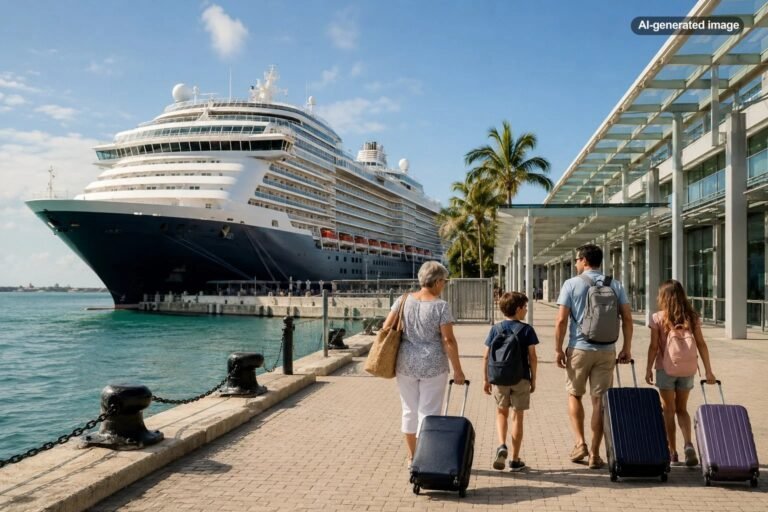
Cruise passengers also have to account for the distance between the ship and the intercity rail network. Civitavecchia is Rome’s principal cruise port, not a neighborhood within Rome. Passengers may need a port shuttle, a transfer to Civitavecchia station, a train into Rome, and local transportation before reaching the Colosseum. The same process must be reversed well before the ship’s all-aboard deadline.
Pompeii is easier to reach from the Port of Naples, but combining it with Rome means traveling north, entering a major attraction, and returning to the ship with no protection from missed connections. A minor rail delay, queue, traffic disruption, or extended walk through either site can compromise the entire plan.
When combining the Colosseum and Pompeii can work
The strongest scenario is a pre-cruise or post-cruise day between hotel stays in Naples and Rome. You are not trying to return to a ship, and you can select train and attraction reservations around a realistic sequence.
A second possibility is an unusually long overnight port call, although passengers should still confirm whether they are permitted to remain ashore overnight and when they must return. Do not assume that an overnight listing eliminates boarding requirements or transportation limitations.
A private driver can simplify some transfers, but driving does not remove the geographical distance or the need for timed attraction admission. It may reduce station changes and luggage complications, yet road congestion can make travel times less predictable than rail.
The most workable one-day sequence
Start in Naples and visit Pompeii first
Stay in Naples the previous night and leave early enough to be near Pompeii when the archaeological park opens. Beginning at Pompeii is generally more practical because the site is expansive, exposed to the weather, and better explored before the hottest part of a summer day.
Reserve admission through the official channel and verify the entrance named on your ticket. Pompeii has multiple entrances, and arriving at the wrong one can cost valuable time. A focused visit of roughly two hours can cover a selection of major streets, public buildings, houses, and the forum area, but it will not provide a comprehensive tour of the park.
Travelers who want a structured visit can consider an official or independently arranged guided route. A guide can reduce time spent navigating, although the itinerary should remain selective rather than attempting to cross every district.
Continue to Rome by high-speed train
After Pompeii, continue to Naples and board a reserved high-speed train to Roma Termini. Leave a generous connection buffer rather than booking the tightest mathematically possible transfer. Regional services and local roads can be affected by ordinary operational delays, and high-speed tickets may have conditions governing changes.
Travel with minimal luggage. Large suitcases are inconvenient on local transportation and may not be accepted at attraction security points. Leave bags at your hotel, use a verified staffed luggage facility, or arrange a through transfer with your accommodation.
Reserve the Colosseum for late afternoon
Book a timed Colosseum entry that leaves room for the trip from Pompeii, the train connection, and transportation from Roma Termini. Do not reserve an ambitious entry time based only on the scheduled train arrival.
Choose the ticket type carefully. Some options focus on the standard monument route, while others may include additional archaeological areas or restricted sections. A combined day favors a straightforward visit. Trying to add the arena, underground areas, Palatine Hill, the Roman Forum, and a long guided program can make the schedule unmanageable.
Plan to end the day in Rome. Attempting to return to Naples, reach a distant airport, or board a cruise ship after the Colosseum introduces another high-consequence deadline.
What to do during a Civitavecchia port call
From Civitavecchia, choose Rome. Reserve the Colosseum in advance, allow time to travel between the port and the city, and add only nearby sights that do not require another long transfer. The Roman Forum, Palatine Hill, Capitoline area, and exterior views along the Imperial Forums can form a coherent archaeological day.
This approach gives you time to understand the setting rather than treating the Colosseum as a photograph between train rides. It also preserves a practical margin for the return to Civitavecchia. Follow the cruise line’s stated all-aboard time, which is more important than the published departure time.
What to do during a Naples port call
From Naples, choose Pompeii. The archaeological park can occupy most of a shore day, especially when transportation, entrance procedures, walking, meals, and the return to the ship are included.
Travelers who prefer a shorter archaeological visit can pair Pompeii with time in Naples, but the second stop should remain flexible. Avoid committing to multiple distant attractions when the ship’s departure creates a fixed deadline.
Pompeii involves uneven ancient streets, limited shade in many areas, and considerable walking. Comfortable footwear, water, sun protection, and a route suited to your mobility level matter more than trying to see every highlighted building.
Comparison of the realistic options
| Starting point | Recommended plan | Main tradeoff |
|---|---|---|
| Civitavecchia port call | Colosseum and central Rome | Pompeii is not realistically compatible with most ship schedules |
| Naples port call | Pompeii and flexible time in Naples | Rome adds excessive distance and missed-ship risk |
| Hotel in Naples | Pompeii first, then late Colosseum entry | Fast pace with limited time inside each site |
| Hotel in Rome | Colosseum plus a separate Pompeii day | Requires an additional day but produces a better visit |
Details travelers often overlook
- Timed tickets are not interchangeable: Reserve each attraction independently and verify names, entry points, identification requirements, and permitted arrival windows.
- The archaeological parks are larger than their signature monuments: A Colosseum ticket may involve adjacent areas, while Pompeii extends far beyond the forum and most photographed houses.
- Summer conditions affect pace: Heat, sun exposure, crowds, and uneven surfaces can make an aggressive schedule physically demanding.
- Train schedules can change: Build the itinerary using the timetable for your actual date rather than a generic travel-time estimate.
- Independent shore travel carries responsibility: A ship generally will not wait for passengers delayed on a privately organized outing.
Frequently asked questions
Can I visit the Colosseum and Pompeii from Civitavecchia in one day?
It may be physically possible under exceptional circumstances, but it is not a prudent plan for a normal port call. The port-to-Rome journey, attraction entry, Rome-to-Pompeii travel, and return to the ship leave inadequate protection against delays.
Can I visit Rome and Pompeii from a Naples cruise stop?
A same-day visit creates similar problems in reverse. Pompeii is appropriate for a Naples call; Rome is better reserved for a separate port day, an overnight stay, or the beginning or end of the cruise.
How much time should I allow at Pompeii?
A focused visit can cover selected highlights in about two hours, while a more satisfying exploration requires substantially longer. Walking speed, heat, mobility, closures, and interest in individual buildings all affect the visit.
Should I book a guided tour?
A guide can help prioritize important features and reduce navigation time. For a combined itinerary, select a concise tour that ends with enough buffer for the onward journey rather than the longest available program.
Is a private car better than the train?
A private car can reduce transfers and simplify luggage handling, but traffic introduces uncertainty. High-speed rail is often more predictable between central Rome and Naples, while a car may be useful for the Pompeii connection or a coordinated hotel-to-hotel transfer.