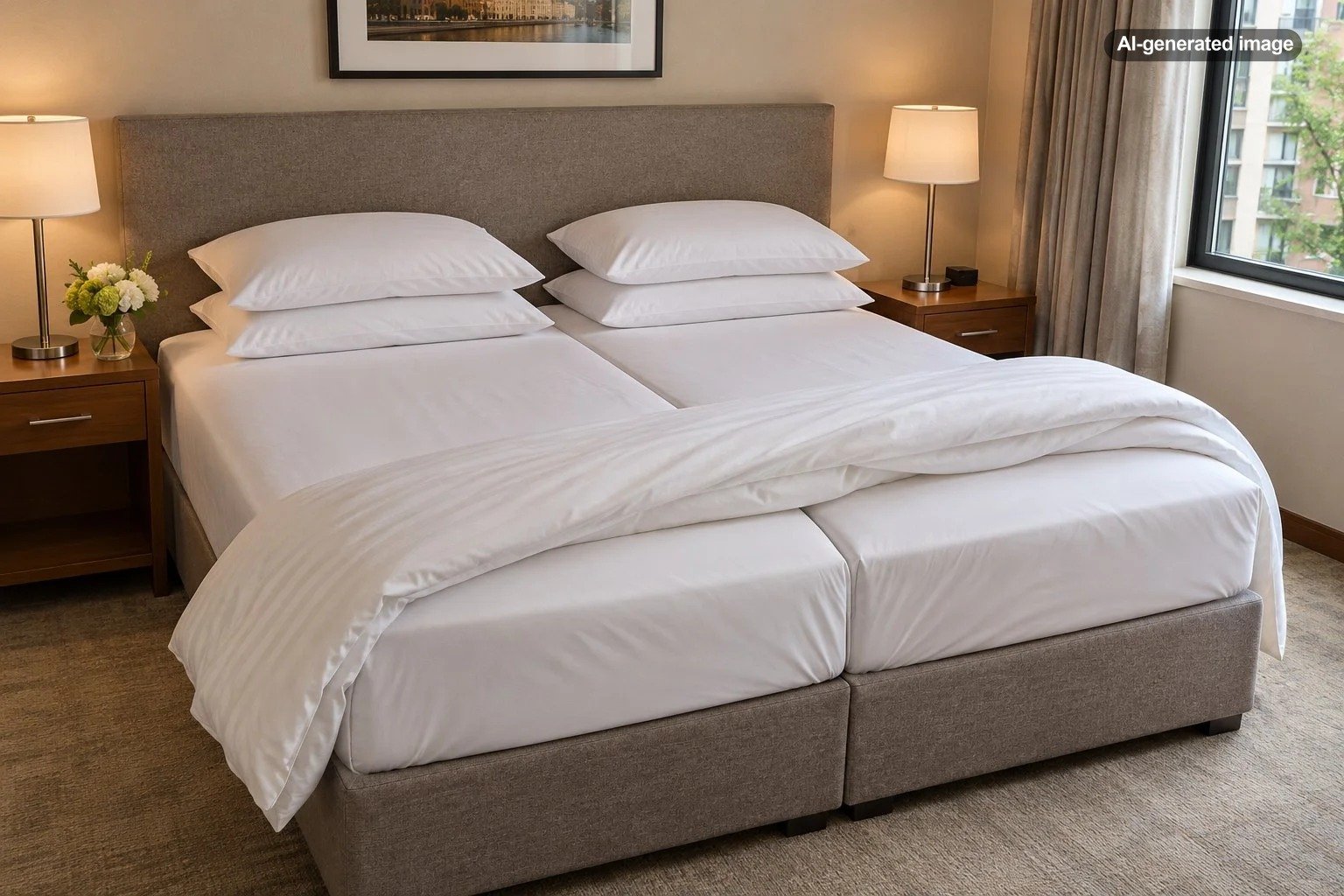
How to Tell If a Hotel’s King Bed Is Actually Two Twin Beds Pushed Together
A hotel room advertised with a king bed does not always contain one continuous king-size mattress. Some properties create a larger sleeping surface by joining two single mattresses, sometimes using purpose-built connectors and sometimes simply positioning two beds together. The arrangement can look almost identical to a conventional king in booking photographs, but it may feel quite different once you lie down.
The most reliable way to tell is to check for a seam running down the center of the mattress, feel whether the two sides move independently, and examine the bedding or bed bases. If you have not yet booked, asking the property whether its king beds use one continuous mattress is more dependable than interpreting photographs alone.
Quick Answer: How to Recognize Two Beds Joined Together
- Feel the center: A pronounced line, depression, or gap running from the pillows toward the foot of the bed suggests two separate mattresses.
- Inspect the mattress edges: Two distinct upholstered edges meeting in the middle are stronger evidence than a crease in the sheets.
- Check the bases: Separate bed frames or box foundations may indicate a convertible twin-to-double arrangement.
- Look at the bedding: Two fitted sheets, separate mattress protectors, or individual duvets can provide clues, although none proves the mattress configuration alone.
- Ask directly: Request confirmation that the room has one continuous king mattress rather than two joined singles.
Why Hotels Sometimes Use Two Single Beds as One Large Bed
Convertible beds give hotels flexibility. A room accommodating a couple one night may need to accommodate two colleagues or friends sleeping separately the next. Rather than maintaining entirely different room inventories, a property can arrange suitable beds together or apart depending on the reservation.
This is especially relevant when booking internationally, where descriptions such as double, twin, king, and super king may follow different national conventions. A hotel might describe the room according to the overall sleeping arrangement rather than the number of individual mattress pieces.
There is also an important distinction between a deliberately engineered convertible bed and two independent beds moved together temporarily. Properly designed systems may use linked bases, joined mattresses, and a continuous topper to create a more unified sleeping surface. Improvised arrangements may leave a noticeable gap or allow the beds to separate.
Neither setup automatically determines the quality of a hotel. The practical question is whether the finished sleeping surface meets your expectations for width, stability, and comfort.
The Center Seam Is Usually the Clearest Clue
Start by running your hand gently across the middle of the made bed. A single continuous king mattress should not have two separate outer mattress edges meeting along its centerline. A joined arrangement often has a detectable seam beneath the sheets.
If the seam is subtle, gently press down on both sides near the center. Separate mattresses may compress differently, revealing the boundary between them. You might also notice a narrow depression where the edges meet.
However, a seam does not necessarily mean you will sleep over an open gap. Some hotels use a mattress bridge, joining strip, or full-width topper to make the surface feel smoother. Conversely, a decorative crease in the bedding does not establish that two mattresses are underneath.
The most useful distinction is between a visible bedding crease and two separate mattress edges. The latter identifies the actual sleeping surface rather than how housekeeping arranged the linens.
Look for Separate Mattress Bases and Bedding
The bed’s construction can provide additional clues without requiring you to dismantle anything. Standing near the foot of the bed, look for two separate foundations beneath the mattress area. Distinct base sections, separate legs, or two individual upholstered platforms suggest a convertible configuration.
A single headboard is not conclusive. Hotels can position two separate beds against one wide headboard, creating the appearance of a permanent king arrangement. Likewise, a continuous bed skirt may conceal two foundations.
What the Sheets Can Reveal
Two individually fitted bottom sheets suggest that each mattress is separate. A single fitted sheet stretched across the entire sleeping surface is more consistent with a unified presentation, but it does not prove that there is only one mattress underneath.
Some properties use a single large duvet over separate mattresses. Others intentionally provide two smaller duvets for couples who prefer individual covers. The number of blankets should therefore be treated as supporting evidence rather than a definitive test.
There is no need to remove bedding or lift heavy bed components. If the arrangement is unclear, hotel staff can explain it without disturbing the room.
Two Standard Twins Are Not Exactly the Same as a U.S. King
Mattress terminology can make the situation more confusing. Under commonly used U.S. mattress dimensions, a standard twin measures approximately 38 by 75 inches, while a twin XL measures approximately 38 by 80 inches. A standard king measures approximately 76 by 80 inches.
Two twin XL mattresses placed side by side therefore create the same nominal width and length as a standard U.S. king. This arrangement is commonly described as a split king. Two ordinary twins create approximately the same width but a sleeping surface about five inches shorter.
Those measurements are useful when evaluating U.S. mattress terminology, but they should not be applied automatically to hotels abroad. Bedding dimensions and the meaning of king or double can vary by country, manufacturer, and property.
For taller travelers, the overall mattress length may matter as much as the presence of a center seam. When dimensions are important, ask for the actual width and length in inches or centimeters rather than relying solely on the bed category.
Does a Joined King Bed Feel Different From a Regular King?
It can, particularly for couples who tend to sleep near the middle. A conventional king provides one uninterrupted mattress surface. A split or joined arrangement has a structural boundary, even if a topper conceals it.
The experience depends on several factors: how tightly the mattresses connect, whether they have matching firmness levels, whether the bases remain stationary, and whether the center is covered by a suitable topper.
When the Difference May Matter Most
- Couples who sleep close together: A noticeable seam or depressed center can interrupt the shared sleeping area.
- People who move across the bed: Crossing between mattresses may feel less consistent than moving across a single surface.
- Light sleepers: Separate mattresses can reduce some movement transferred between partners, which may actually be preferable.
- Taller guests: Two short singles may offer less length than expected from a king-size designation.
- Travelers with specific comfort needs: Differences in firmness, edge support, and alignment may matter more than the arrangement itself.
A well-connected split king can be entirely comfortable. The issue is not that every joined mattress is inferior, but that the term king may communicate a continuous surface to travelers who have a strong preference for one.
How to Check Before Booking a Hotel Room
Room photographs can help, but they rarely prove the mattress configuration. A neatly made joined bed may have an uninterrupted duvet, symmetrical pillows, and one headboard. The central seam may be hidden completely.
Instead, examine the room description for terms such as twin or double configuration, king or twin setup, flexible bedding, or beds that can be separated. Those phrases suggest that at least some rooms may use convertible arrangements.
The absence of such language is not a guarantee of a single mattress.
For confirmation, contact the property directly and ask: Does this room have one continuous king-size mattress, or is the king arrangement made from two single mattresses joined together?
If you have a strong preference, add a second question: Can you confirm a room with one uninterrupted mattress for my dates, and note that requirement on my reservation?
This wording addresses the construction rather than merely repeating your preferred bed size. It also gives the hotel an opportunity to explain whether room assignments are confirmed or subject to availability.
Why a King Bed Request May Not Be Enough
A reservation showing one king bed is useful documentation, but it may not establish whether that sleeping surface is made from one or two mattresses. Staff may understand king as the room’s sleeping configuration rather than a specific construction method.
When booking through a third-party platform, the displayed bed description may not include this level of detail. Confirm important requirements with the property and retain the response, particularly when sleeping arrangements are central to your room choice.
What to Do if Your Hotel King Has an Uncomfortable Gap
If you discover a pronounced gap after check-in, first determine whether the problem is a normal seam or a poorly aligned setup. A center seam that remains stable and level may be manageable. Two beds that shift apart or have noticeably different heights are more likely to interfere with sleep.
Contact the front desk promptly and describe the specific problem. Rather than simply saying the king bed is uncomfortable, explain that the mattresses are separating, the middle has a pronounced depression, or the two sides are not level.
Ask whether housekeeping can properly connect the beds, provide an appropriate mattress bridge or topper, or move you to an available room with a continuous mattress.
Do not assume a room change is guaranteed. The property may have limited inventory, and some room categories may use the same convertible arrangement throughout.
A practical approach is to request a correction first if the problem is minor, then discuss alternative accommodations if the gap or instability remains significant.
What Travelers Often Overlook
A split mattress and a split bed base are not necessarily the same thing. Two mattress sections may rest on one shared platform, while a continuous mattress could rest on multiple supporting base sections. Seeing two foundations is evidence to investigate, not definitive proof of two sleeping surfaces.
A topper can conceal construction without eliminating every difference. A continuous topper may soften the center line, but the underlying mattresses can still compress independently.
Bed width alone cannot identify the setup. Two twin XL mattresses can occupy the same nominal footprint as a U.S. king. Measuring overall width would not distinguish the two arrangements.
Room categories can vary within one property. Even if a hotel offers continuous king mattresses, that does not establish that every king-labeled room uses them. Ask about the specific room category being reserved.
Photos may show only one example. Promotional photography often illustrates a room style rather than every possible bedding configuration. A close-up photo of the mattress edge would be more informative than an attractive wide-angle room image, but direct property confirmation remains the better option.
Frequently Asked Questions
Can two twin beds actually make a king-size bed?
Two U.S. twin XL mattresses placed side by side create the same nominal dimensions as a standard U.S. king: approximately 76 by 80 inches. Two ordinary U.S. twins are shorter, so their combined surface does not match the full length of a standard king.
What is a zip-and-link hotel bed?
A zip-and-link bed is a convertible arrangement designed to connect separate mattress sections and bed bases into a larger sleeping surface. The sections can also be separated for guests who need individual beds. Design and comfort vary, so a connected bed is not automatically equivalent to one continuous mattress.
Is a split king bed worse than a regular king?
Not necessarily. A split king can be comfortable and may reduce movement between sleepers. However, guests who sleep close together or frequently cross the center may prefer one continuous mattress.
Can I request a hotel king bed without a center seam?
Yes. Ask specifically for one continuous mattress rather than simply requesting a king bed. The hotel can explain whether such rooms exist in your reserved category and whether the request can be confirmed.
Does a single large duvet mean the hotel has a real king mattress?
No. Hotels can cover two joined mattresses with one king-size duvet, flat sheet, or topper. The bedding arrangement may conceal the seam, so the most reliable physical clue is whether there are separate mattress edges beneath it.
The Best Way to Avoid an Unexpected Bed Setup
If sleeping on one continuous mattress matters to you, clarify the construction before booking whenever possible. The phrase king bed alone may not provide enough information, particularly at properties that offer convertible twin and double configurations.
Once in the room, a quick check of the mattress center, bedding, and base can reveal whether the bed is a single unit or a joined arrangement. If the configuration is uncomfortable, explain the precise issue to hotel staff while there is still an opportunity to address it.
Ultimately, the important distinction is not whether a hotel uses one mattress or two. It is whether the room provides the sleeping surface, stability, and comfort you expected when making the reservation.