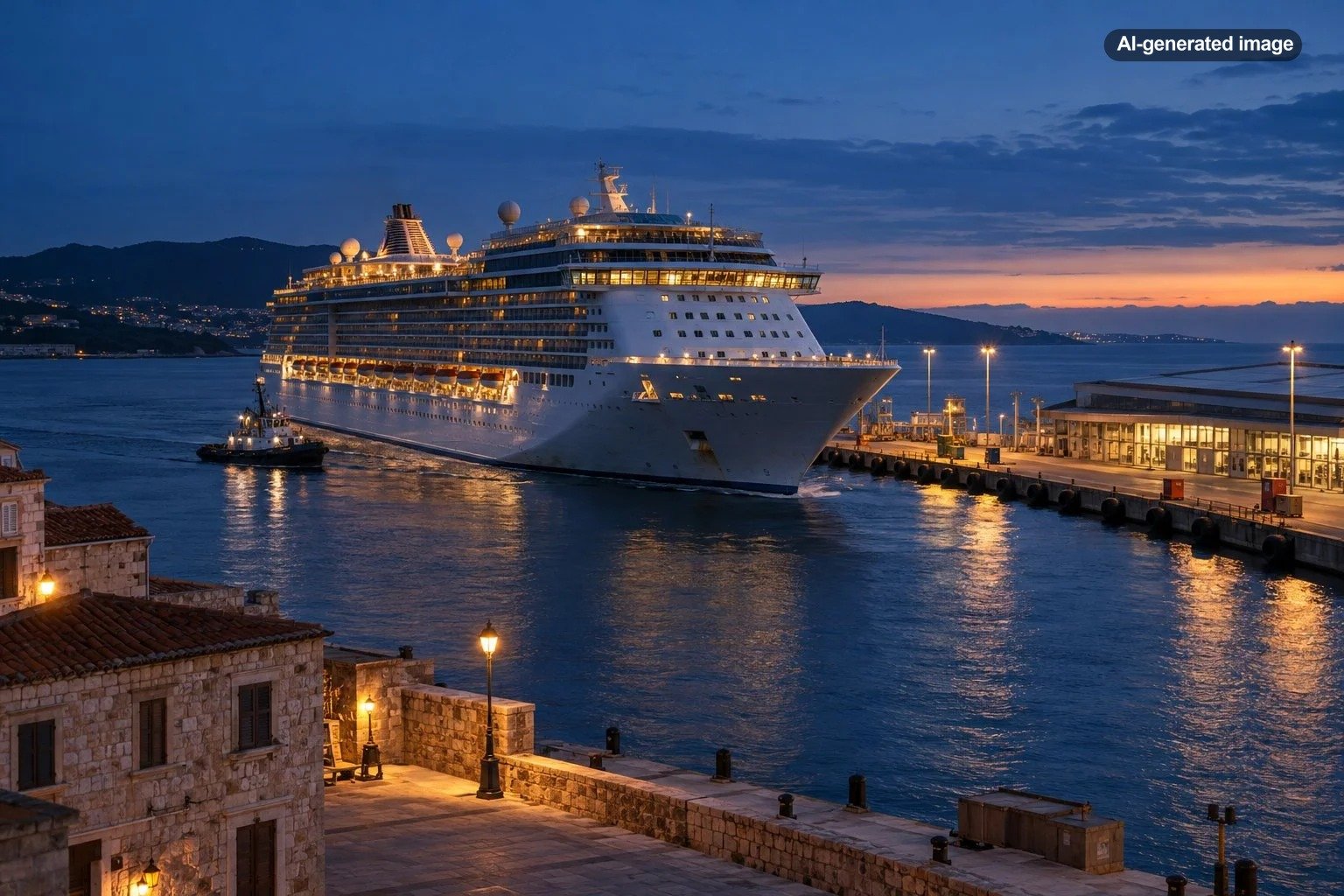
Why Do Some Cruise Ships Arrive in Port Before Sunrise?
Some cruise ships arrive in port while passengers are still asleep, sometimes several hours before sunrise. Although it may seem unnecessarily early, these arrivals usually reflect a carefully coordinated schedule involving port authorities, navigation requirements, passenger operations, and the ship’s next departure.
The central reason is operational efficiency. Arriving before dawn can help a cruise ship secure its assigned berth, complete arrival formalities, prepare for disembarkation, and maximize the usable portion of a port visit. The ship’s arrival time is not necessarily the time passengers can step ashore.
Quick Answer: Why Cruise Ships Arrive So Early
- Port scheduling: Ships must coordinate berth assignments, harbor traffic, and pilot availability.
- Longer port visits: Early docking can preserve more daytime hours for shore excursions and independent exploration.
- Passenger processing: Authorities and cruise staff may need time to complete procedures before guests disembark.
- Navigation conditions: Tides, currents, weather, and harbor restrictions can influence the preferred arrival window.
- Turnaround operations: At the end of a voyage, early arrival gives crews time to prepare for the next group of passengers.
Port Schedules Often Determine Arrival Times
A cruise ship cannot simply enter any harbor and choose an available dock. Ports coordinate the movements of cruise vessels, cargo ships, ferries, and other marine traffic. Larger ships may require particular berths, specialized maneuvering arrangements, or assistance from local harbor pilots.
Berth availability is especially important in destinations accommodating several large cruise ships on the same day. One vessel may be assigned an early arrival window because another requires access to the same harbor facilities later.
Arrival planning also considers the time needed to reach the berth from the harbor entrance. Entering a port, maneuvering through a channel, and securing a large vessel alongside a pier are distinct stages. A ship approaching the harbor before sunrise may not finish docking until considerably later.
These arrangements are made through coordination between the cruise operator, port personnel, and relevant marine services. The scheduled time can change if weather, harbor traffic, or operational conditions require adjustments.
Early Arrival Can Extend the Useful Port Day
For passengers, one of the most noticeable benefits is the potential for a longer day ashore. A ship that reaches its berth early may be ready to begin disembarkation around the start of the morning, allowing travelers to use more of the day before departure.
This matters in ports where popular excursions require substantial travel away from the terminal. A historic site, scenic coastline, or inland attraction may involve a lengthy transfer. An early start can provide a more practical margin for transportation, sightseeing, and returning to the ship.
However, an arrival before sunrise does not automatically mean passengers receive additional sightseeing time. The itinerary’s published departure time, local clearance procedures, excursion schedules, and actual authorization to disembark all affect the available window.
Consider two hypothetical port calls. One ship docks at 6:00 a.m. but does not authorize passengers to leave until 8:00 a.m. Another docks at 8:00 a.m. and begins disembarkation shortly afterward. Although their arrival times differ significantly, their practical sightseeing windows may be similar.
Travelers should therefore compare the scheduled time ashore rather than judging an itinerary exclusively by its arrival time.
Harbor Navigation Does Not Stop at Sunset
Modern cruise ships operate around the clock, and many ports accommodate arrivals outside daylight hours. Navigation teams use instruments, charts, bridge procedures, and established operating practices to manage vessel movements in darkness.
Where required, a local harbor pilot boards the ship to assist with navigation through port approaches and restricted waterways. Pilotage arrangements vary by jurisdiction, port, and vessel characteristics.
Darkness alone does not necessarily prevent a large ship from entering harbor. Nevertheless, individual ports can impose restrictions related to visibility, tidal streams, wind, vessel dimensions, or other operating conditions.
Tides and Currents Can Affect the Best Arrival Window
Some waterways experience tidal currents that complicate ship handling. A port may establish particular entry windows for vessels of certain sizes, especially where maneuvering room is limited.
In such locations, a ship may be scheduled to arrive earlier than passengers expect because a favorable navigation window occurs before sunrise. These circumstances are port-specific rather than a universal explanation for early cruise arrivals.
The Port of Dover in England, for example, publishes cruise vessel movement restrictions associated with tidal conditions and ship length. This illustrates why an apparently unusual arrival time can reflect maritime requirements rather than a preference for nighttime docking.
Customs and Clearance Can Delay Going Ashore
Reaching the pier is only one step in the arrival process. Depending on the destination and voyage, a ship may need clearance from customs, immigration, port health, or other relevant authorities before passenger movement can begin.
Cruise staff also need to organize gangways, confirm operational arrangements with the terminal, and communicate instructions to guests. In some destinations, additional identification checks or local procedures affect how passengers leave the vessel.
These requirements explain why a ship might be visibly docked while passengers are still unable to disembark.
Scheduled arrival, actual docking, and permission to go ashore are three different milestones. Travelers who understand the distinction are less likely to make unrealistic arrangements for early morning transportation or independently booked tours.
Turnaround Days Require Additional Preparation
An early arrival is particularly useful when a ship is finishing one cruise and preparing to begin another on the same day. This is known as a turnaround day.
At a turnaround port, the crew must coordinate a substantial sequence of activities. Departing passengers leave the vessel, luggage is transferred, cabins are cleaned and prepared, supplies may be delivered, and new guests eventually begin boarding.
The ship may also require waste removal, technical servicing, provisions, and other routine operations. Not every activity takes place at every port call, and the sequence depends on local facilities and the cruise line’s procedures.
Arriving before sunrise can create additional operating time for these preparations, even when passengers are not scheduled to disembark immediately.
For travelers ending a voyage, this distinction is particularly important. An early docking time should never be interpreted as confirmation that leaving the ship, collecting luggage, and completing terminal procedures will happen immediately.
How Overnight Sailing Affects Arrival Times
Cruise itineraries are planned around distances between ports, expected sailing conditions, operating speeds, departure commitments, and available arrival windows. A vessel may leave one destination in the evening and reach the next during the early morning.
Because ships travel while passengers dine, attend entertainment, and sleep, an overnight passage can efficiently connect two destinations without consuming an entire daylight period.
The distance between ports also matters. On a relatively short passage, the ship may operate at a suitable speed to reach the next destination at its assigned arrival time. On a longer passage, maintaining the itinerary may require a different speed and departure schedule.
It would be misleading to assume that an especially early arrival always means the ship traveled faster. Ships may adjust their speed for scheduling, weather, efficiency, or operational reasons. Their actual arrival timing depends on the complete voyage plan.
What Passengers Should Do When Arrival Is Before Dawn
Most guests do not need to change their routine simply because the ship is entering harbor early. Unless the cruise line has issued special instructions, passengers can generally continue sleeping until they need to prepare for their day.
Those hoping to watch the arrival should consider that maneuvering, pilot boarding, and docking may occur at different times. An early approach to port can offer interesting views of harbor operations, but visibility and access to outdoor decks depend on conditions and ship procedures.
Plan Around Disembarkation, Not Docking
When arranging an independent shore excursion, confirm the ship’s scheduled port hours and allow a reasonable margin for clearance and getting through the terminal.
Travelers booking private transportation should distinguish between the ship’s arrival and the time they expect to reach the pickup location. This is especially important when the terminal is large or passengers must use a shuttle to access the surrounding area.
For excursions organized through the cruise line, follow the meeting instructions provided onboard. Those arrangements may use designated gathering areas and disembarkation procedures rather than requiring participants to independently estimate when they can leave.
Allow Extra Time on Your Final Morning
Passengers completing a cruise should consider the time needed for disembarkation, baggage collection, immigration or customs processing where applicable, ground transportation, and airport procedures.
A ship scheduled to arrive at 5:00 a.m. does not make an early flight automatically practical. Disembarkation schedules can change, and circumstances outside the cruise operator’s control can affect how quickly passengers reach the terminal exit.
The appropriate flight departure time depends on the cruise line’s guidance, the port, airport distance, transportation arrangements, and the traveler’s tolerance for disruption.
Should Early Arrival Influence Which Cruise You Book?
Arrival time can be a useful comparison point when evaluating itineraries, but it should be considered alongside departure time and the nature of each destination.
Travelers who enjoy full-day excursions may appreciate an itinerary that allows an early start. Families with young children, late risers, or passengers who prefer relaxed mornings may place less value on arriving before dawn.
For a destination with attractions close to the terminal, an additional morning hour might have limited practical importance. At a port where excursions involve substantial transportation, the same difference could be more meaningful.
It is also worth checking whether an early arrival is followed by an unusually early departure. A ship scheduled from early morning until midafternoon may offer less flexibility than one arriving later and remaining into the evening.
Travelers evaluating these differences can compare available sailings through Expedia Cruises, paying particular attention to published port hours and the sequence of destinations.
Because cruise itineraries can change, confirm material scheduling details with the cruise operator before making nonrefundable independent arrangements.
Frequently Asked Questions
Can passengers get off a cruise ship before sunrise?
Sometimes, but only after the ship has completed the required procedures and disembarkation has been authorized. A vessel arriving before dawn may not permit passengers ashore until later in the morning.
Are cruise ships allowed to dock at night?
Many ports permit nighttime arrivals and departures under applicable operating conditions. Individual restrictions may depend on the harbor, vessel size, visibility, tides, weather, and availability of marine services.
Why does my cruise itinerary show a 5:00 a.m. arrival?
The time may reflect berth scheduling, the planned overnight passage, navigation considerations, or the need for an early turnaround. It generally represents the scheduled arrival rather than a guaranteed passenger disembarkation time.
Will an early arrival wake passengers?
Not necessarily. Some guests may notice changes in engine activity, maneuvering, or announcements, while others sleep through the arrival. Noise and vibration depend on the ship, cabin location, and operational circumstances.
Does arriving early mean the ship is running ahead of schedule?
No. A cruise ship may be scheduled to arrive before sunrise as part of its normal itinerary. An early arrival is not inherently evidence that the ship is ahead of schedule.
The Important Difference Is When Your Port Day Begins
Cruise ships arrive before sunrise because their schedules must accommodate both maritime operations and passenger travel. Berth assignments, harbor navigation, local conditions, clearance procedures, and turnaround preparations can all make an early arrival practical.
For passengers, the most useful question is not simply when the ship reaches port, but when they can actually begin their day ashore. Checking the complete port schedule, allowing time for disembarkation, and planning transportation with realistic margins will usually matter more than the hour shown beside the arrival time.
Sources & Further Reading
- International Maritime Organization: Just-in-Time Arrivals – Background on berth scheduling, requested arrival times, and coordination of marine services.
- International Maritime Organization: Ship-Port Interface Measures – Information about arrival clearances and coordination between vessels and port authorities.
- Port of Dover: Marine Operations General Directions – An example of port-specific tidal restrictions affecting cruise vessel movements.
- Royal Caribbean: When Should I Arrive at the Cruise Port Terminal? – Guidance illustrating how passenger terminal arrival and boarding procedures are managed separately from ship arrival.