Where Should I Stay in Rome for History, Dining, and Atmosphere?
The best place to stay in Rome depends on which part of the city’s character matters most to you. For immediate access to monumental squares and historic streets, choose the Centro Storico. For lively evenings and an unmistakably Roman street scene, consider Trastevere. Monti works particularly well for travelers who want ancient landmarks, independent restaurants, and a neighborhood atmosphere in one compact area.
Prati is a polished alternative near Vatican City, while Testaccio is especially appealing to food-focused travelers who do not need to sleep beside the most famous sights. The right choice is less about finding one universally superior neighborhood and more about deciding whether you want to prioritize history outside your door, memorable dinners, quiet nights, transportation convenience, or a balance of all four.
Quick answer: the best Rome neighborhoods by priority
- Best overall for a first visit: Centro Storico, especially near the Pantheon, Piazza Navona, or Campo de’ Fiori.
- Best for ancient Rome: Monti or the area near the Colosseum and Roman Forum.
- Best for dining and evening atmosphere: Trastevere, with Testaccio as a less sightseeing-centered alternative.
- Best for Vatican visits and a calmer base: Prati.
- Best for a more residential food experience: Testaccio.
Rome’s official tourism site groups many of these areas into distinct districts, including Pantheon-Navona-Campo de’ Fiori, Colosseo-Fori-Palatino, Trastevere-Testaccio, Vaticano-Gianicolo-Prati, and Esquilino-Monti. That reflects an important planning reality: central Rome is not one uniform hotel zone, and the experience can change considerably from one district to the next.
Centro Storico: best for landmark access and classic Rome
The Centro Storico is the strongest choice for travelers who want to step outside and immediately feel surrounded by historic Rome. Depending on the exact location, you may be within an easy walk of the Pantheon, Piazza Navona, Campo de’ Fiori, the Trevi Fountain, the Spanish Steps, or the lanes of the old Jewish Ghetto.
This is an especially practical base for a short first visit because it reduces the amount of transportation planning required. Many major sights can be connected on foot, and the walk between them is often part of the appeal. Historic facades, small churches, fountains, cafes, and evening street life fill the spaces between the major attractions.
Who should stay here
Choose the Centro Storico when sightseeing efficiency is your main priority, when you enjoy exploring on foot, or when you want a romantic setting for an anniversary or couples trip. It is also convenient for travelers who prefer returning to their hotel during the afternoon rather than remaining out all day.
The tradeoffs
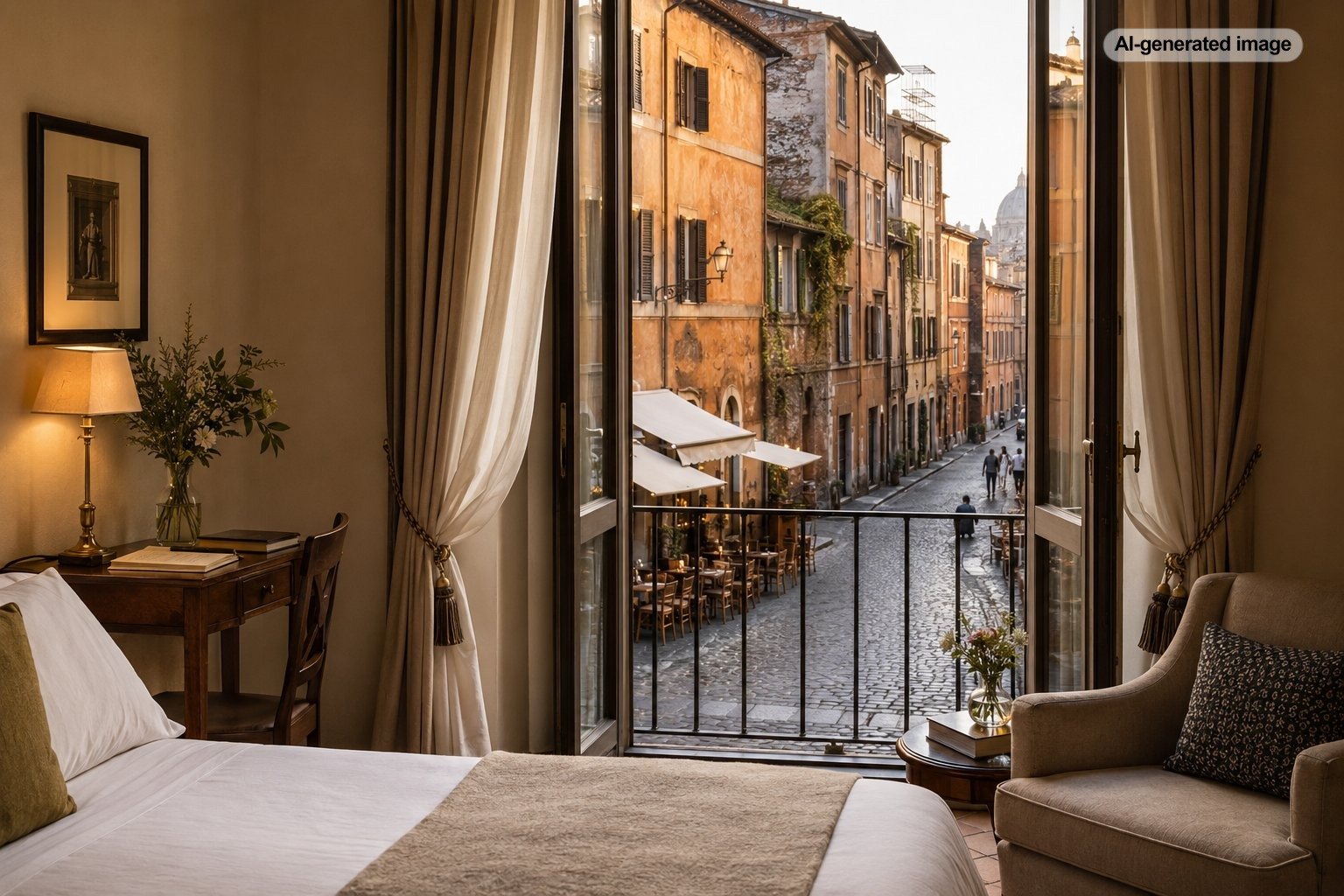
The most famous streets and squares can feel busy, particularly during peak visiting periods. Hotel rooms in historic buildings may also have compact layouts, irregular floor plans, limited views, or elevators that are smaller than travelers expect. A central address does not automatically guarantee a quiet room, so it is worth checking whether accommodations face a major square, restaurant-lined street, interior courtyard, or side lane.
The Centro Storico is broad enough that exact location matters. Staying near the Pantheon creates a different routine from staying near the Spanish Steps. Study the map around the property rather than relying only on a general label such as central Rome.
Monti: best balance of ancient history, restaurants, and neighborhood character
Monti is one of the most balanced options for travelers who want ancient Rome nearby without basing the entire trip in the busiest part of the historic center. The neighborhood sits close to the Colosseum, Roman Forum, and areas around Via dei Fori Imperiali, while its interior streets offer cafes, wine bars, small restaurants, boutiques, and an appealing evening rhythm.
It works particularly well for travelers who want to visit archaeological sites early, return for a break, and then walk to dinner without traveling across the city. Some parts of Monti also provide convenient access to Metro Line B, which can be useful for journeys beyond the immediate neighborhood.
Who should stay here
Monti suits first-time visitors who want a blend of major history and local texture. It can also be a good fit for couples, solo travelers, and repeat visitors who like central neighborhoods but would rather not stay directly beside the Trevi Fountain or Piazza Navona.
The tradeoffs
The terrain and street layout vary. A hotel that appears close to an attraction on a map may involve slopes, uneven paving, or a route that feels longer with luggage. The streets nearest the Colosseum can also have a more visitor-oriented feel than the smaller lanes deeper inside Monti. Confirm the property’s exact position rather than assuming every Monti address offers the same atmosphere.
Trastevere: best for evening atmosphere and animated streets
Trastevere is the most natural choice for travelers who imagine their Rome evenings unfolding around lively squares, narrow lanes, outdoor tables, traditional trattorias, and late dinners. The official Rome tourism site describes the district as known for characteristic squares, traditional Roman cooking, bars, clubs, artisan shops, and a strong evening social scene.
The neighborhood is especially atmospheric after the main sightseeing day ends. It can feel more intimate than the monumental center, even though its best-known streets attract substantial visitor traffic. Access across the Tiber also places parts of Trastevere within walking distance of Campo de’ Fiori, the Jewish Ghetto, and central riverside areas.
Who should stay here
Trastevere is a strong match for travelers who prioritize dinner, nightlife, street character, and leisurely evenings over immediate metro access. It is often appealing to couples, groups of friends, and repeat visitors who want their neighborhood to remain active after dark.
The tradeoffs
Noise is the central consideration. A room above a restaurant-lined lane or close to a popular square may not suit light sleepers. The neighborhood is also less straightforward for travelers who want to rely heavily on the metro. Buses, trams, walking, and taxis may play a larger role, depending on the hotel’s location.
For a quieter experience, look toward the edges of the district or consider accommodations set back from the main evening gathering points. A charming address in the center of the action and a restful room are not always the same thing.
Prati: best for the Vatican, orderly streets, and calmer evenings
Prati offers a different version of Rome. Its broad streets and late-19th- and early-20th-century buildings create a more organized, residential feel than the medieval lanes across the river. It is particularly convenient for visiting Vatican City, St. Peter’s Basilica, and the Vatican Museums, especially when accommodations are located near the Ottaviano or Lepanto areas.
The neighborhood also provides restaurants, cafes, shopping streets, and access to Metro Line A. Travelers who prefer clearer street grids and a somewhat quieter return at night may find Prati easier to navigate than the busiest portions of the historic center.
Who should stay here
Prati works well for Vatican-focused itineraries, families who prefer a calmer base, business travelers, and visitors who value metro access. It is also a sensible option for people who enjoy walking but do not need to sleep amid ancient ruins or crowded landmark squares.
The tradeoffs
Prati can feel less cinematic than Trastevere or the Centro Storico, particularly after dark. Reaching the Colosseum, Roman Forum, and some eastern neighborhoods usually requires a longer walk or a transit connection. Travelers visiting in summer 2026 should check current ATAC service updates before depending on a specific station; for example, ATAC announced a temporary refurbishment closure for Lepanto station from July 18 through August 30, 2026.
Testaccio: best for traditional food and a more residential rhythm
Testaccio is a compelling choice for travelers whose ideal Rome trip revolves around markets, Roman cooking, neighborhood bars, and a setting that feels less dominated by headline attractions. The district has deep connections to the city’s historic food culture and remains associated with characteristic trattorias and traditional Roman dishes. Rome’s official tourism site presents it as a central, well-connected area served by buses, trams, and Metro Line B via Piramide, which lies roughly a kilometer from parts of the neighborhood.
Who should stay here
Testaccio is best for repeat visitors, serious food travelers, and people who prefer observing everyday neighborhood life to waking up beside a major monument. It can also work for longer stays, when a residential routine becomes more valuable than maximum sightseeing efficiency.
The tradeoffs
You will spend more time traveling to attractions around the Pantheon, Trevi Fountain, Spanish Steps, and Vatican City. Some trips are walkable for energetic visitors, but the neighborhood is not the most convenient base for travelers trying to cover Rome’s main sights in two days. It is a deliberate lifestyle choice rather than the default recommendation for a first short visit.
Near Termini: best for transportation convenience, not atmosphere
The area around Roma Termini can be practical for travelers arriving late, leaving early, taking several train day trips, or staying for only one night. It connects with Metro Lines A and B and provides access to regional and intercity transportation. Nearby areas such as Repubblica, Via Nazionale, and parts of the Esquilino can offer a more appealing base than choosing a property solely because it sits immediately beside the station.
This district is usually a logistical decision rather than an atmospheric one. Travelers who want memorable evening walks, intimate piazzas, and a strong sense of historic setting may prefer Monti or the Centro Storico, even when that means arranging a taxi or transit connection on arrival.
How to choose the right neighborhood for your itinerary
For a two- or three-night first visit: Favor the Centro Storico or Monti. Reducing daily transportation usually matters more than finding a quieter residential district.
For a food-centered trip: Choose Trastevere for animated evenings or Testaccio for a more neighborhood-oriented experience. Staying in the Centro Storico still provides excellent dining access, but restaurant research becomes important in streets dominated by heavy visitor traffic.
For ancient history: Monti or the Colosseum area minimizes travel to the Roman Forum, Palatine Hill, and surrounding archaeological sites. Confirm whether the hotel is uphill, beside a busy road, or on a quieter interior street.
For Vatican priorities: Prati is generally the most efficient choice. Select a location that balances Vatican access with a convenient Metro Line A station and the evening atmosphere you prefer.
For nightlife: Trastevere provides the clearest concentration of late-evening activity. Request a courtyard-facing or upper-floor room when sleep quality matters.
Transportation and walkability considerations
Rome rewards walking, but distances can be deceptive. Cobblestones, summer heat, crowded pedestrian areas, hills, and long museum days can make a route feel more demanding than its map distance suggests. A hotel that saves 20 minutes of walking twice a day may meaningfully improve a short trip.
The metro is useful but does not reach every part of the historic center directly. Buses and trams fill many gaps, while taxis can be practical for luggage, early departures, or cross-city evening trips. ATAC publishes official city-center, metro, rail, tram, and night-service maps, along with a journey planner and service updates. Check those resources shortly before travel because station works and route changes can affect the most convenient option.
What travelers often overlook
- Street-facing rooms: A beautiful piazza view can come with late-night conversation, deliveries, traffic, or early cleaning activity.
- Building access: Historic accommodations may have stairs before the elevator, compact lifts, or reception on an upper floor.
- Exact neighborhood boundaries: Hotel descriptions may use the name of a desirable nearby district even when the property sits outside its most convenient section.
- Walking conditions: Uneven surfaces and slopes matter for rolling luggage, strollers, mobility concerns, and travelers who plan long sightseeing days.
- Restaurant reservations: Staying in a dining neighborhood does not guarantee easy access to every sought-after restaurant, particularly at popular dinner times.
- Departure-day logistics: A romantic pedestrian lane may be delightful during the stay but awkward for an early airport transfer or heavy luggage.
Frequently asked questions
What is the best area to stay in Rome for a first-time visitor?
The Centro Storico is the easiest general recommendation because it places many famous sights within walking distance. Monti is an excellent alternative for travelers who prioritize ancient Rome and want a stronger neighborhood feel.
Is Trastevere or the Centro Storico better?
Choose Trastevere for evening energy, trattorias, and street atmosphere. Choose the Centro Storico for maximum sightseeing convenience and easier walks to a broader range of major landmarks.
Where should food lovers stay in Rome?
Trastevere is best for a lively dining scene, while Testaccio appeals to travelers seeking a more residential district with strong connections to traditional Roman food. The historic center also has excellent restaurants, but careful selection helps avoid overly visitor-focused dining rooms.
Should I stay near the Colosseum?
Stay near the Colosseum when ancient sites are a major priority or your visit is short. Monti generally offers a better balance of archaeological access, restaurants, and evening character than choosing a hotel based only on the closest possible distance to the monument.
Do I need to stay near a metro station in Rome?
Not necessarily. Travelers staying in the Centro Storico can complete much of their sightseeing on foot. Metro access becomes more valuable in Prati, near Termini, or when your itinerary includes destinations spread across different parts of the city.