Where to Stay in Split for Diocletian’s Palace Without Cruise-Ship Crowd Noise
Split presents an unusual hotel-location dilemma. Diocletian’s Palace is the city’s defining attraction, but the surrounding historic center is also where cruise passengers, ferry travelers, walking tours, restaurant crowds, and evening visitors frequently converge. Staying close to the palace makes sightseeing remarkably convenient. Staying directly on one of its busiest pedestrian routes, however, can mean sacrificing the atmosphere that makes a longer visit to Split appealing.
For travelers who want to explore the palace without spending their entire stay surrounded by waterfront foot traffic, the strongest choices are generally Veli Varo�, the northern edge of the historic center, and carefully selected properties west of the Riva. These locations preserve convenient access while offering alternatives to the busiest harbor-facing streets. Hotels farther toward Marjan or Bacvice can provide additional separation, although they introduce longer walks or different neighborhood noise considerations.
Quick Answer: Where Should You Stay?
- Best balance of atmosphere and location: Camera Heritage Hotel in Veli Varo�.
- Best for independent travelers seeking residential character: Divota Apartment Hotel.
- Best intimate retreat near the western waterfront: Heritage Hotel 19.
- Best polished city hotel near the palace’s northern approach: Heritage Hotel FERMAI.
- Best for convenient sightseeing with extensive hotel facilities: Cornaro Hotel.
- Best for greater separation from the historic-center bustle: Hotel Cvita near Marjan.
Planning snapshot: For a two- or three-night cultural stay, Veli Varo� and the northern historic-center streets offer especially useful starting points. Most central sightseeing can be done on foot. Summer brings particularly active waterfront and sightseeing areas, while evenings can also be lively independently of cruise arrivals. Travelers prioritizing sleep should investigate the exact room position, not simply the hotel address.
Why the Quietest Location Is Not Necessarily the Farthest Away
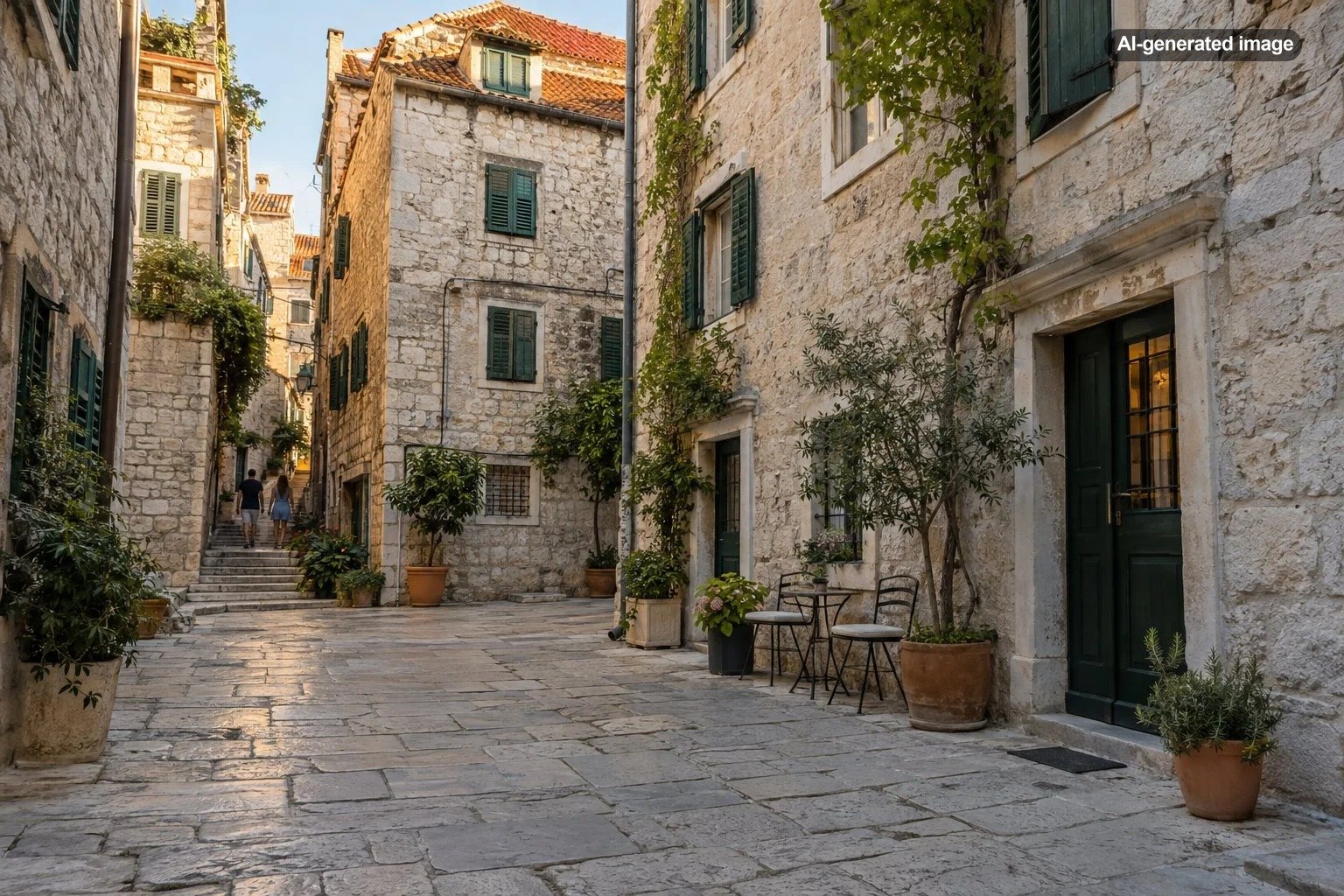
Diocletian’s Palace is not an isolated archaeological site with one controlled entrance. Its ancient streets form a functioning part of Split’s city center. Restaurants, residences, small hotels, shops, and historic monuments occupy the same compact network of passages.
Cruise visitors commonly concentrate around major attractions and the historic waterfront, especially during organized sightseeing periods. Yet crowd levels depend on more than ships. Ferry movements, independent day-trippers, summer events, restaurant activity, and nightlife also influence how busy an individual street feels.
The distinction between daytime crowds and nighttime noise is important. A hotel overlooking a major pedestrian passage might experience heavy foot traffic during the afternoon but relatively little activity later. Another property on a seemingly quieter lane could face a restaurant terrace or late-night gathering point.
The most effective approach is to select a hotel slightly beyond the principal sightseeing corridors, then request a room facing an interior courtyard, garden, or less active street where available. No central neighborhood guarantees silence.
Camera Heritage Hotel: Historic Veli Varo� Character
Area: Veli Varo�, west of the palace. Positioning: Upscale boutique heritage accommodation.
Camera Heritage Hotel occupies a restored historic family house on Jerina Street in Veli Varo�. Its location places guests within a short walk of Diocletian’s Palace while retaining the character of an older residential neighborhood rather than a major commercial promenade.
The property combines traditional architecture with a collection of photographic artwork. Its official website also identifies accessibility provisions, making it worth investigating for travelers who want heritage surroundings without automatically accepting the stair-related limitations of many older buildings.
Best for: Couples, design-minded visitors, and travelers who value small-scale hospitality.
Tradeoff: Veli Varo� contains narrow streets, uneven surfaces, and local pedestrian activity. Confirm the approach to the property and the room’s exposure to nearby restaurants or passing pedestrians. Its location is promising for reduced cruise-tour concentration, not a guarantee of complete quiet.
Divota Apartment Hotel: Residential Atmosphere and Flexibility
Area: Varo�. Positioning: Upscale apartment-style and boutique accommodation.
Divota Apartment Hotel offers a different experience from a conventional single-building hotel. Its accommodations are integrated into the Varo� neighborhood, with reception facilities based on Plinarska Street.
This arrangement appeals to travelers who would rather inhabit Split’s established residential fabric than remain within the densest sightseeing district. Selected accommodations offer features such as courtyard settings, balconies, or additional living space, although these details vary by unit.
Best for: Independent travelers, longer city stays, and couples who appreciate a neighborhood setting.
Tradeoff: Individual accommodation locations and layouts matter significantly. Confirm the exact building, check-in arrangements, stairs, and distance from reception. A unit on a quiet-looking lane can still be affected by neighboring activity.
Heritage Hotel 19: A Small Retreat Near the West Coast
Area: Solurat Street, between the Riva and western waterfront. Positioning: Upscale boutique hotel.
Heritage Hotel 19 occupies a particularly interesting position for visitors who want to stay close to the historic center without sleeping inside the palace’s principal pedestrian circuit. The hotel identifies its Solurat Street address as a quiet pedestrian-only location.
The western side of central Split provides convenient access to the Riva, Veli Varo�, and routes toward Marjan. That combination makes Heritage Hotel 19 attractive for travelers who want both historical sightseeing and relaxed walks away from the busiest squares.
Best for: Couples and visitors seeking an intimate, centrally located stay.
Tradeoff: Proximity to the waterfront remains a consideration. Ask specifically about room orientation and nighttime activity nearby. Pedestrian-only access may also require planning when arriving with luggage.
Heritage Hotel FERMAI: Elegance on the Northern Approach
Area: Livanjska Street, north of Diocletian’s Palace. Positioning: Upscale heritage design hotel.
Heritage Hotel FERMAI occupies an Art Nouveau building a short walk from the palace’s Golden Gate. Its location offers a practical alternative to the harbor-side approach used by many visitors.
For travelers who expect to enter the palace several times a day, this northern position is useful. Guests can explore the historic center in the morning, leave when tour groups become more concentrated, and return later without having to cross the full length of the waterfront promenade.
Best for: Architecture enthusiasts, couples, and first-time visitors who prioritize efficient sightseeing.
Tradeoff: The hotel is still in central Split. Nearby streets can carry urban traffic and pedestrian activity, so a less exposed room is preferable for particularly light sleepers.
Hotel Marul: Central Convenience With a Garden Setting
Area: Cirila i Metoda Street, north of the historic core. Positioning: Upscale four-star city hotel.
Hotel Marul offers a useful compromise between immediate historic-center accommodation and a more conventional urban hotel experience. Its official website highlights a restaurant, bar, and garden, giving guests an alternative place to relax between sightseeing excursions.
The northern location is especially convenient for visitors who want to reach Diocletian’s Palace without basing themselves along the Riva.
Best for: Couples and travelers who appreciate having a hotel restaurant and garden close to the major attractions.
Tradeoff: A pleasant garden does not mean every room has the same acoustic environment. Ask whether the requested room overlooks the street, garden, or another part of the property, and whether restaurant activity might be audible.
Cornaro Hotel: Upscale Comfort Just Outside the Palace
Area: Northern historic-center edge, around Sinjska Street and Ulica Kralja Tomislava. Positioning: Luxury city hotel.
Cornaro Hotel is an option for travelers who want immediate access to the historic center but prefer a larger, more extensively serviced hotel over a small heritage property. Its modern accommodations and rooftop bar distinguish it from Split’s more intimate stone-house hotels.
The location makes early palace visits straightforward and avoids requiring guests to cross the waterfront every time they return to their room.
Best for: First-time visitors, couples seeking upscale facilities, and travelers who prefer a full-service city-hotel atmosphere.
Tradeoff: Cornaro is firmly part of the lively city center. Rooftop hospitality and surrounding urban activity may make it less suitable for travelers whose overriding requirement is exceptional quiet. Room position deserves careful attention.
Hotel Globo: Practical Accommodation Beyond the Main Tourist Lanes
Area: Lovretska Street, north of the historic center. Positioning: Moderate to upscale traditional city hotel.
Hotel Globo is worth considering when proximity remains important but staying directly among historic-center restaurants and sightseeing groups is unnecessary. The hotel describes itself as approximately a ten-minute walk from central Split and provides private parking.
Its more conventional hotel format may appeal to travelers who prioritize straightforward arrival arrangements and functional accommodation over historic interiors.
Best for: Practical-minded visitors, business travelers adding sightseeing, and guests arriving by car.
Tradeoff: The surrounding area feels more like an ordinary city neighborhood than an atmospheric palace district. Traffic noise may replace tourist noise, depending on the room.
Hotel Ambasador: Waterfront Luxury West of the Busiest Routes
Area: Zapadna obala, Split’s western waterfront. Positioning: Luxury hotel.
Hotel Ambasador occupies Trumbiceva obala, west of the palace and near the transition toward Marjan. Its facilities include dining, a spa, fitness facilities, and an outdoor pool.
The location is particularly appealing for guests who want sea views and a contemporary luxury-hotel setting while maintaining easy access to the old town.
Best for: Luxury-focused couples, travelers combining sightseeing and relaxation, and visitors who prefer comprehensive hotel facilities.
Tradeoff: Waterfront exposure can mean passing pedestrians, outdoor dining activity, and general harbor-city bustle. A sea-facing room is not automatically quieter than an inward-facing one. This is a better choice for avoiding the palace’s narrow sightseeing passages than for avoiding all urban waterfront activity.
briig Boutique Hotel: Modern Design Near Bacvice
Area: Bacvice, southeast of the old town. Positioning: Upscale design hotel.
briig Boutique Hotel sits in the Bacvice area, close enough for convenient walks to the palace but beyond its densest cluster of heritage accommodation. The hotel’s architecture and art-oriented interiors create a contemporary alternative to Split’s traditional stone properties.
Its location near the beach makes it particularly useful for a visit that combines cultural sightseeing with time by the water.
Best for: Design-focused travelers and couples dividing their days between the historic center and beach.
Tradeoff: Bacvice has its own social and nightlife character. Being away from cruise crowds does not necessarily mean being away from evening noise, especially during summer. Confirm the room’s exposure to nearby activity.
Hotel Cvita: A More Secluded Marjan Alternative
Area: Southern slopes of Marjan. Positioning: Upscale boutique hotel.
Hotel Cvita is one of the more compelling alternatives for travelers willing to trade immediate palace access for a stronger sense of retreat. Located near Marjan’s wooded landscape, the hotel emphasizes its tranquil setting and sea views.
The location creates a more pronounced separation from the waterfront sightseeing corridors than hotels immediately bordering Diocletian’s Palace.
Best for: Couples, nature-oriented visitors, and travelers planning relaxed afternoons outside the busiest city streets.
Tradeoff: The hillside location introduces more walking effort, especially when returning uphill. Travelers with mobility limitations or frequent plans in the old town may prefer a more central property or occasional vehicle transportation.
Which Split Neighborhood Offers the Best Balance?
| Area | Main advantage | Main compromise |
|---|---|---|
| Veli Varo� | Residential character and easy historic-center access | Narrow lanes, stairs, and variable evening activity |
| Northern old town | Convenient access to the Golden Gate | Central traffic and nearby city activity |
| Western waterfront | Sea views and access toward Marjan | Waterfront pedestrians and hospitality noise |
| Bacvice | Beach and city sightseeing combination | Seasonal beach-area nightlife |
| Marjan slopes | Greater separation from central sightseeing corridors | Longer or hillier trips into town |
For a first visit primarily focused on Diocletian’s Palace, Veli Varo� and the northern historic-center edge generally offer the most attractive balance. Travelers who place greater importance on hotel facilities may prefer the western waterfront. Those particularly sensitive to crowd density should consider Marjan while accepting the additional transportation effort.
How to Choose a Room That Actually Feels Quiet
Neighborhood choice solves only part of the problem. In Split, two rooms within the same hotel can have very different sound environments.
- Ask about the window exposure: A room facing an inner courtyard may have less pedestrian noise than one facing a busy lane, although courtyards can carry voices too.
- Check nearby evening venues: Restaurants, terraces, bars, and event spaces may matter more for sleep than afternoon tour groups.
- Consider the floor: Higher floors sometimes reduce direct street noise, but rooftop bars and terraces can create a different issue.
- Investigate air conditioning: Effective climate control can make sleeping with closed windows more practical in warm weather.
- Confirm luggage access: Historic pedestrian streets may require carrying bags over stone paving or coordinating a drop-off point.
- Clarify stairs and elevators: Heritage buildings vary considerably, and accessibility should be checked directly rather than assumed.
When contacting a property, a useful question is: ‘Which room category is least exposed to pedestrian traffic, restaurants, bars, and hotel entertainment?’ That is more informative than simply asking whether the hotel is quiet.
How to Experience Diocletian’s Palace With Fewer Crowds
Staying nearby creates a useful advantage: flexibility. Visitors do not need to fit the entire palace into one long sightseeing session. They can explore prominent areas early, leave during busier periods, and return later.
Visit the Main Squares Early
The Peristyle and surrounding streets can feel substantially different before large sightseeing groups accumulate. Early visits offer an opportunity to appreciate the architecture without competing with as many organized tours or stopping pedestrians.
Explore Beyond the Main Waterfront Approaches
Approaching from the Golden Gate or through smaller streets north and west of the palace can diversify the experience. These routes are not guaranteed to be empty, but they reduce dependence on the most obvious harbor-to-palace pedestrian paths.
Separate Cruise Traffic From Evening Noise
Cruise-group activity generally follows sightseeing schedules, while restaurants and nightlife can continue after those groups depart. Travelers seeking quiet sleep should prioritize evening conditions around their hotel rather than concentrating exclusively on ship arrivals.
Build Flexibility Into Busy Days
For travelers who wish to plan around cruise activity, published port schedules can provide context. However, ship arrivals do not translate directly into a guaranteed number of pedestrians at any particular hour. Passenger itineraries, shore excursions, other visitors, and events all affect local congestion.
Frequently Asked Questions
Is it better to stay inside Diocletian’s Palace or outside it?
Staying inside the palace offers extraordinary historical atmosphere and immediate access to major sights. Staying just outside its busiest routes may provide more separation from daytime foot traffic. For noise-sensitive travelers, a carefully chosen room outside the palace is often the more practical compromise.
Is Veli Varo� a good area for a quiet stay?
Veli Varo� is among the strongest areas to investigate because it combines residential character with proximity to the historic center. Individual streets and buildings vary, however, and restaurant activity, pedestrians, and old-building sound insulation remain considerations.
Does the Riva become quiet after cruise passengers leave?
Not necessarily. The Riva is an important public promenade used by residents and independent visitors, with dining and evening activity unrelated to cruise schedules. Waterfront-facing accommodation should be evaluated for nighttime noise separately.
Do you need a rental car when staying near Diocletian’s Palace?
Usually not for a sightseeing-focused city stay. Split’s compact historic core is best explored on foot, and a car can complicate parking and access to pedestrian streets. A rental car becomes more relevant for certain excursions beyond the city, depending on the route and transportation alternatives.
Which hotel is the strongest choice for particularly light sleepers?
Hotel Cvita offers greater physical separation from the busiest central sightseeing corridors, while Camera Heritage Hotel, Divota Apartment Hotel, and Heritage Hotel 19 provide appealing closer-in alternatives. None should be treated as acoustically guaranteed. Confirm the precise room location and surrounding nighttime activity before booking.
The Best Choice Depends on Which Noise You Want to Avoid
For travelers primarily concerned about organized sightseeing groups, staying just west or north of Diocletian’s Palace is often the smartest starting point. Camera Heritage Hotel and Divota Apartment Hotel offer a neighborhood-based experience in Varo�, while Heritage Hotel FERMAI provides polished accommodation near the northern palace approach. Heritage Hotel 19 offers a particularly attractive western location for visitors who want central access without staying directly inside the palace.
Travelers prioritizing extensive facilities may find Cornaro Hotel or Hotel Ambasador more suitable, while Hotel Cvita offers a stronger retreat for those comfortable with additional walking or transportation. The key is not merely selecting the closest hotel with favorable reviews. It is understanding which direction its rooms face, how the surrounding streets function after dark, and how much distance from the palace actually improves the stay.
A thoughtful location choice allows Split’s historic center to remain the highlight of the visit rather than the soundtrack throughout the night.
Sources & Further Reading
- Split-Dalmatia County Tourist Board: Split destination information
- Camera Heritage Hotel: Official property information
- Divota Apartment Hotel: Official website and location information
- Heritage Hotel 19: Official website
- Heritage Hotel FERMAI: Official website
- Hotel Marul: Official website
- Cornaro Hotel: Official website
- Hotel Globo: Official website
- Hotel Ambasador: Official hotel information
- briig Boutique Hotel: Official website
- Hotel Cvita: Official location information