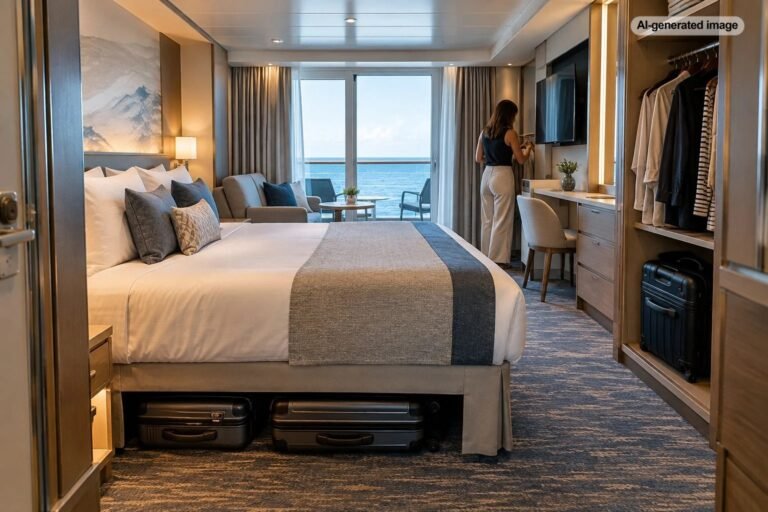
Sofa Bed vs. Pullman Bed in a Cruise Cabin: Which Is More Comfortable?
When three or four people share a cruise cabin, the extra sleeping arrangements can matter almost as much as the itinerary. A sofa bed and a Pullman bed may both accommodate an additional passenger, but they offer quite different experiences. One sits close to the floor and may take up valuable living space, while the other folds down from the wall or ceiling and requires climbing into an elevated berth.
For most adults, a well-designed sofa bed is the more practical and potentially more comfortable choice. It is easier to enter and exit, generally offers a more familiar sleeping position, and avoids the ladder associated with an upper berth. A Pullman bed, however, can be surprisingly comfortable for a child or agile traveler who prefers a dedicated sleeping surface and appreciates having more floor space available. Neither option is automatically superior: mattress construction, berth dimensions, cabin layout, and individual mobility all influence the result.
Quick Answer: Which Cruise Bed Should You Choose?
- For most adults: A sofa bed is generally preferable because it provides easier access and eliminates climbing.
- For school-age children: A Pullman bed can be appealing, provided the child meets the cruise line’s age and safety requirements.
- For travelers with limited mobility: A lower sleeping surface is usually the more practical option, although the exact sofa height and accessibility should still be checked.
- For preserving cabin floor space: A Pullman bed often has an advantage because it does not require a sofa to extend across the floor.
- For two additional passengers: A double sofa bed may provide a shared surface, while two Pullman berths can give each person an individual sleeping space.
What Is the Difference Between a Sofa Bed and a Pullman Bed?
How a Cruise Cabin Sofa Bed Works
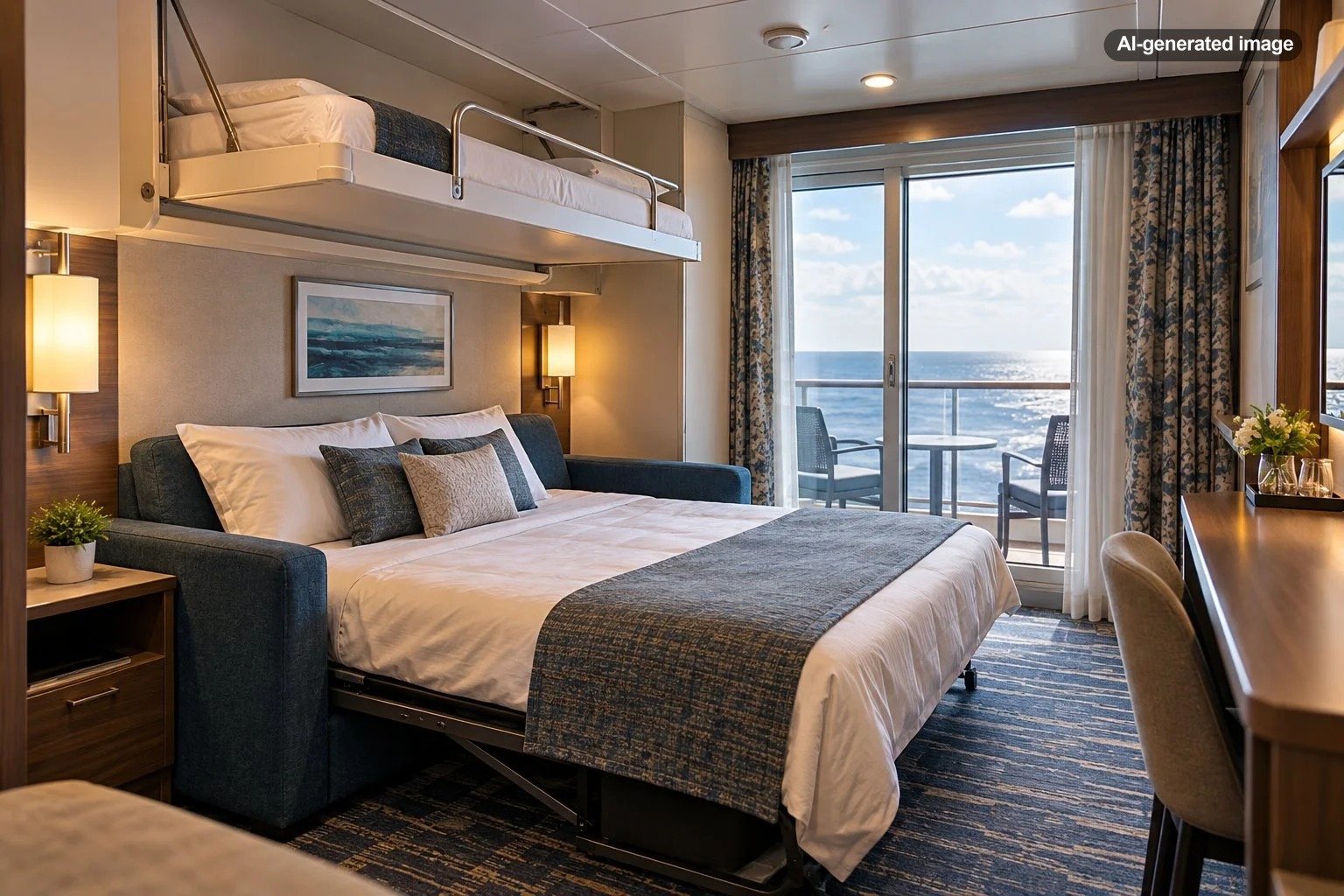
A cruise cabin sofa bed converts an existing seating area into a sleeping surface. Depending on the ship and cabin category, this may involve extending a mattress, folding down part of the sofa, or rearranging cushions to create a bed. Some models accommodate one person; others open into a wider surface for two.
The principal benefit is accessibility. Passengers can usually sit down and lie back without negotiating a ladder, making the arrangement convenient for adults, older children, and anyone who prefers sleeping closer to the floor.
The disadvantage is the loss of seating and circulation space. When extended, a sofa bed may occupy an area normally used for walking, accessing storage, or moving between the main bed and balcony door. In a compact interior cabin, that difference can be substantial.
How a Pullman Bed Works
A Pullman bed is a folding berth that lowers from a wall or ceiling. It is usually positioned above another part of the cabin, keeping the lower floor area available for other uses. Passengers generally access it using a short ladder.
Unlike a sofa that converts into a bed, a Pullman berth commonly has its own mattress and fixed sleeping platform. This can produce a more consistent surface, although actual firmness and cushioning vary between ships.
The tradeoff is height. Passengers must be comfortable climbing into and out of the berth, and overhead clearance can be limited. Guardrails and access arrangements also differ by design. Cruise lines may impose restrictions on who can occupy an upper berth, particularly younger children.
Sofa Bed vs. Pullman Bed: Comfort Comparison
| Comfort factor | Sofa bed | Pullman bed |
|---|---|---|
| Sleeping surface | Varies by conversion mechanism | Usually a dedicated berth mattress |
| Getting in and out | Typically easier | Usually requires a ladder |
| Floor space | May restrict movement when open | Generally preserves more floor space |
| Overhead clearance | Typically less restrictive | Can be limited |
| Nighttime bathroom access | Usually more convenient | Requires descending from the berth |
| Best potential fit | Adults and travelers prioritizing accessibility | Agile travelers and eligible older children |
These distinctions describe typical configurations rather than guaranteed features. Two cabins aboard the same ship may use different auxiliary beds, making the exact stateroom arrangement more important than the general bed label.
Which Bed Has the Better Mattress?
Mattress comfort is the area where a Pullman bed can compete especially well with a sofa bed. Because an upper berth commonly uses a dedicated mattress resting on a fixed platform, it may feel more uniform than a convertible sofa.
A sofa bed can be comfortable when its cushioning, frame, and extension mechanism create a level sleeping surface. However, some designs introduce seams, changes in firmness, or support differences between sections. A person who sleeps on their side may notice pressure around the hips or shoulders, while someone who sleeps on their back may be more sensitive to uneven support.
Conversely, a Pullman mattress can be relatively thin or firm. A dedicated berth does not necessarily mean a luxurious mattress, particularly if the passenger is accustomed to a deeply cushioned bed at home.
The useful question is not simply which type of bed is better, but what mattress and conversion design the specific cabin uses. Recent cabin photographs, ship-specific passenger accounts, and information from the cruise line can help clarify those details. Reports from another ship in the same fleet may not accurately represent your cabin.
Which Bed Is Better for Adults?
For an adult occupying the third sleeping position, a sofa bed is usually the safer practical preference from a convenience standpoint. Most adults can enter and exit it without special effort, and there is no elevated sleeping position to negotiate during the night.
This becomes particularly relevant for travelers who wake frequently, use the bathroom after dark, wear glasses that need to be located before moving, or simply dislike climbing down a ladder when half asleep.
A Pullman bed may nevertheless suit a healthy, agile adult who prefers a separate mattress and does not mind the climb. Before choosing one, confirm the permitted occupant weight, mattress dimensions, ladder placement, and available clearance directly with the cruise line. Do not assume every upper berth is suitable for every adult.
For a longer voyage, small inconveniences can become more noticeable. A sleeping arrangement that seems acceptable for two nights may feel less appealing after a week of repeated climbs or disrupted sleep.
Which Bed Is Better for Children?
Children may find a Pullman berth appealing because it resembles a bunk bed. It can offer a distinct sleeping area without taking over the sofa, giving a family more flexibility in how the cabin is used.
However, suitability is not determined by enthusiasm alone. The child must meet the applicable cruise line’s minimum age and other upper-berth safety requirements. Royal Caribbean, for example, states in its published guest terms that children under six cannot occupy upper berths. Requirements should be confirmed for the particular operator and sailing rather than generalized across the industry.
A sofa bed may be more appropriate for a younger child who is eligible to use that arrangement, especially when parents want a sleeping surface closer to the floor. Parents should still confirm the configuration, any relevant sleeping arrangements for young children, and the cruise line’s guidance.
For families with two older children, separate Pullman beds may prevent disagreements about shared sleeping space. A double sofa bed can provide more room to turn over in some configurations, but two sleepers must also accommodate one another’s movements.
How the Bed Changes the Cabin Layout
Comfort extends beyond the mattress. In a cruise stateroom, the ability to move around without stepping over luggage or disturbing another sleeper can be equally valuable.
Imagine a family of four occupying a compact balcony cabin. If the sofa converts into a double bed, it may restrict access between the main bed and the balcony, depending on the floor plan. If the same cabin uses upper Pullman berths, the floor may remain more open, although lowered bunks can create headroom restrictions beneath them.
On some ships, the cabin steward prepares additional beds in the evening and returns them to their daytime configuration later. Exact practices vary, so passengers should not assume a sofa or Pullman berth will automatically be folded away on a particular schedule.
The configuration also matters if one person goes to sleep much earlier than everyone else. Converting the sofa removes a shared seating area, while lowering a Pullman berth may affect the space around the main bed. Consider how the arrangement will work when everyone is awake, not just when everyone is sleeping.
What About Cabins That Have Both Beds?
Some cruise cabins accommodate larger groups using a combination of sofa and Pullman berths. This is especially relevant for families comparing cabins designed for four or five occupants.
For example, Royal Caribbean’s published Oasis of the Seas deck information describes certain ocean-view cabins with a double sofa bed and an additional fold-down Pullman berth for configurations accommodating up to five guests. Princess Cruises also describes selected Deluxe Balcony accommodations where a sofa bed accommodates a third passenger and a Pullman berth may accommodate a fourth.
These arrangements illustrate an important booking distinction: the number of passengers a cabin accepts does not tell you which passenger will sleep where. A four-person cabin might feature two upper berths, a double sofa bed, or another combination depending on its category and individual cabin number.
For groups with varying ages and mobility needs, establishing the exact sleeping assignments before booking can prevent an uncomfortable surprise after boarding.
How to Choose the Right Cabin Before Booking
Start by deciding who will use the additional bed. An adult with back discomfort, a teenager who prefers a private sleeping surface, and a younger child may each have very different priorities.
Then inspect the ship’s current deck plan for the sailing you are considering. Look for symbols identifying third- and fourth-passenger sleeping positions, and check whether the cabin has a sofa bed, one Pullman, two Pullmans, or a combination.
Ask the cruise line or booking representative to clarify the following details:
- The exact supplemental bed configuration for the cabin number.
- Whether the sofa bed is single or double and how it opens.
- The dimensions and occupant limits of each additional berth.
- Any age restrictions or mobility considerations for upper bunks.
- Whether the deployed beds obstruct wardrobes, walking routes, or access to other cabin features.
- Whether a different cabin category offers a more suitable layout.
Cabin selection should also take account of the whole itinerary. For a short cruise with busy port days, travelers may spend relatively little waking time in the room. On a longer sailing with sea days, preserving a comfortable seating area and an uncluttered pathway may matter considerably more.
When comparing ships and departure dates, travelers can compare available sailings through Expedia Cruises, then confirm the specific cabin’s sleeping configuration with the cruise operator before completing a reservation.
What Travelers Often Overlook
Cabin Capacity Does Not Guarantee Bed Preference
A cabin advertised for four guests is not necessarily equipped with four conventional lower beds. The stated capacity describes the permitted occupancy, not the relative comfort of each sleeping position.
Two Sofa Beds Can Be Very Different
Even within one cruise line, a simple single sleeper and a wider convertible sofa may have noticeably different mattresses, dimensions, and mechanisms. Avoid relying on a generic photograph of the cabin category.
Nighttime Movement Matters
If someone needs to climb down from an upper bunk or walk around an extended sofa after dark, the room’s layout becomes more consequential. Establish a clear route to the bathroom and keep luggage out of walking areas.
The Main Bed May Affect the Extra Beds
Depending on the cabin design, separating the main bed into twin beds or keeping it configured as a larger bed can change the available circulation space. Ask whether the preferred main-bed arrangement works with all additional berths deployed.
An Additional Cabin May Be Worth Comparing
When several adults are traveling together, compare the overall cost and convenience of a crowded shared cabin with two separate cabins, potentially connecting ones. The latter may provide more privacy, bathroom access, and sleeping flexibility, even if it is not the least expensive arrangement.
Frequently Asked Questions
Are Pullman Beds on Cruise Ships Comfortable?
They can be. Pullman berths often have dedicated mattresses and may feel more consistent than some convertible sofas. Their comfort depends on mattress quality, dimensions, overhead clearance, and the sleeper’s tolerance for climbing into an elevated bed.
Can Adults Sleep in Pullman Beds?
Adults may use Pullman beds when the specific berth permits their age, size, and weight. Confirm the published limitations and access arrangements with the cruise line. An upper berth is generally unsuitable for someone who cannot safely manage the ladder.
Are Cruise Ship Sofa Beds Big Enough for Two Adults?
Some cabins contain double sofa beds designed for two passengers, but dimensions and comfort vary. Others have single sofa beds intended for one person. Check the exact cabin description rather than assuming any sofa can sleep two adults comfortably.
Do Pullman Beds Make Cruise Cabins Feel Smaller?
They can make the space above the main sleeping area feel more enclosed, particularly when ceiling clearance is limited. However, they generally preserve more lower floor space than a sofa bed that extends into the room. The better arrangement depends on the cabin’s physical layout.
Can You Change From a Pullman Bed to a Sofa Bed After Boarding?
Not necessarily. The type of supplemental bed is normally determined by the cabin’s built-in furniture and certified occupancy arrangement. A steward may be able to adjust how available beds are prepared, but cannot be assumed to substitute an entirely different sleeping system. If this choice is important, resolve it before booking.
The Verdict: Choose Comfort for the Person, Not Just the Cabin
For most adult travelers, a sofa bed offers the better overall combination of convenient access, familiar sleeping height, and nighttime practicality. A Pullman bed may provide a more consistent mattress surface and preserve valuable floor space, making it attractive for eligible children and agile passengers comfortable with an upper bunk.
Neither arrangement should be judged by its name alone. The most comfortable cruise cabin is the one whose actual bed dimensions, mattress design, access, and floor plan suit the people using it. Confirm those details for the specific stateroom, and the third or fourth sleeping position becomes a considered part of the trip rather than an unwelcome surprise.
Sources & Further Reading
- Royal Caribbean: Serenade of the Seas Deck Plans – examples of single sofa, double sofa, and Pullman berth configurations.
- Royal Caribbean: Oasis of the Seas Deck Plans – cabin arrangements combining sofa beds and upper berths.
- Royal Caribbean: Guest Terms and Conditions – upper-berth restrictions and guidance on stateroom sleeping configurations.
- Princess Cruises: Regal Princess Deluxe Balcony – examples of third-passenger sofa beds and optional fourth-passenger Pullman berths.