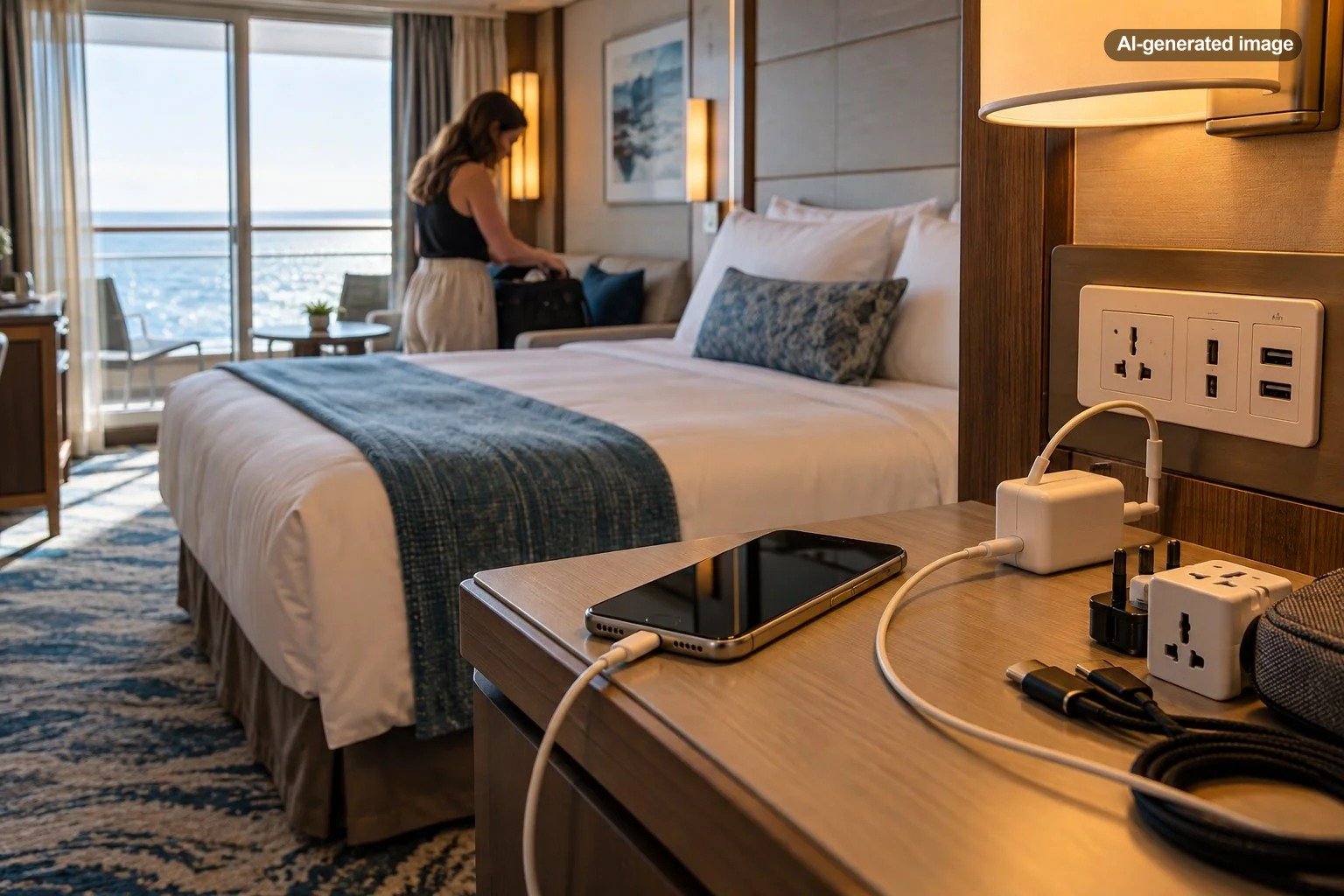
Do Cruise Cabins Have USB-C Ports or Should You Bring Adapters?
Some cruise cabins have USB-C charging ports, but many do not. Newer ships are more likely to offer modern charging connections, while older vessels may have USB-A ports or only conventional electrical outlets. Because charging arrangements vary by cruise line, ship, and sometimes cabin configuration, bringing your own USB-C wall charger is usually the simplest way to avoid inconvenience.
You do not necessarily need a travel plug adapter, particularly when your cabin has a compatible North American outlet. What matters is distinguishing between USB-C charging, USB-A charging, electrical plug compatibility, and the cruise line’s rules about multi-outlet devices.
Quick Answer: What Should You Pack?
- Bring a USB-C wall charger: A compact charger that plugs into a standard electrical outlet provides a dependable alternative to built-in USB ports.
- Carry the correct charging cable: USB-C-to-USB-C works with USB-C chargers, while USB-A-to-USB-C connects newer devices to older USB-A ports.
- Check your ship’s outlet types: Some cabins have North American sockets, European sockets, or both.
- Avoid assuming power strips are permitted: Cruise lines have different restrictions, including rules concerning surge protection and multi-plug accessories.
- Confirm the details before departure: The specific ship matters more than the cruise line’s general reputation for modern amenities.
Do Most Cruise Ship Cabins Have USB-C Ports?
USB-C is increasingly common in consumer electronics, but cruise ship cabin upgrades do not follow one universal schedule. A modern phone or tablet may use USB-C even when the cabin’s charging connections were designed for older devices.
There are three common arrangements travelers should understand.
Cabins With Built-In USB-C Ports
Some newer accommodations include USB-C connections built into bedside panels, desks, or other charging areas. These are convenient because a compatible cable can connect directly without a separate wall charger.
However, the presence of a USB-C socket does not establish its charging speed. A port may provide enough power for a phone while being less suitable for a laptop or another device that expects higher wattage.
Cabins With USB-A Ports Only
USB-A is the older rectangular USB connection. It remains relevant on cruise ships because it was widely adopted before USB-C became the standard connection on many personal devices.
A traveler with a USB-C phone can often use a USB-A-to-USB-C cable to charge through one of these ports. Charging may be slower than through a suitable modern wall charger.
Cabins With Conventional Electrical Outlets
Some cabins rely primarily on wall outlets rather than built-in USB charging. This is generally manageable if you bring a compatible charging brick.
For example, a traveler carrying a USB-C phone and a charger with a North American plug can charge normally when an appropriate North American outlet is available. No built-in USB-C port is necessary.
What Do Major Cruise Lines Say About Cabin Charging?
Official cruise line information illustrates why travelers should avoid making assumptions across an entire fleet.
Carnival Cruise Line
Carnival publishes detailed information about electrical outlets and USB connections. Its guidance identifies ships with USB-A ports in all staterooms and others where those ports are available only in select cabins.
Carnival also describes conventional North American and European-style outlets in its staterooms. The arrangement and number of outlets can differ on particular vessels.
Importantly, a ship appearing on Carnival’s USB-A list does not establish that it also has USB-C ports. Travelers should check the exact ship rather than assume the USB standards are interchangeable.
Disney Cruise Line
Disney’s published electrical guidance provides a clear example of ship-specific differences. It states that Disney Adventure cabins include USB-A and USB-C ports, along with electrical outlets that differ from the arrangements on most other Disney ships.
For Disney ships other than Disney Adventure, the line describes North American-compatible 110V outlets and European-compatible 220V outlets. Travelers should not interpret this general outlet information as a guarantee of built-in USB-C charging.
The distinction is particularly important for passengers moving between ships or using charging equipment purchased for a different region.
Royal Caribbean
Royal Caribbean’s electrical-device policies are an important consideration when deciding what charging accessories to pack. Its published prohibited-items guidance restricts extension cords, power strips, and multi-plug outlets while identifying exceptions for qualifying device and USB chargers.
The practical lesson is that a conventional certified USB wall charger may be a better packing choice than an electrical outlet extender. Exact USB port arrangements still need to be checked for the particular ship and cabin.
USB-C Versus USB-A: Which Cable Do You Actually Need?
Many charging problems arise because travelers pack a cable without checking the connector on the charger or wall socket.
| Available connection | Useful accessory | Main consideration |
|---|---|---|
| Built-in USB-C port | USB-C cable | Charging speed may vary |
| Built-in USB-A port | USB-A-to-USB-C cable | May charge slowly |
| North American wall outlet | Compatible USB-C wall charger | Check charger voltage rating |
| European-style wall outlet | Compatible charger or suitable plug adapter | Check plug shape and voltage |
For a USB-C phone, packing both a USB-C-to-USB-C cable and a USB-A-to-USB-C cable creates flexibility without adding much luggage weight.
Travelers with older iPhones or other devices using Lightning, micro-USB, or proprietary connectors should pack cables specifically compatible with those devices.
Do You Need a Plug Adapter or a Voltage Converter?
A plug adapter and a voltage converter perform different jobs. A plug adapter changes the physical connection so a plug can fit a differently shaped socket. It does not ordinarily change the electrical voltage.
A voltage converter changes the supplied voltage for equipment that cannot accept the available electrical supply.
Many contemporary USB phone and laptop chargers are designed for an input range of 100-240V AC. If your charger’s label specifies that range, it can generally operate with either common North American or European shipboard voltages, provided the plug connection is compatible.
However, never assume every electrical appliance is dual-voltage. Hair-styling equipment and other higher-wattage devices may have different requirements, and cruise lines may restrict them independently of voltage compatibility.
For someone traveling from the United States on a ship with standard North American outlets, a normal USB-C wall charger may be all that is required. On a ship with only unfamiliar outlet shapes, an approved plug adapter might be necessary.
Can You Bring a Multi-Port USB Charger on a Cruise?
A compact USB charger with two or more charging ports can be useful for travelers carrying a phone, smartwatch, earbuds, and tablet. It allows several devices to share one compatible electrical socket without requiring a traditional power strip.
Nevertheless, a multi-port USB charger and a multi-outlet electrical adapter are not necessarily treated the same way under cruise ship rules.
Royal Caribbean’s published policy makes a distinction between certain qualifying device and USB chargers and prohibited electrical accessories such as multi-plug outlets. Carnival’s policy differs, permitting some electrical accessories without surge protection when used with appropriate caution, while retaining discretion to remove items considered hazardous.
The safest approach is to choose a reputable, certified USB charging brick and verify the cruise line’s current restrictions. Do not assume that a device advertised by a retailer as cruise approved has actually been approved for every cruise line.
A separate concern is power delivery. A charger’s advertised maximum wattage may be shared among its USB ports, meaning several devices charging simultaneously may receive less power than they would individually.
Where Are Charging Outlets Usually Located?
The location of charging connections can be just as important as their number. A cabin may have sufficient charging capacity but inconvenient socket placement.
On some ships, the main outlets are positioned around the desk or vanity rather than beside the bed. Other cabins offer bedside USB connections or charging panels.
This matters when two travelers want to charge phones overnight, particularly if they use their devices as alarms. A cable that works comfortably at a desk may not reach a bedside table.
Rather than packing an extension cord without checking permission, consider whether a longer charging cable will resolve the problem. Use it where it will not create a tripping or entanglement hazard, and keep cords away from cabin walkways.
Travelers relying on CPAP machines or other essential powered medical equipment should contact the cruise line’s accessibility or medical-support team in advance. Ordinary phone-charging arrangements are not a substitute for confirming suitable medical equipment power access.
What Travelers Often Overlook About Charging at Sea
A USB-C Port Does Not Guarantee Laptop Charging
USB-C describes a connector, not a universal power output. Many laptops require USB Power Delivery at a higher wattage than an ordinary built-in charging port supplies.
If you plan to work onboard, bring your laptop’s manufacturer-recommended charger or an appropriately rated compatible alternative. Do not depend on the cabin’s USB connection to power a computer.
Cabin Power Can Be Controlled by a Keycard
Some cruise cabins use an energy-saving keycard switch that controls electrical power. Depending on the ship, removing the room card may interrupt charging.
This is especially important for travelers planning to charge devices while away from the cabin. Confirm how the electrical system operates and avoid leaving charging devices unattended contrary to the cruise line’s rules.
Portable Power Banks Have Separate Rules
A power bank can be useful for excursions, long port days, and situations where an electrical socket is unavailable. It should not replace a normal cabin charger, however.
Cruise lines and airlines can apply different rules to lithium-battery power banks. Carnival, for example, specifies carry-on handling and unattended-charging restrictions for portable chargers.
If your journey includes a flight, check the airline’s battery restrictions separately before packing.
Cabin Photos May Not Show Every Outlet
Promotional cabin photographs usually emphasize layout, furnishings, and views rather than electrical details. An outlet hidden behind furniture or beside a desk may not be visible.
When charging access is important, consult official ship information or contact the cruise line. Avoid relying exclusively on photographs of another cabin category or an earlier version of the ship.
A Practical Charging Checklist for Your Cruise
For a typical traveler carrying a phone, earbuds, and perhaps a tablet, the following preparations are usually sufficient:
- Pack one reliable USB-C wall charger compatible with the expected outlets.
- Bring a USB-C-to-USB-C cable for modern chargers and compatible devices.
- Include a USB-A-to-USB-C cable if you want to use older built-in USB ports.
- Check whether a plug adapter is necessary for your particular ship.
- Bring a separate, appropriately rated laptop charger if needed.
- Confirm policies before packing any multi-port charger, outlet extender, or extension cord.
- Keep essential charging equipment in your carry-on bag so it remains accessible before checked luggage reaches your cabin.
Families and groups sharing a cabin may benefit from coordinating accessories in advance. For example, two travelers with USB-C phones could share a permitted dual-port charger while retaining separate cables. This is generally more convenient than packing several incompatible chargers or competing for one bedside outlet.
Frequently Asked Questions
Can I Charge My iPhone in a Cruise Cabin?
Yes, provided you have a compatible charging connection. A USB-C iPhone can use a suitable USB-C charger or compatible USB-A cable. Older Lightning-equipped models require a Lightning cable. A conventional wall charger is useful when the cabin has no built-in USB ports.
Do Cruise Cabins Have Outlets Next to the Bed?
Some do, but not all. Electrical outlets may be located at a desk or vanity, while newer cabin designs may include bedside charging. Confirm the layout of the specific ship or cabin when bedside power is important.
Are USB-C Chargers Allowed on Cruise Ships?
Ordinary certified personal-device chargers are generally a practical option, but cruise lines retain their own electrical safety restrictions. Confirm the current policy, especially for unusual chargers or accessories that incorporate additional electrical outlets.
Can I Use My USB-C Laptop Charger for My Phone?
Often, yes, if the charger and phone support compatible USB charging standards and power negotiation. A properly designed USB Power Delivery charger can adjust power delivery for compatible devices. Check manufacturer specifications rather than assuming compatibility solely because both devices use USB-C.
Should I Bring a European Plug Adapter on a Cruise?
Only if the available outlet types and your equipment make one necessary. Some ships offer both North American and European sockets. Others have different arrangements. Review the ship’s electrical information and the voltage rating printed on your charger before departure.
The Simplest Charging Strategy for Most Cruisers
For most passengers, bringing a compatible USB-C wall charger and the appropriate cables is more dependable than counting on the cabin to provide built-in USB-C ports. It covers the common situation of finding conventional electrical outlets, while an additional USB-A cable preserves compatibility with older shipboard charging connections.
The final decision should be based on the particular vessel, not an assumption that all new ships have the same features or that every cruise line allows the same charging accessories. A brief check of outlet arrangements and electrical-device rules before departure can prevent one of the more avoidable inconveniences of a cruise vacation.