How to Choose a Safari Camp Near the Great Migration Without Chasing Exact Dates
Choosing a safari camp near the Great Migration is less about predicting where a particular herd will stand on a particular day and more about putting yourself in the right ecosystem, in the right broad season, with enough flexibility to respond to wildlife movement. The migration is a natural cycle shaped by rainfall, grazing conditions, water, and animal behavior, so exact dates are inherently unreliable. A stronger strategy is to choose a camp according to the migration phase you most want to experience and then evaluate how easily that camp can reach several productive wildlife areas.
That distinction matters. Travelers who book around a single anticipated river-crossing date can spend a great deal of money pursuing a moment that may happen earlier, later, somewhere else, or not during their particular game drive. Travelers who book around a broader wildlife season tend to have more ways for the safari to succeed.
Quick answer: choose the season first, then the camp
- Decide which migration experience matters most. Calving, large moving herds, river-country drama, and general predator viewing are different safari priorities.
- Think in seasonal windows rather than exact dates. Wildlife movement responds to environmental conditions, not a tourism calendar.
- Favor camps with access to more than one productive area. A flexible game-drive radius can matter more than being beside one famous landmark.
- Ask how the camp responds when the herds move. Guiding strategy, vehicle access, and camp mobility can materially affect your experience.
- Judge the camp as a safari base, not simply as lodging. Location and daily wildlife access are usually more consequential than elaborate facilities.
Start with the migration experience you actually want
The Great Migration is not one event. It is a continuous movement through the wider Serengeti-Mara ecosystem, and different parts of that cycle create very different trips.
If your priority is the calving period, southern areas of the Serengeti ecosystem generally become more relevant during the early part of the year. Travelers interested in vast concentrations of animals, newborn wildebeest, and active predator-prey interactions may prefer this phase to a river-crossing safari.
As conditions change, the herds gradually move through other parts of the ecosystem. Later in the cycle, western and northern areas can become more important, while the Maasai Mara in Kenya is associated with part of the migration during the middle and later portions of the year. These patterns are useful for planning, but they should be treated as broad seasonal guidance rather than an appointment schedule.
This leads to the most useful first question for a safari planner: What would make the trip feel successful even if I never see a dramatic crossing? Your answer may be enormous herds, predators, young animals, photography, varied landscapes, quieter game viewing, or simply spending several days in a wildlife-rich area. That answer is more useful than choosing a camp solely from a migration map.
Choose a migration zone, not a single predicted herd location
A map can make the migration appear more orderly than it is. In reality, the animals can spread over broad areas, split into groups, change direction, and respond to local rainfall and grazing. A camp that appears perfectly positioned on a diagram may not be beside the largest concentration of animals during your particular stay.
Instead, look at camps in terms of zones of access. Ask what areas can realistically be explored on a normal game drive, whether vehicles can travel toward multiple wildlife concentrations, and whether the camp’s location leaves you dependent on one narrow migration scenario.
This is particularly important for travelers staying only two or three nights. With limited time, a conveniently positioned camp with several productive game-drive options can be more useful than a remote camp chosen for one highly specific wildlife possibility.
Understand the difference between permanent and mobile camps
The distinction between permanent and mobile safari camps can be especially useful when planning around the migration.
Permanent camps stay in one location. Their advantage is predictability: the camp’s setting, access routes, and operating base do not move with the season. A well-positioned permanent camp may also provide excellent year-round wildlife viewing even when the largest migratory herds are elsewhere.
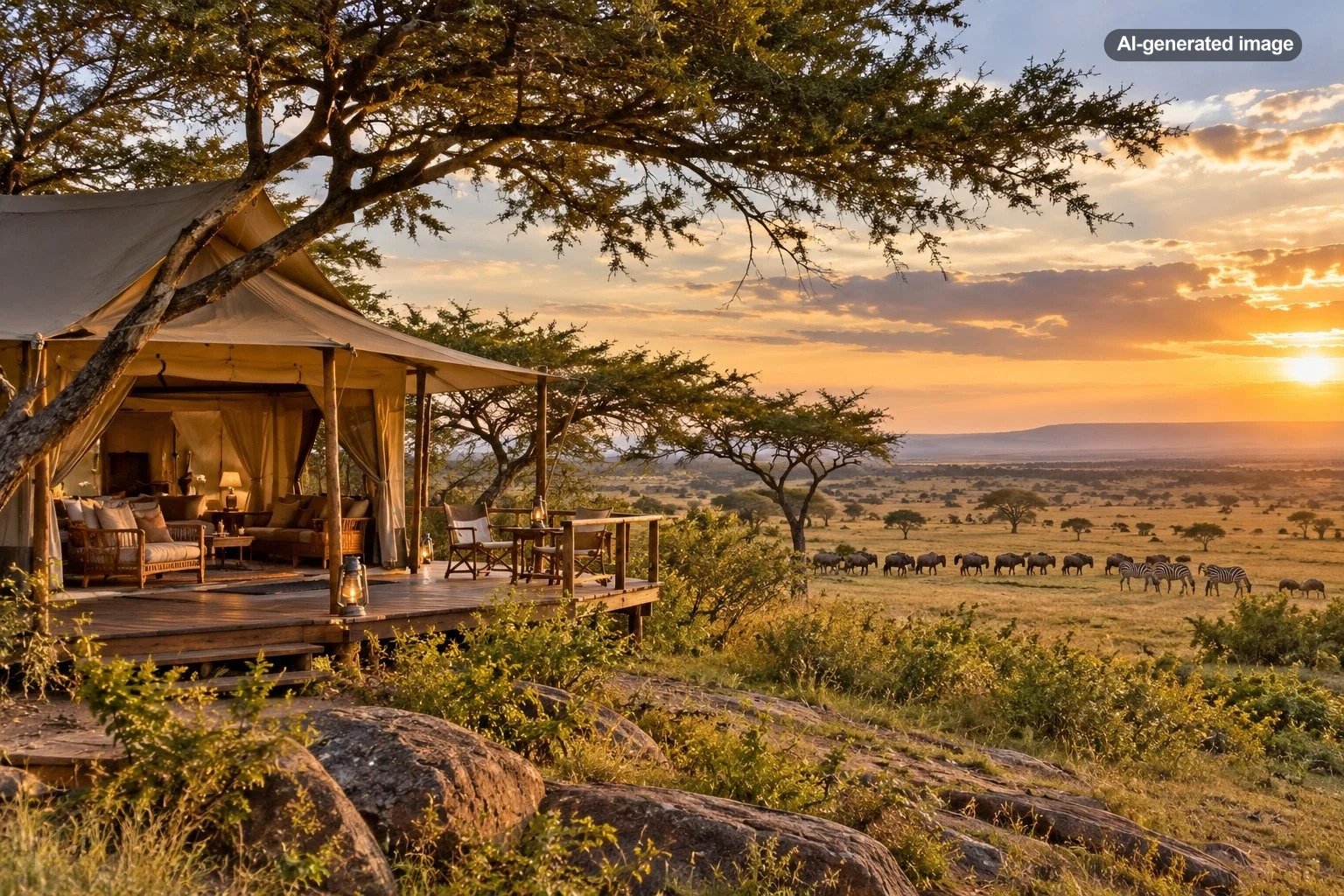
Mobile or seasonal camps are designed to operate in different migration areas during different parts of the year. Their appeal is straightforward: instead of expecting wildlife to remain near the accommodation, the accommodation strategy is built around broad seasonal animal movement.
Neither format is automatically better. A mobile camp may appeal strongly to a traveler whose trip is centered almost entirely on migration viewing. A permanent camp may be preferable for someone who wants a broader safari experience involving resident wildlife, varied landscapes, or a less migration-dependent itinerary.
Do not choose a camp solely for a possible river crossing
River crossings are among the most widely photographed elements of the migration, which can create unrealistic expectations about how frequently travelers witness them. The animals do not cross according to a published schedule. Herds can gather near a river without crossing immediately, and conditions can change quickly.
If river-country wildlife is your priority, choose a camp that gives you a sensible opportunity to explore the relevant area over several days. Then treat an actual crossing as a possible highlight rather than the minimum requirement for a successful safari.
This approach also improves the rest of the trip. Waiting for one specific event can consume valuable game-drive time. A strong guide may instead recommend following predators, locating large concentrations of wildebeest and zebra, exploring different habitats, or returning to a promising area when conditions change.
Ask how much driving is required each day
Two camps can both be marketed as convenient for the migration while creating very different daily routines. One may put guests close to productive wildlife areas, while another may require substantial driving before meaningful viewing begins.
Before booking, ask where game drives usually go during your travel period and how much time guests commonly spend reaching those areas. The goal is not necessarily to minimize every drive. Longer drives can be rewarding when they cross wildlife-rich country. The issue is whether you are consistently using prime safari hours simply to commute between camp and the area you came to see.
Photographers and travelers staying only a few nights should pay particular attention to this distinction. Convenient access can create more opportunities to respond when guides receive information about changing wildlife activity.
Give yourself enough nights for nature to be unpredictable
A short stay places more pressure on every game drive. If the animals are dispersed, weather changes, or the most active wildlife happens to be farther away, there is little time to adapt.
Where the budget and itinerary allow, spending several nights in a migration-focused area gives guides more opportunities to work with changing conditions. It also reduces the temptation to race between sightings simply because the traveler feels that every famous migration moment must happen immediately.
For longer safaris, another useful approach is to split the trip between two complementary areas rather than expecting one camp to provide every experience. This can broaden the landscapes and wildlife encountered while reducing dependence on a single forecast about herd movement.
Evaluate the guiding and game-drive strategy
The camp’s position is only part of the equation. A knowledgeable guide who understands local animal movement, road conditions, recent sightings, and alternative wildlife areas can make an enormous difference when the herds are not where visitors expected them to be.
Ask whether game drives are generally shared or private, how flexible departure and return times can be, and how the camp handles days when wildlife activity shifts farther from its usual area. The answers can reveal more about the actual safari experience than a description of the tent, lounge, or dining area.
Travelers with specialized priorities should be particularly specific. Serious photographers may value the ability to spend extended time at one sighting. Families may prioritize manageable drive lengths and a predictable daily rhythm. Travelers who dislike rushed schedules may prefer a camp that does not treat every game drive as a race toward the latest reported herd location.
What travelers often overlook
Migration proximity is not the same as wildlife quality. A camp can be away from the largest migratory concentration and still offer excellent viewing of resident animals. Conversely, being near thousands of wildebeest does not guarantee a dramatic encounter every hour.
Camp atmosphere matters more on a multi-night stay. Once location requirements are satisfied, consider privacy, camp scale, dining arrangements, noise, daily schedule, and the style of hosting you prefer. These factors become more noticeable after several days in the bush.
Transfers affect usable safari time. A camp that appears ideal geographically may fit poorly into the larger itinerary if reaching it requires an awkward connection. Consider the entire route through Tanzania or Kenya rather than judging each camp independently.
Flexibility has value. The more narrowly a trip is built around seeing one exact event on one exact day, the greater the chance of disappointment. A safari designed around a rich seasonal wildlife window provides more possible definitions of success.
A practical way to make the final choice
Once you have narrowed the options, compare camps using four questions: Which migration phase does this location suit? How much territory can guides reasonably explore from the camp? What happens if the herds are farther away than expected? Would I still want to stay here if the migration were not directly outside camp?
A camp that performs well on all four questions is usually a stronger choice than one selected because someone predicted that the wildebeest would arrive on a particular date.
Frequently asked questions
Can you predict the Great Migration months in advance?
You can plan around broad seasonal patterns, but exact herd positions and individual events are not reliably predictable months ahead. Rainfall, grazing, water availability, and animal behavior influence movement.
Is a mobile camp always better for the migration?
No. Mobile camps can be strategically useful because their seasonal locations are chosen around broad migration patterns, but permanent camps may offer excellent resident wildlife, convenient access, or a style of safari that better suits your trip.
How important is it to stay beside the Mara River?
It is important only if river-country viewing is a central priority. Even then, proximity cannot guarantee a crossing. Give yourself multiple game-drive opportunities and choose the area for its broader wildlife value as well.
Should I change travel dates because of a recent migration report?
Be cautious about rebuilding an entire trip around a short-term herd update. Migration conditions can continue changing, and logistics elsewhere in the itinerary may become less convenient. Broad seasonal positioning is generally more useful than reacting to one recent sighting.
What is the simplest rule for choosing a migration camp?
Choose a camp that is well positioned for the broad migration phase you want, provides access to multiple wildlife areas, and would still deliver a rewarding safari if nature does not follow the itinerary you imagined.