Are Cruise Cabins Near the Medical Center Quiet or Busy?
Cabins near a cruise ship’s medical center are not automatically busy or noisy. In many cases, the medical center generates less routine passenger traffic than elevators, stairwells, theaters, dining venues, kids’ clubs, or major outdoor decks. The important distinction is whether your cabin is merely on the same deck as the medical facility or directly beside its entrance, a crew access door, or a corridor used for medical operations.
For most travelers, proximity to the medical center is a secondary cabin-location concern rather than a reason to reject an otherwise good stateroom. Light sleepers, however, should examine the exact deck plan rather than relying on the words near the medical center alone.
Quick answer: usually quieter than you might expect
- Medical centers generally do not create the constant foot traffic associated with major public venues.
- Routine visits tend to be concentrated around scheduled consultation periods, while medical teams remain available for urgent situations.
- A cabin directly beside the entrance can experience more conversations, doors opening, or occasional activity than one farther down the same corridor.
- Emergency activity is possible at any hour, so travelers who are exceptionally sensitive to unexpected nighttime noise may prefer additional separation.
- The spaces above, below, and across from the cabin may matter as much as the medical center itself.
Why the medical center is different from a typical busy cruise venue
A medical center serves an important operational function, but it is not designed as a gathering place. Passengers normally go there because they need care, not because they are passing through on the way to entertainment, dining, shopping, or an outdoor deck.
That difference can make nearby corridors comparatively calm for long stretches. Carnival, for example, publishes routine medical-center office periods while keeping medical staff available around the clock for urgent needs. Royal Caribbean and Norwegian Cruise Line likewise describe onboard medical services with medical personnel available for emergencies or care throughout the day. Actual operating procedures vary by cruise line and ship, so published information for your sailing should take precedence over general expectations.
The exact cabin position matters more than the deck number
Two cabins described as being near the medical center can have very different noise profiles. One might be several doors away in an ordinary passenger corridor. Another might face the entrance or sit beside a crew-only doorway.
Cabins several doors away
This is often the least concerning arrangement. You may receive the convenience of a relatively low-traffic part of the ship without being immediately exposed to people entering and leaving the facility.
Cabins directly opposite the medical center
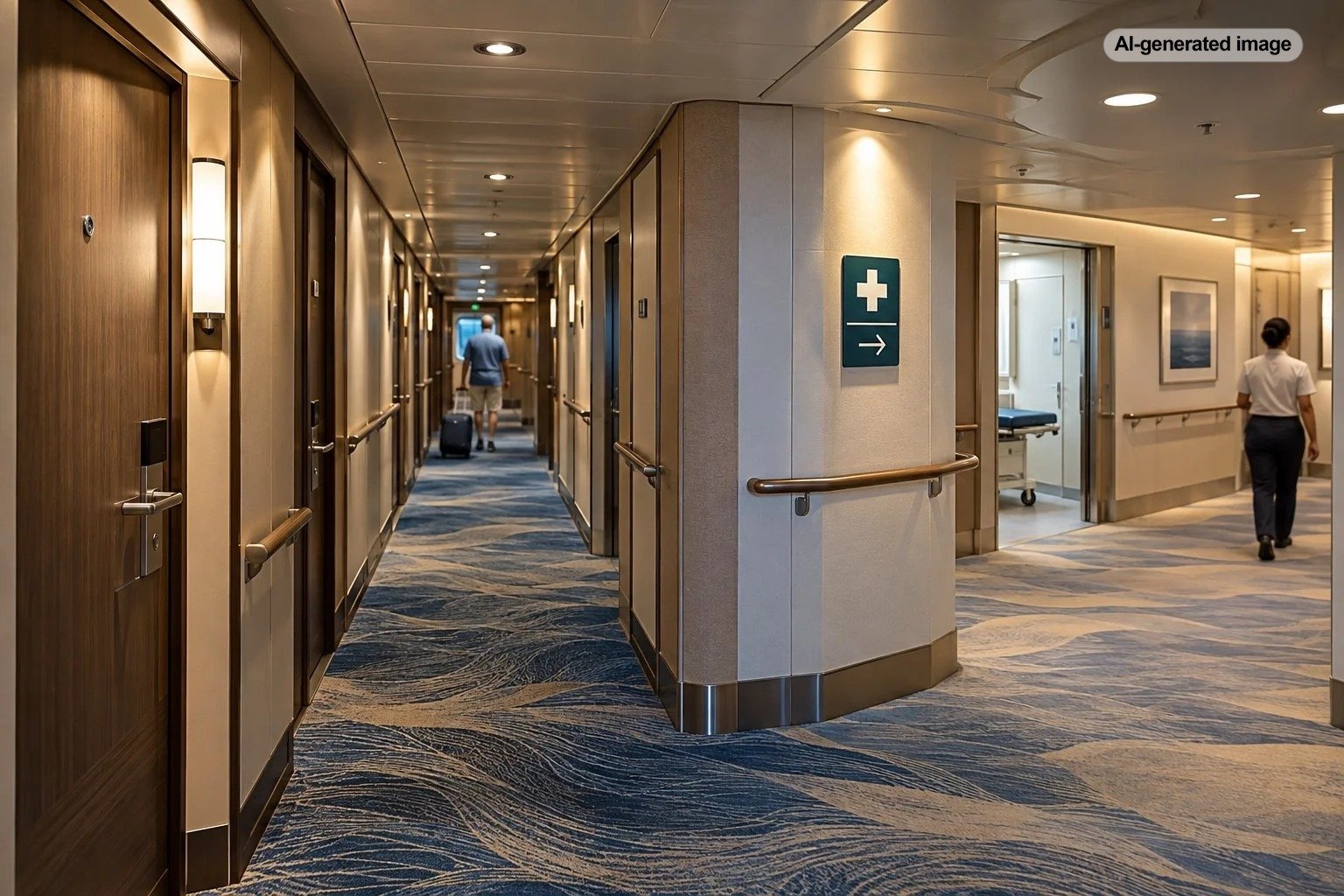
These deserve more scrutiny. Conversations in the hallway, doors opening, passengers waiting briefly, and staff movement may be more noticeable simply because the activity occurs immediately outside the cabin.
Cabins beside crew or service access
This can matter more than the medical-center label itself. Service doors can introduce intermittent staff movement, carts, equipment handling, or door noise. A deck plan may not reveal every operational detail, so a cabin surrounded primarily by other staterooms is generally easier to evaluate than one bordering several non-passenger spaces.
Could emergency activity wake you at night?
It is possible, but it should not be treated as a predictable nightly problem. Shipboard medical teams must be able to respond when urgent situations arise, including outside routine consultation periods. An unusual late-night event could therefore bring footsteps, voices, doors, or operational movement into an otherwise quiet corridor.
That is different from choosing a cabin below a nightclub or near a heavily used stairwell, where the noise source may recur every day. Medical-center noise is better thought of as potentially unpredictable rather than continuously busy.
If uninterrupted sleep is your highest cabin priority, the conservative choice is a stateroom surrounded by other cabins on the same deck and on the decks immediately above and below.
Check what is above and below the cabin
A common cabin-selection mistake is focusing only on what appears beside the room. Vertical neighbors frequently deserve equal attention.
For example, a cabin several doors from a medical center might still sit underneath a working area, public deck, theater-related space, galley, or another facility capable of producing more consistent sound. Conversely, a cabin near the medical center that has passenger cabins above and below may prove relatively sheltered.
When reading a deck plan, compare at least three decks: the cabin’s own deck, the deck immediately above, and the deck immediately below. Align stairwells and elevator shafts so you do not accidentally compare the wrong section of the ship.
Medical-center proximity can have advantages
Not every traveler should view this location negatively. A cabin near the medical center may appeal to someone traveling with a health concern, a family member who could need care, or a traveler who simply values knowing where the facility is located.
There can also be an indirect benefit if the medical area is positioned away from the ship’s busiest entertainment zones. That does not guarantee quiet, but it illustrates why cabin selection should be based on the surrounding deck layout rather than assumptions about a single nearby facility.
Who should be more cautious about booking nearby?
Very light sleepers may prefer additional distance because even occasional hallway activity can be disruptive when it happens unexpectedly. The same applies to travelers who become easily awakened by doors, voices, or rolling equipment.
Families with young children who nap may also value a cabin deeper inside a residential corridor, particularly if predictable daytime quiet is more important than convenient access to the medical center.
Travelers who want to be close to medical assistance, on the other hand, may consider proximity useful. The appropriate balance depends on whether convenience or maximum separation from operational spaces matters more to your trip.
How to evaluate the cabin before booking
Start with the cruise line’s current deck plan for the exact ship. Do not rely only on a generic description such as forward, midship, or lower deck.
- Locate the medical center entrance, not merely the labeled medical area.
- Count how many stateroom doors separate your cabin from that entrance.
- Look for nearby elevators, stairwells, blank operational spaces, and crew-access areas.
- Check the decks above and below.
- Compare another available cabin in a passenger-only corridor if quiet is especially important.
Affiliate disclosure: HotelInfo.com may earn a commission when you book or purchase through links on this page. This does not affect the price you pay. Learn more.
If you are still comparing ships, sailing dates, or cabin choices, you can compare available sailings with Expedia. Cabin inventories, fares, itineraries, taxes, gratuities, onboard charges, and cancellation terms vary, so confirm the specific details shown for your sailing before booking.
What travelers often overlook
The phrase near the medical center can sound more concerning than the actual layout warrants. What matters is the pathway people use. If passengers reach the medical center from a stairwell on the opposite side, your nearby cabin may see little related traffic. If the entrance opens directly into your corridor, the effect can be different.
Also consider the cabin’s relationship to elevators. A medical center located near an elevator bank does not necessarily mean the medical center is creating the traffic. The elevator lobby itself may be the more important source of conversations and movement.
Finally, remember that deck plans simplify operational spaces. They are excellent for identifying obvious adjacency, but they cannot guarantee a particular noise level on a future sailing.
FAQ
Are cruise ship medical centers open all night?
Routine consultation hours may be limited, but major cruise lines maintain medical personnel who can respond to urgent situations outside normal office periods. Procedures differ by cruise line and ship.
Is a cabin directly across from the medical center a bad choice?
Not necessarily, but it carries more potential for intermittent hallway activity than a cabin several doors away. Light sleepers may prefer greater separation.
Are lower-deck cabins near medical facilities generally quiet?
They can be, but deck level alone does not determine noise. Nearby elevators, service spaces, machinery, public areas, and the spaces above or below the cabin all matter.
Should I avoid every cabin on the medical-center deck?
No. Being on the same deck does not mean you are beside the facility. A cabin well down the corridor may have little practical connection to medical-center traffic.
What is the safest choice if quiet is my priority?
For noise avoidance, a straightforward strategy is to choose a cabin in a passenger-stateroom corridor with other cabins beside it and passenger cabins directly above and below. That does not guarantee silence, but it reduces exposure to obvious public and operational spaces.