How to Tell If a Cruise Cabin Has a Pullman Bed Before You Book
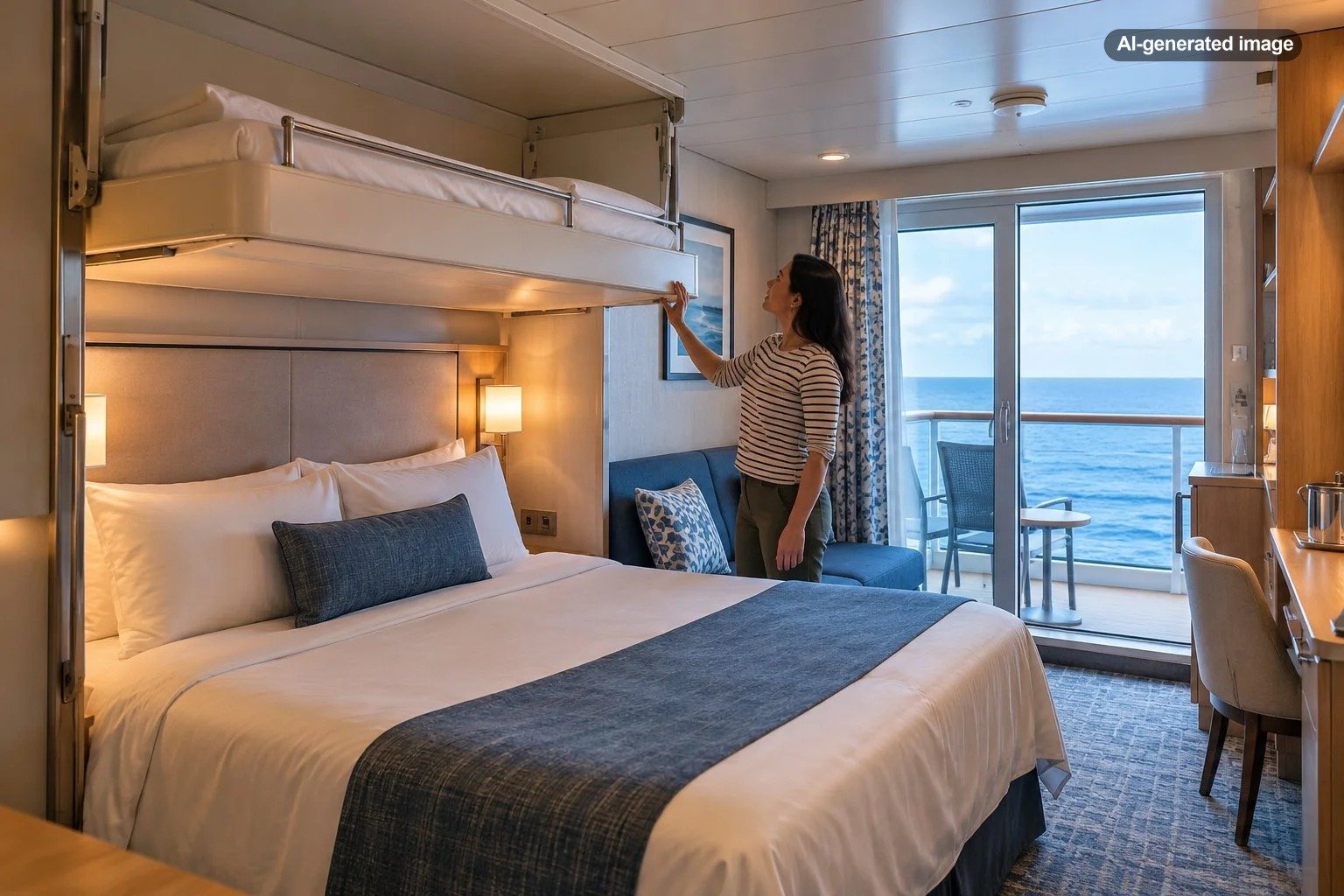
A Pullman bed is an extra berth that typically folds down from a wall or ceiling area in a cruise cabin, allowing the same stateroom to accommodate an additional passenger without permanently occupying floor space. The most reliable way to determine whether a cabin has one before booking is to check the exact stateroom number against the cruise line’s current deck plan, read the symbol legend, and confirm the listed sleeping configuration. Do not assume that every cabin in the same category has identical extra beds.
This distinction matters most when three or four people will share a cabin. A room advertised for four guests might use Pullman beds, a sofa bed, a combination of the two, or another configuration depending on the ship and specific stateroom.
Quick answer: how to identify a Pullman bed
- Find the ship’s deck plan for the sailing period you are booking.
- Locate the exact cabin number rather than relying only on the cabin category.
- Check the deck-plan legend for symbols indicating Pullman beds, upper berths, or third- and fourth-person beds.
- Read the cabin’s bed description for terms such as Pullman bed, fold-down bed, upper berth, or upper bed.
- If the configuration remains unclear, ask the cruise line or booking provider to confirm the sleeping arrangement for that exact stateroom number.
Start with the exact cabin number, not just the category
Cruise cabin categories can contain rooms with different layouts. Two staterooms sold under the same broad category may have different maximum occupancies or different arrangements for the third and fourth passengers.
For example, one cabin in a category might sleep four using two fold-down Pullman beds, while another could use a sofa bed. Some rooms may sleep only two even though they share a similar location, size, or descriptive category with higher-occupancy cabins.
That is why the cabin number is the key piece of information. Once you have it, locate that individual room on the ship’s official deck plan and compare its symbols with the legend.
Learn the symbols on the cruise line’s deck plan
Deck plans often use small symbols to identify cabins with special configurations. Depending on the cruise line and ship, a symbol may indicate that a room accommodates a third passenger, a third and fourth passenger, connecting cabins, accessible accommodations, or another feature.
A Pullman bed may not be drawn as a literal bunk on the deck plan. Instead, the legend may state that cabins carrying a particular symbol have an additional Pullman berth or additional upper berths available.
Always read the legend that accompanies the specific deck plan rather than assuming a symbol means the same thing across cruise lines. Even within one cruise company, ship classes and deck-plan formats can differ.
Look for several different names for the same basic idea
The word Pullman is common in cruising, but it is not the only terminology you may encounter. Cruise lines and booking systems may describe similar sleeping arrangements as an upper berth, upper bed, fold-down bed, fold-down Pullman, bunk, or third- or fourth-person berth.
The important distinction is whether the additional bed deploys above another sleeping or living area rather than unfolding across the cabin floor. If the description merely says that a stateroom sleeps three or four guests, that does not tell you which type of extra bed is provided.
Maximum occupancy does not reveal the bed configuration
A cabin listed for four people confirms that four passengers can be accommodated when the room is booked accordingly, but it does not necessarily mean there are two Pullman beds.
Several arrangements are possible. A cabin could have the main bed plus two Pullmans, the main bed plus a double sofa bed, the main bed plus one sofa bed and one Pullman, or another ship-specific setup. Larger family accommodations can use still different arrangements.
This is especially important when travelers have a strong preference about who sleeps where. A family expecting two separate upper beds may be disappointed to discover that the additional sleeping space is a shared sofa bed instead.
Check the deck plan for the correct sailing period
Cruise lines sometimes publish more than one deck-plan version for the same ship, particularly when future sailings follow a refurbishment or configuration change. The booking date itself is less important than the dates for which the deck plan applies.
If several plan versions are available, choose the one covering your sailing. This helps avoid relying on an older cabin map or a third-party image that may no longer represent the configuration being sold.
Why Pullman beds can affect how a cabin feels
Pullman beds are useful because they add sleeping capacity without permanently consuming valuable cabin floor space. During the day, they can generally be stowed so that the room functions more like a conventional cabin.
When deployed, however, they change how the room is used. An upper berth can sit over part of the main bed or another area, depending on the configuration. The person using it will also need to climb into the berth, commonly using a ladder or similar access arrangement.
For families with children or adults who are comfortable with an upper berth, that can be perfectly practical. Travelers who dislike climbing, have limited mobility, or simply want every passenger sleeping at floor level may prefer a cabin with a sofa bed or a different room arrangement.
Do not assume the cruise line will use every available berth
A room may physically contain a Pullman bed even when only two people occupy it. Conversely, finding a photograph showing a Pullman in a cabin that looks similar to yours does not prove your exact room contains one.
Cruise ships frequently contain variations within what appears to be the same cabin family. Photographs are useful for understanding what a Pullman looks like, but the exact cabin number and official sleeping configuration are stronger evidence than a generic promotional image.
Verify the arrangement before paying for a cabin you cannot easily change
If sleeping configuration is important to your trip, confirm it before completing a restrictive booking. This is particularly worthwhile for families, groups of three or four, travelers who need separate beds, and anyone who would have difficulty using an elevated berth.
Affiliate disclosure: HotelInfo.com may earn a commission when you book or purchase through links on this page. This does not affect the price you pay. Learn more.
When comparing ships, itineraries, sailing dates, and available cabin categories, you can also browse cruises with Expedia. Once you identify a possible sailing, verify the exact stateroom configuration against the cruise line’s current deck plan before making the sleeping arrangement part of your decision.
A practical verification sequence before booking
For the clearest answer, work through the cabin information in a specific order:
- Confirm the ship and sailing. Similar ship names or different vessels within the same fleet can have very different layouts.
- Find the exact room number. If the booking system does not assign a specific cabin yet, you may not be able to verify the final bed configuration.
- Open the applicable deck plan. Make sure its effective dates include your sailing.
- Check the symbol beside the room. Match it with the legend.
- Read the category’s bed description. Look for the number and type of additional berths.
- Confirm directly when necessary. If the deck plan and description leave room for interpretation, ask specifically whether that cabin number contains a Pullman bed and how many.
What travelers often overlook
One of the easiest mistakes is choosing a room based only on maximum occupancy. Sleeping four and having four conventional beds are not the same thing. Another common mistake is studying a cabin tour online without checking whether the room number in the video matches the room being booked.
Also consider the sleeping arrangement alongside everyday cabin movement. A setup that works comfortably for parents and two school-age children may be less appealing for four adults. The cabin may technically accommodate everyone while still feeling more constrained once all nighttime berths are deployed.
If the Pullman arrangement is undesirable, compare other cabins before changing to an entirely different ship or itinerary. A nearby stateroom category may offer a sofa-bed configuration, a larger family layout, connecting cabins, or another arrangement that better fits the group.
Frequently asked questions
Is a Pullman bed the same as a sofa bed?
No. A Pullman is generally an elevated berth that folds down from a wall or ceiling area. A sofa bed converts seating at floor level into sleeping space.
Does a cabin that sleeps four always have two Pullman beds?
No. Four-person cabins can use several combinations of main beds, sofa beds, Pullmans, and other sleeping arrangements. Check the exact cabin configuration.
Can I identify a Pullman bed from a cabin photo?
Sometimes, but photographs should not be your only evidence. Generic cabin images may represent a category rather than the exact stateroom you are considering.
What if the booking website does not show the bed configuration?
Check the cruise line’s deck plan and cabin description directly. If the information is still ambiguous, contact the cruise line or booking provider and ask about the exact stateroom number.
Should I avoid a Pullman bed?
Not necessarily. Pullmans are an efficient way to accommodate additional passengers while preserving daytime floor space. The better question is whether an elevated berth suits the age, mobility, comfort preferences, and sleeping needs of the person who will use it.
Ultimately, the cabin number and current deck plan are more useful than the broad room category. Confirm those details before booking, and you can know whether a Pullman bed is part of the sleeping arrangement instead of discovering it only after boarding.