Swim-Up Bar Room vs. Quiet Pool Room: Which Is Better at an All-Inclusive Resort?
A swim-up bar room is usually better for travelers who want a lively, social vacation and expect to spend much of the day around the resort pool. A quiet pool room is generally the stronger choice for travelers who prioritize rest, privacy, calmer afternoons, and a terrace that feels less connected to the resort’s main activity zone. Neither is automatically better: the right room depends on whether direct access to the action is a benefit or a drawback.
The important detail is that room names are not standardized across all-inclusive resorts. A room marketed as swim-up, swim-out, pool access, or poolside may have a very different layout from a similarly named room elsewhere. Likewise, a quiet pool may be adults-only, relaxation-oriented, located in a separate building, or simply less active than the main pool. Before booking, compare the actual resort map and room description rather than relying on the category name alone.
Quick answer: which room should you choose?
- Choose the swim-up bar room if easy access to drinks, music, conversation, and daytime pool activity is part of the vacation you want.
- Choose the quiet pool room if you expect to read, nap, work remotely, enjoy slower mornings, or spend substantial time relaxing on your terrace.
- Choose carefully if you are a light sleeper. A room near a pool bar can remain active even when you are inside the room.
- Do not assume direct pool access means privacy. Shared water, neighboring terraces, walkways, and passing swimmers can make some swim-up rooms surprisingly social.
- Check the exact building location. Distance from entertainment areas, restaurants, walkways, and the main pool can matter as much as the room type itself.
Swim-up bar rooms put convenience and atmosphere first
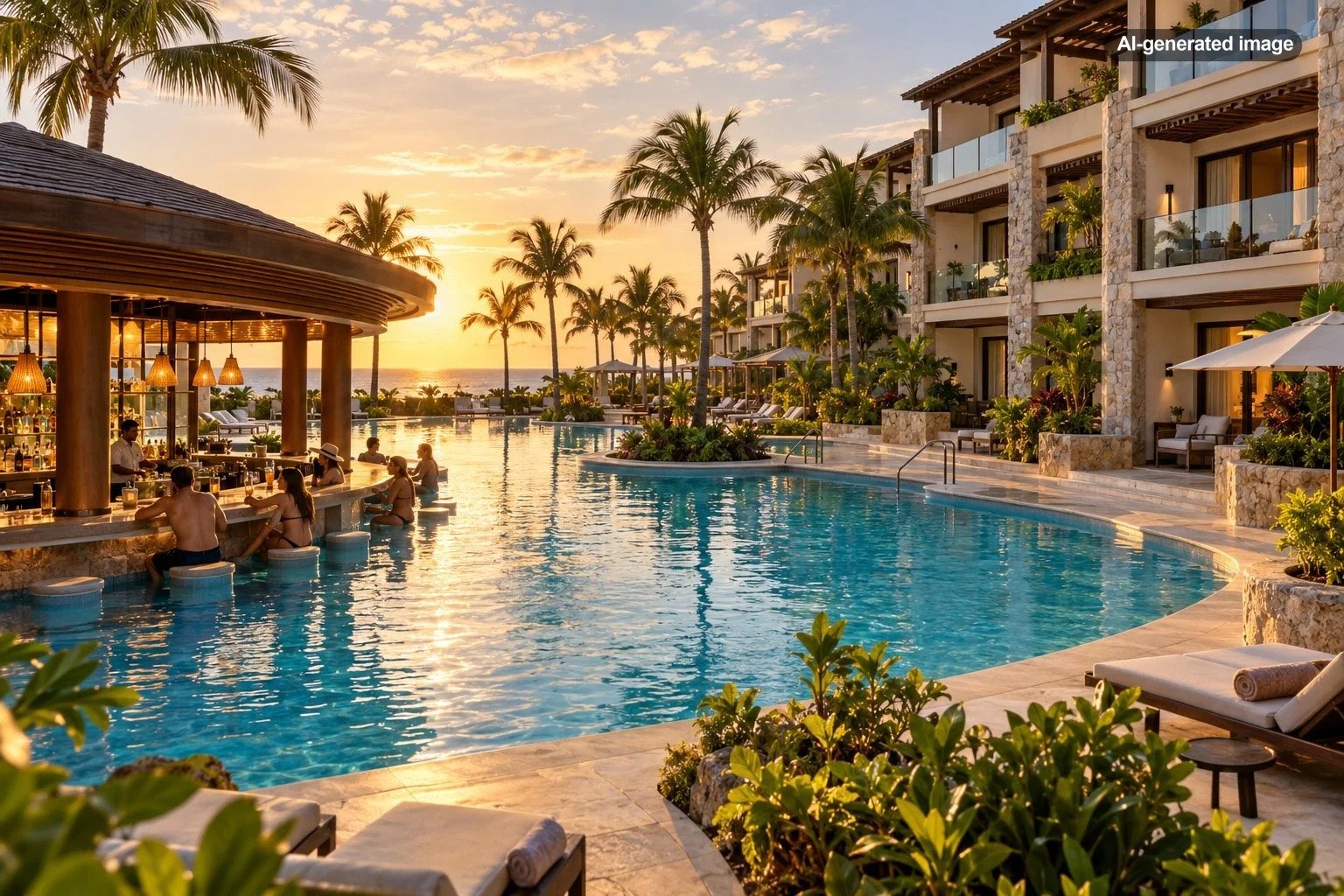
A swim-up bar room places you close to one of the resort’s most social areas. Depending on the property, you may be able to step from your terrace into a pool connected to the bar area, or the room may simply sit beside the pool where the bar is located. Either arrangement can make the vacation feel effortless if your ideal day involves swimming, ordering a drink, meeting other guests, and returning to your room without crossing the resort.
This room type can be especially appealing to couples or groups who view the pool scene as a central part of the trip. You can change clothes, retrieve sunscreen, take a short break, or return to the water with minimal effort. At a sprawling resort, that convenience can be more valuable than it initially sounds.
The tradeoff is that convenience works in both directions. The activity you can reach easily can also reach your room. Conversations, splashing, music, organized games, bartending activity, and guests moving through the pool may all become part of the room’s daytime environment.
Quiet pool rooms are better when the room itself is part of the vacation
A quiet pool room makes more sense when you want the room and its immediate surroundings to function as a retreat. These rooms may face a smaller relaxation pool, sit in a less central section of the resort, or simply be separated from the main entertainment area.
For travelers who like a slow breakfast on the terrace, an afternoon nap, a book beside the pool, or a peaceful hour between activities, that separation can significantly improve the experience. It can also be useful on longer stays, when constant proximity to the busiest pool area may become less appealing after the first few days.
The downside is convenience. A quieter location can mean a longer walk to the main bar, entertainment, restaurants, beach access, or evening activity. At compact resorts the difference may be trivial, but at a large all-inclusive property it can affect how often you move back and forth during the day.
Noise is the biggest practical difference
Noise near a swim-up bar is not limited to music. Even without a DJ or organized entertainment, social pools generate conversation, laughter, splashing, glassware or cup handling, staff activity, and people moving between loungers and the water. Rooms facing the central section of a pool can experience more passing activity than rooms at the end of a swim-up block.
A quiet pool generally reduces those variables, but the label still deserves scrutiny. A relaxation pool beside a restaurant terrace, service corridor, pedestrian path, or evening venue may not remain quiet throughout the entire day. Resort maps, recent wide-angle guest photos, and direct questions to the property can help reveal what sits around the pool.
Privacy can be more complicated than the room photos suggest
Swim-up rooms often look private in tightly framed promotional photographs because the terrace appears to have its own section of water. In practice, the pool may be shared with several neighboring rooms. Other guests might swim directly past your terrace, and neighboring patios may be separated by only landscaping or partial dividers.
A quiet pool room is not automatically private either. Ground-floor accommodations can face paths or shared pool decks, while upper floors may overlook terraces below. Travelers who care strongly about privacy should distinguish between exclusive pool access, direct pool access, and visual privacy. Those are three different features.
Compare how you will actually use the resort
| Consideration | Swim-up bar room | Quiet pool room |
|---|---|---|
| Atmosphere | Social and active | Calmer and more relaxed |
| Daytime noise | Usually higher near the bar and activity areas | Usually lower, depending on surrounding facilities |
| Pool convenience | Excellent for frequent pool and bar use | Good for relaxing, but potentially farther from the main pool |
| Privacy | Can be limited by shared water and passing guests | Often calmer, but layout still matters |
| Best fit | Social couples, groups, pool-focused vacations | Couples seeking quiet, readers, light sleepers, slower-paced trips |
Think about morning and evening, not just the afternoon
Booking photos naturally encourage travelers to imagine peak vacation hours: sunny afternoons, drinks in the pool, and a lively atmosphere. The better test is to picture the room at 8 a.m. and again when you want to relax in the evening.
If you like opening the curtains early and sitting quietly outside with coffee, a room beside an active pool route may feel less peaceful than expected once staff and guests begin moving through the area. Conversely, if you expect to leave the room after breakfast and remain around the main pool most of the day, paying for a remote quiet-pool location may provide less benefit.
Room position within the same category can change the experience
Two rooms sold under the same category can have meaningfully different surroundings. One swim-up room might sit at the center of the pool near the bar, while another is positioned at the far end of the same waterway. One quiet-pool room might face the water directly, while another sits beside a walkway connecting guest buildings.
When room placement matters, ask the resort specific questions rather than simply requesting a quiet room. Useful questions include whether the pool connects to the main activity pool, whether the bar can be reached directly from the water, whether organized entertainment occurs nearby, whether a public walkway passes the terrace, and whether the room block is near evening entertainment.
What travelers often overlook
Ground-floor rooms can trade views for access
Direct pool access almost always places the room near ground level. That can be convenient, but travelers who value elevated ocean, garden, or resort views may prefer a balcony room instead. Decide whether stepping directly into the water matters more than having a broader outlook.
Shade can affect how appealing the terrace feels
Building orientation, landscaping, and neighboring structures can change how much direct sun reaches a pool-access terrace. This is not automatically good or bad. Some travelers appreciate a shaded terrace in a hot climate, while others specifically want sun exposure. It is worth examining the building orientation rather than assuming every swim-up section receives similar light.
The main pool may still be where you spend most of your time
A premium pool-access room has less value if your routine will revolve around the beach, excursions, restaurants, or the main entertainment pool. Before choosing the upgrade, estimate how many hours you realistically expect to spend using the pool immediately outside the room.
Which room is better for couples?
For a couple seeking conversation, drinks, music, and a lively resort atmosphere, the swim-up bar room can be the more enjoyable choice. For a honeymoon, anniversary, or relaxation-focused trip where uninterrupted time together matters more, a quiet pool room may be preferable. Couples seeking genuine seclusion should also investigate whether a private-pool or plunge-pool category is available, since a shared swim-up pool may offer less privacy than its photographs suggest.
Which room is better for a longer all-inclusive stay?
On a short, energetic getaway, immediate access to the social pool can feel like an advantage from morning until afternoon. On a longer vacation, some travelers place increasing value on having a calm space away from the resort’s busiest areas. If the trip lasts several days and the room will be used for more than sleeping and changing clothes, the quieter option deserves extra consideration.
Questions to ask before booking
- Does this room’s pool connect directly to the main pool or swim-up bar?
- Is the pool shared with other room terraces?
- Are there scheduled activities or music in this pool area?
- Does a public walkway run between the room and the pool?
- How far is this building from restaurants, the beach, and evening entertainment?
- Can the resort note a preference for a room at the quieter end of the building?
FAQ
Are swim-up bar rooms noisy at night?
Not necessarily. The answer depends on the resort’s bar hours, entertainment layout, walkways, and pool operations. A busy daytime pool can become quiet in the evening, while another may sit close to nightlife. Ask about the specific location rather than assuming.
Does a swim-up room have a private pool?
Often it does not. Many swim-up or swim-out rooms provide direct access to water shared with neighboring rooms. A private-pool room normally refers to a pool reserved for one accommodation, although visual privacy can still vary.
Is a quiet pool room always far from everything?
No. Some resorts place quiet pools only a short walk from restaurants and the beach. At larger properties, however, choosing a calmer area can mean being farther from the resort’s main activity hub.
Is a swim-up bar room worth paying more for?
It can be if you will repeatedly use the direct pool access and enjoy being close to the social atmosphere. If you expect to spend most of your time at the beach, on excursions, or around a different pool, the room’s main advantage may go underused.
The better room depends on what you want outside your door
The simplest way to choose is to decide what you want to encounter when you open the terrace door. If the answer is music, conversation, drinks, and immediate access to the resort’s social center, the swim-up bar room is likely the better fit. If the answer is quiet water, fewer interruptions, and a more restful place to spend time between activities, choose the quiet pool room.
Then verify the exact layout. At an all-inclusive resort, location within the property can matter just as much as the room category printed on the reservation.