How to Choose a Safari Camp With Night Drives
Choosing a safari camp with night drives requires more than finding a property that lists an evening activity. The important questions are whether vehicles may remain out after dark, how often the drives operate, who leads them, how many guests share a vehicle, and whether the surrounding habitat makes nighttime exploration genuinely worthwhile.
A well-run night drive can reveal a side of the landscape that is largely invisible during the day. It may bring opportunities to observe nocturnal mammals, predators becoming active, owls, reptiles, insects, and smaller species that receive less attention on conventional game drives. Sightings are never guaranteed, however, and the quality of the experience depends heavily on access, guiding, and responsible spotlight use.
Quick answer
- Confirm that true after-dark driving is permitted. A sunset drive that returns shortly after dusk is not necessarily a full night drive.
- Ask whether the activity is included. Some camps include night drives in the stay, while others charge separately or require advance reservations.
- Compare vehicles and group sizes. Fewer rows and fewer passengers generally make it easier to hear the guide and follow sightings.
- Check the schedule. Night drives may run daily, only on request, or only when minimum participation requirements are met.
- Evaluate the entire safari program. Night access is valuable, but it should not compensate for weak daytime guiding, inconvenient logistics, or an unsuitable camp atmosphere.
Start with the reserve’s access rules
The first distinction is between camps in private reserves or conservancies and accommodations inside or near national parks. Rules vary by destination, but private concessions often have greater flexibility to drive after dark. In some national parks, ordinary visitor vehicles must return before gates close, while authorized guided vehicles can continue under specific conditions.
Do not assume that every camp in a region offers the same access. Two properties separated by a short distance may operate under different land-use agreements. One may conduct extended night drives on its own concession, while another may offer only a short spotlighted return to camp after sunset.
Ask the camp to describe a typical evening in plain terms: when the vehicle leaves, approximately when it returns, where it may travel, and how much of the activity normally takes place in full darkness. This is more revealing than an amenities list that simply says “night drives available.”
Distinguish a night drive from a sunset drive
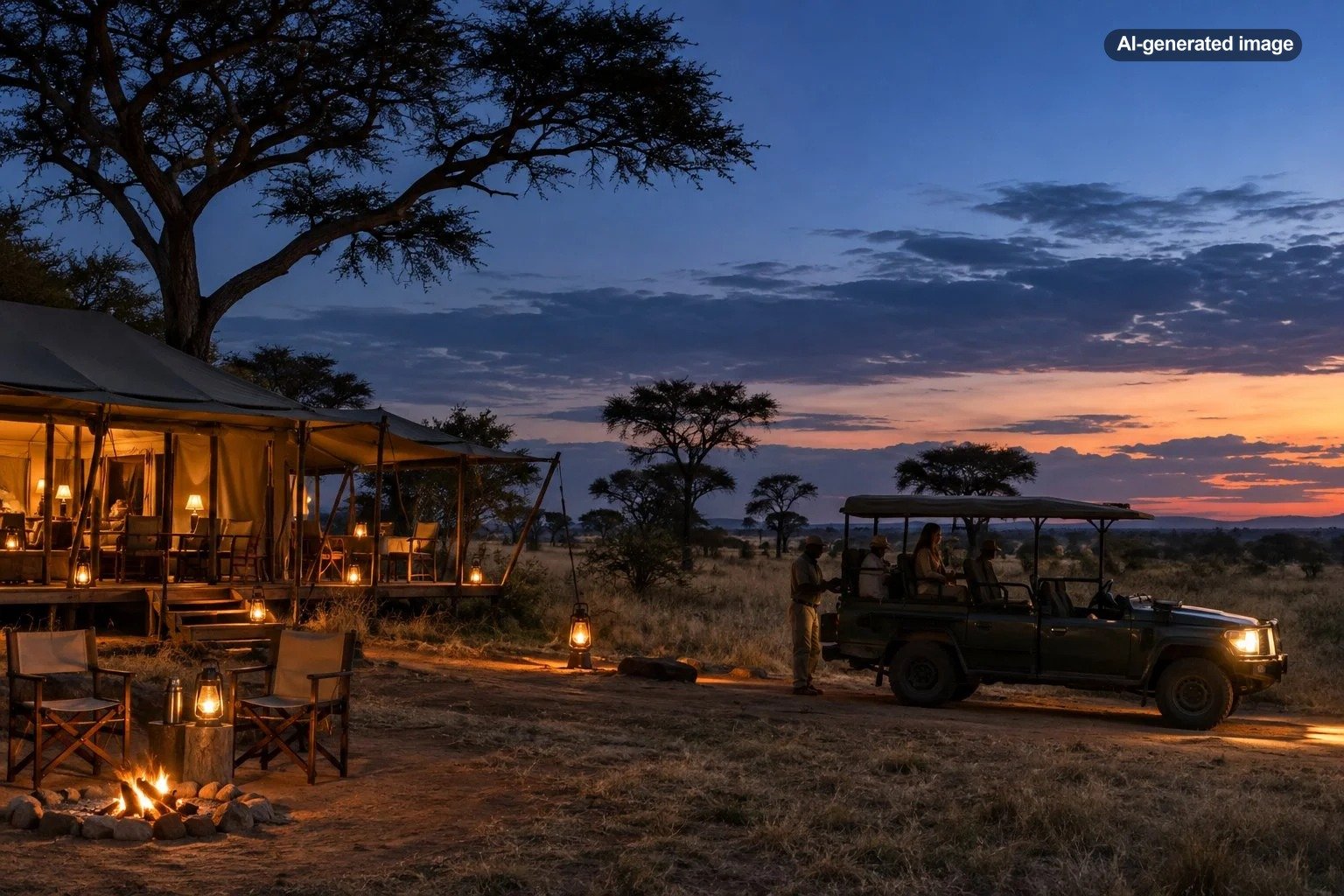
A sunset drive usually begins in daylight and bridges the transition into evening. It can be an excellent experience, especially when temperatures fall and animals become more active. Still, only the final portion may occur after dark.
A dedicated night drive normally departs after dinner or once darkness has settled. It may focus more deliberately on nocturnal behavior and smaller species. Some camps offer both formats, while others use the terms interchangeably.
Travelers primarily interested in stars, night sounds, and the atmosphere of the bush may be satisfied with either option. Those hoping for a focused nocturnal wildlife experience should ask how long the vehicle ordinarily remains out after nightfall. Treat any answer as a description of the program, not a promise of particular sightings.
Look closely at the guiding team
At night, guide quality matters even more than it does during the day. The guide or tracker must interpret sounds, tracks, movement, and subtle changes in animal behavior while also navigating in limited visibility. Strong guides know when to switch off the engine, when to wait quietly, and when an animal should be left undisturbed.
Ask whether drives use both a guide and a tracker or spotlight operator. A two-person team is not automatically superior, but it can divide the work of driving, scanning, interpreting, and managing the light. It may also allow the guide to give guests more attention.
Responsible spotlight technique is another useful indicator. Light should not be held directly on sensitive animals for prolonged periods, and guides should respond cautiously when animals show signs of disturbance. A camp that can clearly explain its viewing practices is generally a better choice than one that sells the experience through dramatic predator promises.
Compare vehicle design and passenger numbers
Night drives are less comfortable when too many passengers compete for a narrow field of view. Ask for the maximum number of guests per vehicle and whether every passenger receives an outside seat. A vehicle with three rows may feel very different from one carrying a larger group.
Consider the following practical details:
- Whether vehicles are open-sided or enclosed
- Whether raised seating gives each row a usable view
- Whether blankets or weather protection are normally available
- Whether the vehicle has secure steps and handholds
- Whether private vehicles can be arranged, subject to availability and additional cost
A private vehicle can be worthwhile for photographers, families, and travelers who want flexibility, but it is not essential for everyone. Shared drives can be sociable and substantially more economical. The more important issue is whether the camp limits the group to a size that allows guests to see, listen, and ask questions.
Match the habitat to your interests
Night drives are not interchangeable across habitats. Open savanna may provide longer sight lines, while woodland can produce closer but more fleeting encounters. Arid environments can be rewarding for smaller nocturnal mammals, reptiles, and clear night skies. Riverine areas may offer a different mix of activity around water and dense vegetation.
Rather than asking which camp has the “best” night drives, ask which ecosystem suits your interests. A traveler focused only on large predators may overlook an excellent program centered on nocturnal birds, genets, porcupines, chameleons, or insect life. A knowledgeable camp should explain what is realistically associated with its habitat without guaranteeing a checklist.
Check frequency, availability, and booking terms
Night drives may depend on staffing, weather, season, minimum guest numbers, reserve rules, or vehicle availability. Families should also ask about minimum ages. Restrictions can differ by camp and may apply even when a child regularly participates in daytime drives.
Before confirming a stay, request answers to several specific questions:
- How many nights per week are drives normally offered?
- Must guests reserve before arrival?
- Is the activity included in the accommodation package?
- Is there a minimum or maximum age?
- What happens if weather or operational conditions prevent departure?
- Can the camp arrange a private drive?
Policies and schedules can change, so confirm these details directly with the camp for the dates of the trip. If night drives are a major reason for choosing the property, written confirmation is preferable to relying on a third-party listing.
Consider how the drive fits the daily schedule
A late night drive followed by an early morning departure can make a safari more tiring than expected. This matters particularly on a short stay, when travelers may feel pressure to join every activity.
Ask whether the night drive replaces the usual evening drive, extends it, or operates as a separate departure. Also consider dinner timing. Some camps serve dinner before the activity, some afterward, and others adjust the meal around the group. Travelers with children, medical routines, or early bedtimes should understand that rhythm before booking.
For a stay of three or four nights, having the option to take one night drive may be more valuable than following a mandatory late schedule every evening. Flexible programming allows guests to balance nocturnal viewing with rest and daytime activities.
Evaluate the camp beyond the night-drive label
A night drive is only one part of a safari. Compare the camp’s daytime game-viewing area, guiding approach, transfer logistics, meal schedule, room layout, accessibility, and overall scale. A remote camp with excellent night access may involve more complicated transfers. A larger lodge may offer broader facilities but use bigger vehicles or a more fixed activity schedule.
Travelers who value quiet and personalized guiding may prefer a small camp with fewer vehicles. Families may place greater importance on age-appropriate activities and adaptable meal times. Photographers may prioritize vehicle space and patient guides, while first-time safari travelers may benefit most from a balanced program of morning, evening, and night experiences.
What travelers often overlook
Temperature changes: Open vehicles can become cold after sunset even when afternoons are warm. Conditions vary by season and elevation, so ask the camp what clothing it recommends.
Photography limitations: Night wildlife photography is technically demanding, and flash may be restricted or discouraged. Travelers should not choose a camp on the assumption that every nighttime sighting will produce a usable photograph.
Noise and patience: The experience often involves long periods of listening and scanning. It is better suited to guests who appreciate subtle observation than those expecting continuous action.
Location terminology: A lodge may market access to a famous ecosystem while actually operating outside the core wildlife area. Clarify exactly where drives occur and whether reaching the game-viewing zone requires a transfer.
Frequently asked questions
Are night drives worth it on a first safari?
Usually, if the camp offers a well-guided program and the schedule leaves enough time for daytime drives. Night drives complement rather than replace the broader safari experience.
Do night drives guarantee predator sightings?
No. Predators may be more active after dark, but wildlife movements are unpredictable. A responsible operator will emphasize the ecosystem and the experience rather than promise a particular animal.
How many night drives should a traveler book?
One drive is a sensible starting point on a short stay. Travelers especially interested in nocturnal wildlife may want additional opportunities, provided the late schedule does not interfere with the rest of the safari.
Are night drives suitable for children?
That depends on the camp’s minimum-age policy, drive length, vehicle setup, and the child’s ability to remain seated and quiet. Families should confirm the exact policy before booking.
What is the clearest sign of a strong night-drive program?
Look for specific information about access, duration, guides, group size, vehicle design, and wildlife-viewing practices. Clear operational detail is more useful than a long list of animals a traveler might see.
The best choice is the camp that explains the experience clearly
The strongest safari camp is not necessarily the one advertising the longest list of nocturnal animals. It is the one that can clearly explain where its vehicles may travel, how the drive is conducted, what the schedule involves, and how guides minimize disturbance. Compare those details alongside the camp’s daytime program and overall fit. That approach produces a more informed choice and more realistic expectations once the vehicle heads into the dark.