How to Tell If a Swim-Up Room Will Be Noisy All Day
A swim-up room can be one of the most enjoyable resort upgrades, but direct access to the water also places your terrace unusually close to other guests, pool activity, walkways, music, and outdoor service areas. Whether the room will be noisy all day depends less on the words swim-up and more on exactly where that pool sits within the resort.
The strongest warning signs are a swim-up pool connected to or immediately beside the main activity pool, a nearby pool bar, organized entertainment, a busy pedestrian route, or a large shared lagoon serving many rooms. A quieter swim-up room is more likely to sit on a separate residential-style pool, toward the end of a room block, or away from the resort’s daytime activity center.
Quick answer: what makes a swim-up room more likely to be noisy?
- Main-pool proximity: The closer the room is to the resort’s primary pool, the more likely you are to hear conversations, splashing, music, games, and announcements.
- Pool bars and entertainment: A room near a swim-up bar, DJ area, activity stage, or organized games may remain lively for much of the day.
- Shared-pool size: A long pool serving many terraces usually creates more opportunities for passing swimmers and conversations outside your room.
- Walkways: A pedestrian path between the terrace and the rest of the resort can introduce almost as much noise as the pool itself.
- Room position: End rooms and sections farther from central facilities may be calmer than units in the middle of the busiest resort zone.
Start by finding out which pool the room actually uses
The term swim-up room does not describe one standardized layout. At one resort, a swim-up room may open onto a quiet pool reserved for a small group of neighboring rooms. At another, the terrace may face a long lagoon connected to a much busier pool complex. Some properties use terms such as swim-out, pool-access, or lagoon-access for similar arrangements.
That distinction matters because a small residential pool and a main activity pool create very different sound environments. Before booking, examine the room description and resort map together. If the description is vague, ask the property whether the swim-up section connects directly to the main pool or uses a separate pool.
Look for the main activity pool before choosing your building
The most useful question is often not whether the resort is noisy, but whether your particular room block sits inside the resort’s activity zone.
Large resorts frequently separate different functions across the property. One pool might host games and music, another may be intended for quieter relaxation, and still another may primarily serve the rooms surrounding it. A swim-up room beside the quieter pool can therefore have a completely different atmosphere from an apparently identical room category near the central pool.
On a resort map, identify the main pool, entertainment areas, bars, restaurants, children’s facilities, beach access routes, and major pathways. Then locate the building containing the swim-up category. A room separated from the main pool by another building or landscaped area generally has a better chance of being peaceful than one opening directly toward the center of the action.
A nearby pool bar can matter more than the pool itself
Water is not necessarily the primary source of noise. The bigger issue can be what happens around it.
A bar creates a gathering point. People may spend longer in one location, conversations become more concentrated, and music may be present. Similarly, an entertainment area can introduce amplified sound that travels farther than ordinary pool conversation.
If quiet afternoons matter to you, look at resort maps and photographs for bars, speaker locations, activity areas, and entertainment spaces. A beautiful swim-up terrace immediately beside a popular gathering point may be ideal for travelers who enjoy a social atmosphere but disappointing for someone planning to read, nap, or work from the room during the day.
Check whether people can swim directly past your terrace
One of the most overlooked differences between swim-up rooms is the amount of through traffic in the water.
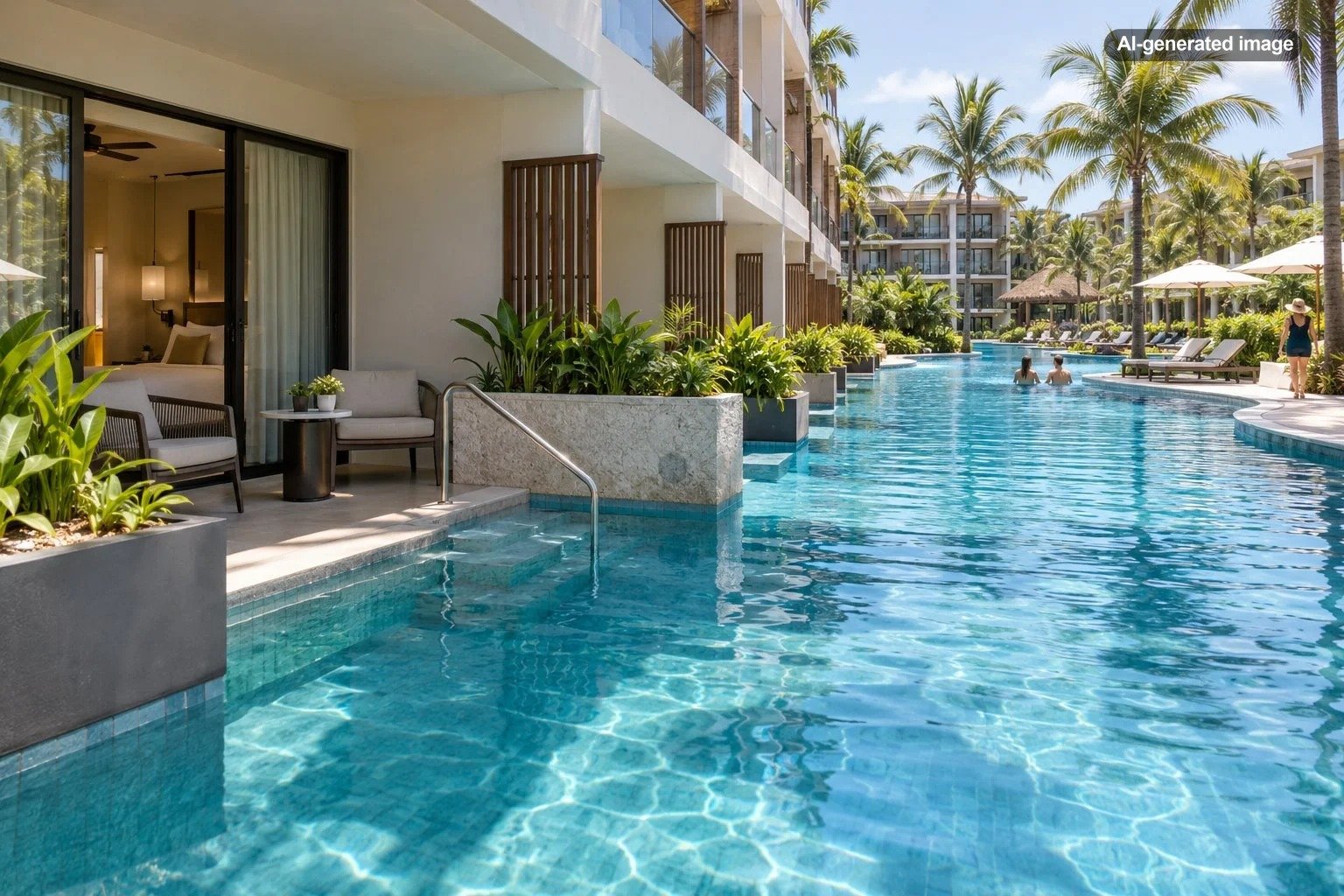
Some layouts create small semi-contained pool sections shared by only a handful of rooms. Others use a continuous lagoon running past many terraces. In the second arrangement, guests may repeatedly swim or float past your outdoor space throughout the day.
This is partly a privacy issue, but it also affects noise. Two people chatting while floating past a terrace may be more noticeable than general pool noise farther away. If the pool forms a circulation route between different parts of the resort, expect more movement than if it ends near your room.
Do not overlook pedestrian traffic behind or in front of the pool
A room can have a relatively calm pool and still feel busy if a major resort walkway runs nearby. Ground-floor accommodations naturally place you closer to people traveling between restaurants, the beach, elevators, pools, and guest buildings.
Study photographs carefully. Look for paths directly in front of terraces, bridges across lagoon pools, staircases, building entrances, elevators, and shortcuts between major resort facilities. A swim-up room at the end of a building may receive less passing traffic than one positioned beside the primary route through the complex.
Use recent guest reviews to investigate locations, not just ratings
Reviews become especially useful when you search them for specific terms rather than relying on an overall score. Look for words and phrases such as swim-up, pool, music, quiet, noise, building, entertainment, and room location.
Pay attention when several reviewers independently describe the same pattern. One guest complaining that a pool was loud may simply have different expectations. Multiple recent comments describing music beside the same building or daytime activity near the same pool are much more informative.
Also distinguish daytime pool noise from nighttime resort noise. A swim-up room might be lively between breakfast and late afternoon yet become very quiet once the pool area closes. Another room might avoid pool noise but sit close enough to evening entertainment that the overall experience is noisier after dark.
Photos can reveal clues that the room description does not
Marketing photographs are useful when treated as evidence of layout rather than evidence of tranquility. Look beyond the terrace furniture and water.
Count how many rooms appear to share the pool. Check whether sun loungers for general resort guests surround the same water. Look for a bar, restaurant terrace, children’s area, pathway, bridge, or main pool just beyond the swim-up section. Satellite imagery and resort maps can also help establish whether a room block is central or peripheral.
A photograph showing an empty pool should not be interpreted as proof that the setting remains empty during normal resort hours.
Ask the hotel a specific question instead of requesting a quiet room
A general request for a quiet room leaves considerable room for interpretation. A more useful approach is to explain exactly what you are trying to avoid.
You might ask whether any rooms in your booked swim-up category are farther from the main pool, daytime entertainment, pool bars, or heavily used pathways. You can also ask whether different buildings within the same category have meaningfully different locations.
Room requests are generally requests rather than guarantees unless the property explicitly confirms otherwise. The goal is therefore to understand the category before paying for it, not to assume that a favorable location can always be assigned later.
Decide what kind of noise actually bothers you
Not every traveler means the same thing by a noisy room. Someone who spends the entire afternoon at the pool may enjoy hearing activity immediately outside the terrace. Someone planning to nap after lunch may find the same setting frustrating.
Consider three different types of sound. Ambient pool noise includes splashing and normal conversation. Activity noise includes music, announcements, games, and group events. Traffic noise comes from people walking or swimming past the room. A particular swim-up category may perform well in one area and poorly in another.
Travelers seeking privacy and quiet should usually prioritize a smaller shared pool, a room block away from the central activity zone, and a terrace that is not beside a major walkway. Travelers who want a social resort experience may deliberately prefer the opposite.
When a regular balcony room may be the better choice
Swim-up access is valuable primarily when you expect to use it. If uninterrupted daytime quiet is more important than stepping directly into the water, an upper-floor room away from pools and entertainment may better match your priorities.
There is also a tradeoff between convenience and separation. Swim-up rooms make the pool part of your private living space, but that same proximity makes other pool users part of the surrounding environment. Travelers who love being immersed in resort activity may consider this a benefit rather than a drawback.
What travelers often overlook
The quietest-looking swim-up pool is not automatically attached to the quietest room. Interior hallways, neighboring rooms, restaurants, service routes, evening shows, and building entrances can all affect the experience. Evaluate the complete location rather than focusing exclusively on the water outside the terrace.
It is also worth checking the specific room category again immediately before booking. Resorts can have several categories that appear similar in photographs while occupying completely different sections of the property.
Frequently asked questions
Are all swim-up rooms noisy?
No. Noise depends heavily on resort layout. A swim-up room beside a small pool serving a limited number of rooms can feel very different from one beside a central activity pool.
Are end rooms usually quieter?
They can be, especially when an end position reduces passing swimmers or pedestrian traffic, but the surrounding facilities matter more than the room number alone.
Will closing the patio door solve the problem?
It may reduce outdoor sound, but sound insulation varies by building and room. If you plan to spend significant time on the terrace, the outdoor noise environment still matters.
Should I avoid a swim-up room if I like afternoon naps?
Not necessarily. Look for a swim-up category on a separate pool away from entertainment and the main activity zone. If that information cannot be established before booking, a room farther from the pool may be the more predictable choice.
What is the single best question to ask before booking?
Ask whether the swim-up pool for your exact room category is separate from the resort’s main activity pool and whether any buildings in that category are farther from bars, entertainment, and major walkways. That question usually reveals far more than simply asking whether the resort is quiet.