What Does “Accessible Room” Mean If You Did Not Request One?
If a hotel assigns you an accessible room even though you did not request one, it generally means the room includes features intended to make the space more usable for guests with certain disabilities. It does not necessarily mean anything went wrong with your reservation, and it does not automatically mean the room will feel dramatically different from a standard room.
The important detail is that “accessible room” is not one universal room design. Accessibility features can vary according to the room, property, building, and type of accessibility it is designed to address. A mobility-accessible room may differ from a room equipped primarily with communication features for guests who are deaf or hard of hearing.
Quick answer
- An accessible room is designed with one or more features that improve usability for guests with disabilities.
- You may receive one simply because it was the room available within the category you booked.
- Accessible rooms can differ from standard rooms in bathroom layout, maneuvering space, fixtures, controls, or communication features.
- Not every accessible room has a roll-in shower, and not every accessible room includes the same features.
- If the layout does not work well for you, you can ask whether another room is available, but a change may depend on the hotel’s inventory.
Why would a hotel give you an accessible room?
Hotels manage rooms as inventory, and an accessible guest room can still be part of the broader room category being sold. If you reserved a particular bed type or general room class, the property may assign an accessible version of that room when completing room assignments.
This can happen because of occupancy patterns, maintenance issues elsewhere in the building, the timing of your arrival, or simply the remaining mix of rooms. It does not necessarily indicate an upgrade, downgrade, mistake, or special designation attached to your reservation.
If you booked through a third-party reservation service, the information displayed during booking can also differ from what appears in the hotel’s own reservation system. That is one reason it is worth looking at the room details rather than relying only on a short room-category label.
What can be different inside an accessible hotel room?
The differences depend on the specific accessibility features provided. Some are immediately noticeable, while others are subtle enough that a traveler may not realize the room is accessible until looking closely at the bathroom, doorway, controls, or safety equipment.
More maneuvering space
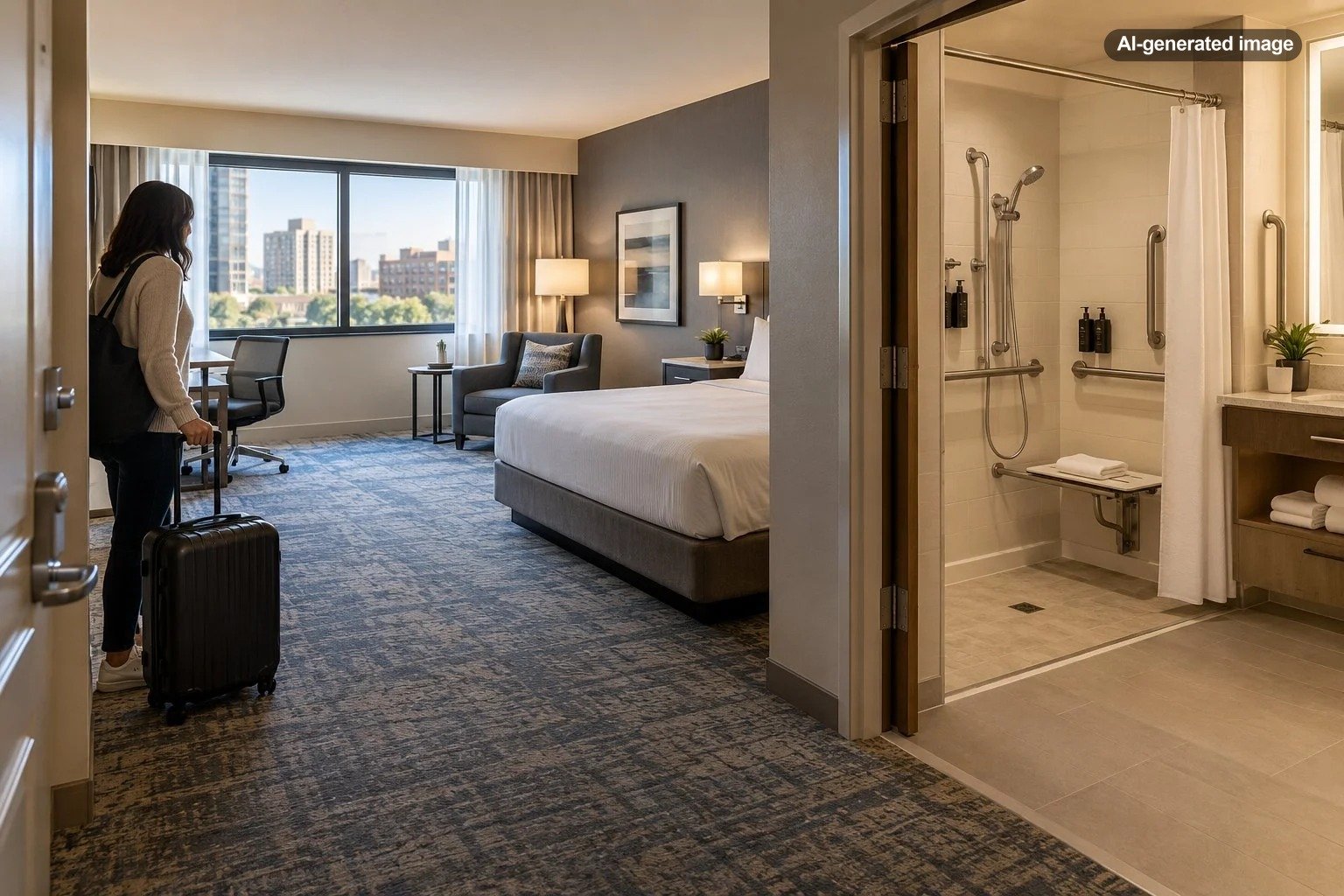
A mobility-accessible room may provide additional clear floor space or a layout intended to make movement through the room easier for someone using a wheelchair or another mobility device. Furniture placement may therefore feel slightly more open than in another room of the same general category.
Bathroom differences
The bathroom is often where travelers notice the biggest distinction. Depending on the room, accessible features can include grab bars, additional clear space, an accessible bathing configuration, or fixtures arranged for easier reach and use.
One important distinction is that accessible does not automatically mean roll-in shower. Accessible bathing arrangements can differ, so travelers who specifically require a roll-in shower should confirm that feature rather than assuming any room labeled accessible will provide one.
Communication-accessible features
Some rooms are designed around communication accessibility rather than mobility. Depending on the property and room, these accommodations can include visual notification features associated with alerts or incoming communications. A guest without hearing-related accessibility needs may notice very little difference in the basic room layout.
Does an accessible room mean it is larger?
Not necessarily. Certain layouts need sufficient clear space for accessible movement, which can make a room feel more open in particular areas. That does not mean an accessible room is automatically a larger, more expensive, or higher-category room.
In some buildings, the additional clearance may come from arranging the same approximate space differently. In others, the accessible version of a room category may indeed have a somewhat different footprint. Travelers should avoid treating the accessible designation as shorthand for either a bigger room or a smaller room.
Is an accessible room better or worse than a standard room?
Neither description is especially useful. The better question is whether its particular layout works for your trip.
A traveler who likes an open bathroom layout might find the room perfectly comfortable. Another traveler may prefer a conventional tub-and-shower arrangement or a different placement of bathroom fixtures. Someone traveling with children might have preferences that differ from those of a solo business traveler. These are practical layout considerations rather than indicators of room quality.
The accessible designation also should not be treated as evidence that the room has better furnishings, a better view, a quieter location, or more amenities. Those characteristics depend on the hotel’s room inventory and the specific room assigned.
Should you ask to change rooms?
You do not need to request a change merely because the room is accessible. If the bed configuration, general condition, location, and room features work for you, there may be no practical reason to move.
It can make sense to contact the front desk if a particular accessibility feature creates a genuine inconvenience for your stay or if the room does not match an important element of what you reserved. Ask whether a comparable non-accessible room is available rather than assuming the hotel can make an immediate switch.
If another room is unavailable when you arrive, you can also ask whether the situation may change later. Avoid assuming that a different room will necessarily have the same location, view, floor, bedding, or other characteristics unless the hotel confirms them.
Do you need to give up the room for someone who needs it?
If the hotel has assigned the room to you, you generally do not need to make your own assumptions about another guest’s needs or the property’s inventory. Room allocation is the hotel’s responsibility.
That said, if you would genuinely prefer a standard room, there is nothing wrong with telling the front desk that you are flexible. The hotel can then decide whether moving you would make sense based on current reservations and available inventory.
The more important etiquette point is not to treat accessibility equipment as unnecessary clutter. Avoid removing, disabling, or altering accessibility or safety-related features simply because you personally do not need them.
What travelers often overlook
Travelers sometimes focus on the word “accessible” while overlooking the specific feature that actually matters. For guests who require accessibility accommodations, the general label alone may not provide enough information. A traveler may need to know, for example, whether the bathing setup is a tub or roll-in shower, whether the room is mobility accessible, or whether communication-accessible features are provided.
The same principle helps travelers who did not request an accessible room. Instead of deciding that the category is automatically undesirable, look at the actual room. If the layout works, the label may have little effect on your stay. If it does not work, identify the specific issue when speaking with the front desk. “I would prefer a room with a conventional bathtub” is more useful than simply saying, “I don’t want an accessible room.”
FAQ
Can a hotel assign an accessible room if I did not book one?
Yes, an accessible room may be assigned as part of the hotel’s available inventory even when a guest did not specifically request accessibility features. The exact circumstances depend on the reservation and property.
Does accessible always mean a roll-in shower?
No. Accessible rooms can have different bathing configurations and different types of accessibility features. If a roll-in shower is essential, confirm that specific feature rather than relying only on the word “accessible.”
Will an accessible room have a different bed?
Not necessarily. Bed size and configuration depend on the specific room category. Check the reservation details and ask the hotel if a particular bed arrangement is important.
Can I request a standard room instead?
You can ask the front desk whether a comparable non-accessible room is available. Whether the hotel can move you will depend on its current room inventory and the details of your reservation.
Should I avoid booking an accessible room unless I need one?
If you are deliberately selecting a room, it is sensible to choose the room type that matches your needs and leave accessibility-specific inventory available when you do not require those features. An unexpected assignment at check-in is different: if the hotel places you in the room, you can simply evaluate whether its layout works for your stay.