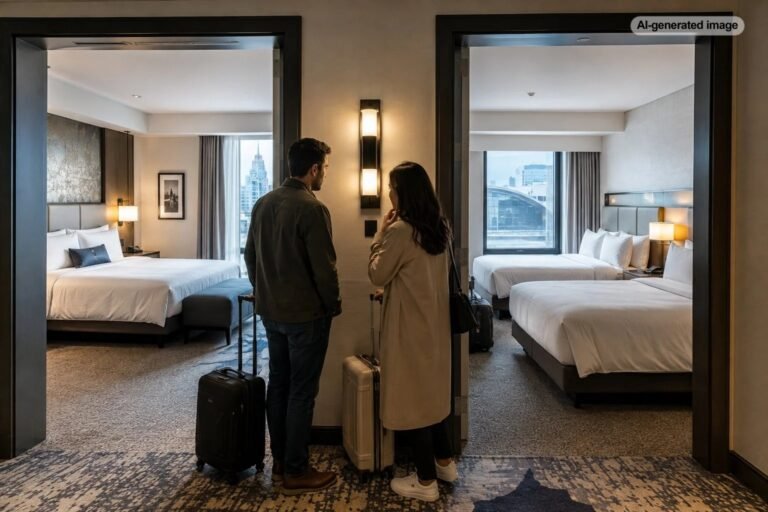
How to Tell If a Hotel Has Thin Walls Before You Book
There is no foolproof way to measure a hotel’s sound insulation from a booking page, but thin walls usually leave a trail. Repeated review complaints about hearing conversations, televisions, alarms, doors, or ordinary footsteps are much more revealing than a few broad comments that a property was noisy.
The best approach is to identify the type of noise mentioned, study when and where it occurs, and ask the hotel about room placement before committing. A lively street can affect otherwise well-insulated rooms, while a quiet suburban property can still have poor separation between neighboring rooms.
Quick answer: Look for patterns, not isolated complaints
- Search recent reviews for specific words such as walls, voices, TV, hallway, footsteps, doors, and elevator.
- Give more weight to guests who describe what they heard than to reviews that merely say the room was noisy.
- Check whether complaints appear across different floors, room types, and dates.
- Look for connecting-room doors, hard flooring, elevators, service areas, bars, and event spaces near guestrooms.
- Contact the property and request a room away from predictable noise sources, while recognizing that requests are not guarantees.
Separate thin-wall complaints from other hotel noise
Not every report of a noisy room indicates weak walls. Understanding the sound path helps you decide whether choosing another room could solve the problem or whether the building itself may be a poor fit.
Noise through a shared wall
Reports of clearly audible conversations, television dialogue, phone notifications, alarms, or normal-volume speech from the next room are the strongest warning signs. If multiple guests say they could follow conversations without anyone shouting, the separation between rooms may be limited.
Noise through the corridor door
Voices in the hall, slamming doors, housekeeping activity, and rolling luggage may enter through the room entrance rather than the wall. Reviewers often describe this as thin walls even when the corridor door or its seals are the main issue. A room farther from the elevator and housekeeping areas may help, although it cannot eliminate every corridor sound.
Impact noise from above
Footsteps, moving chairs, dropped objects, and children running are transmitted differently from speech. These complaints can point to limited floor and ceiling isolation, especially where guestrooms have hard flooring. Requesting a top-floor room may reduce overhead noise, but it will not address sound from adjacent rooms or hallways.
Mechanical and exterior noise
Elevators, plumbing, ice machines, heating and cooling equipment, traffic, trains, aircraft, nightlife, and early deliveries can all disturb sleep without saying much about the walls between rooms. These risks are often manageable through room orientation and location within the building.
Search reviews with precise noise terms
Do not rely only on the overall rating or the first page of featured reviews. Search reviews on more than one established platform when possible, because each platform may contain a different mix of travelers and room assignments.
Useful search terms include:
- Thin walls, paper walls, or soundproof: Direct references to room-to-room sound.
- Could hear, conversation, talking, or TV: Signs that normal airborne sound may travel between rooms.
- Connecting door or adjoining room: A possible weak point even when the main wall performs reasonably well.
- Footsteps, stomping, or chairs: Evidence of impact noise from the room above.
- Hallway, slamming doors, housekeeping, or elevator: Clues about corridor and room-location noise.
- Street, bar, train, traffic, or construction: Exterior conditions that may affect only one side of the property.
Pay attention to phrasing. A review that says, “We heard the people next door speaking until midnight,” provides more diagnostic value than, “It was loud.” Also note whether a guest reports an unusually disruptive neighbor. Even good sound isolation has limits when music, shouting, or a party is involved.
Judge whether the complaints form a credible pattern
A single noise complaint should not automatically disqualify a hotel. Room location, temporary maintenance, an event, or inconsiderate guests can produce an isolated bad night. A pattern becomes more meaningful when several independent reviews describe the same sound in similar terms.
Recent reviews deserve extra attention because furnishings, flooring, operating practices, or nearby construction can change. Older reviews can still reveal a persistent building characteristic, but they should not be treated as proof of current conditions.
Compare traveler types as well. A business traveler trying to sleep at 9 p.m. may notice evening hallway activity that does not bother a leisure guest returning after midnight. Families may be more concerned about overhead footsteps or connecting doors, while light sleepers may react strongly to ventilation noise that other guests barely register.
Inspect the room description and property layout
Words such as “soundproof” or “sound-insulated” can be encouraging, but they do not guarantee silence. The description may refer primarily to exterior windows, and the term may not communicate how well the room blocks voices, hallway activity, or impact noise.
Room photos can reveal possible clues, though they cannot establish acoustic performance. A visible connecting door introduces another potential sound path. Large gaps under entrance doors may allow more corridor sound. Hard flooring can make sounds within a room feel sharper and may contribute to impact noise below, while rugs and upholstered furnishings can reduce reverberation inside the room without necessarily blocking sound through the structure.
Study the hotel’s facilities list and any available floor information. Rooms near elevators, ice machines, vending areas, housekeeping closets, fitness centers, pools, restaurants, bars, ballrooms, and loading areas face different risks. A small property with rooms directly above a restaurant may require a different review strategy than a tower hotel where only certain floors face nightlife.
Ask the hotel questions it can answer clearly
Calling or messaging the property can help, but “Are the rooms quiet?” invites a subjective answer. Ask questions tied to location and room features instead:
- Does this room category include connecting rooms?
- Can a non-connecting room be requested?
- Which room locations are farthest from elevators, ice machines, housekeeping areas, and event spaces?
- Are guestrooms located above or beside a bar, restaurant, gym, or ballroom?
- Can a room on a high floor or away from the street be requested?
- Does the property’s quiet-hours policy apply to guestrooms and corridors?
Phrase your preference precisely in the reservation notes and repeat it during check-in. For example, request a non-connecting room away from elevators and service areas rather than simply asking for a quiet room. Hotels assign rooms according to availability and operational needs, so treat the request as a preference rather than a confirmed feature unless the property explicitly confirms otherwise.
Match the booking decision to your sensitivity and trip
A moderate noise risk may be acceptable for one night after a late arrival but unsuitable for a weeklong work trip. Light sleepers, travelers with early meetings, families with infants, and guests recovering from long travel days have more reason to prioritize acoustic evidence over a slightly better view or more central position.
Cancellation flexibility matters when the evidence is mixed. Review the applicable terms before booking, since policies vary by property and rate. If the hotel’s recent reviews contain repeated, specific room-to-room complaints and the property cannot address basic placement questions, choosing another option may be the more practical decision.
Affiliate disclosure: HotelInfo.com may earn a commission when you book or purchase through links on this page. This does not affect the price you pay. Learn more.
If conventional hotel listings do not provide enough detail, you can also explore available accommodations through Homes & Villas by Marriott Bonvoy. Rates, availability, standards, amenities, and cancellation terms vary by property, and vacation rentals require the same careful review of location and noise comments.
What travelers often overlook
Renovation language is not acoustic proof. A recently updated room may have new finishes without changes to walls, doors, floors, windows, or mechanical systems. Do not assume that “renovated” means quieter.
Luxury positioning does not guarantee silence. Service level, interior design, room size, and acoustic separation are different qualities. Evaluate the review evidence rather than using the market tier as a shortcut.
Quiet can depend on the day. Wedding weekends, conferences, school holidays, and local events can change occupancy patterns and hallway activity. This does not necessarily reveal thin walls, but it can change the practical sleep environment.
Room moves are not always available. If quiet is essential, do the screening before arrival instead of relying on the hotel to solve the problem after check-in.
Frequently asked questions
Does a hotel listing that says “soundproof rooms” guarantee quiet?
No. The term may describe particular building components or an effort to reduce sound, but it does not promise complete silence. Check recent reviews for specific descriptions of voices, televisions, footsteps, doors, and exterior noise.
Are older hotels more likely to have thin walls?
Age alone is not a reliable guide. Older masonry buildings can feel acoustically solid, while conversions may have uneven performance between rooms. Newer buildings can also transmit sound through doors, connecting-room openings, floors, or mechanical systems.
Is the top floor always the quietest?
A top-floor room can remove overhead footsteps, but it may still be near elevators, rooftop equipment, nightlife, or street noise. Consider the full location rather than the floor number alone.
Should I avoid connecting hotel rooms?
If you are sensitive to voices and television noise, requesting a room without a connecting door is sensible. Connecting doors can be a weaker sound path, although actual performance varies by door construction, seals, and the behavior of neighboring guests.
What is the most useful warning sign?
The clearest warning is a repeated pattern of recent reviews saying guests could hear ordinary conversations or television dialogue from adjacent rooms. That evidence is more persuasive than a few vague complaints about noise.