Where to Stay on the Amalfi Coast If You Want Fewer Stairs
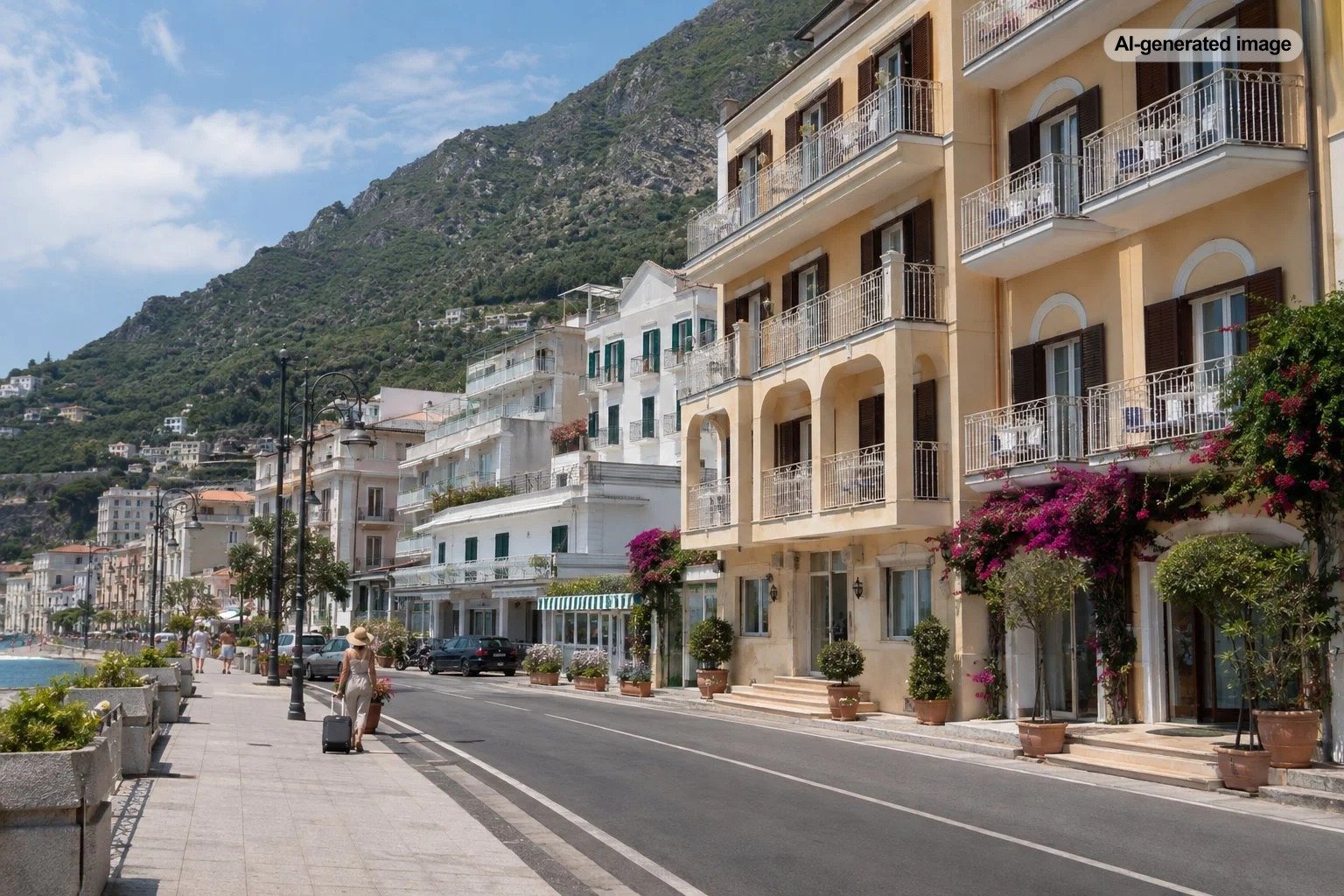
If minimizing stairs is a priority on the Amalfi Coast, start by choosing the right town before choosing a hotel. Maiori is usually the most practical base for travelers who want substantial stretches of relatively level waterfront walking, while compact Minori can also work well if you stay close to the seafront. Central Amalfi is another possibility when the hotel, ferry pier, restaurants, and main square are close together.
Positano is the clearest place to approach cautiously. Italy’s official tourism site describes it as a vertical village filled with stairways and alleys, and that topography affects everyday trips between hotels, restaurants, shops, roads, and beaches. Ravello is similarly elevated above the coast. Travelers with limited mobility do not necessarily need to avoid these places entirely, but they may be more comfortable visiting them on day trips rather than using them as a base.
Quick answer: the easiest areas to consider
- Maiori: the strongest starting point if fewer stairs and easier waterfront walking matter most.
- Minori: smaller and compact, with several hotels close to the town center and seafront.
- Central Amalfi: useful if you choose a property close to the waterfront, harbor, bus connections, and Piazza Duomo.
- Positano: beautiful but particularly challenging for travelers trying to minimize stairs.
- Before booking: ask the hotel to confirm the exact route from street entrance to reception, room, breakfast area, and any pool or beach facilities.
Planning snapshot
| Area | Why consider it | Main tradeoff |
|---|---|---|
| Maiori | Long seafront, large beach, several centrally located hotels | Hillier attractions and the Lemon Path still involve climbing |
| Minori | Compact center and waterfront | Routes leaving the center can become steep or stepped |
| Amalfi | Central transportation hub and compact waterfront core | Side streets and destinations above town can involve stairs |
| Positano | Iconic scenery and extensive hotel choice | Vertical layout and numerous stairways |
The following hotels are currently operating according to their official websites. They were selected primarily because their locations can reduce unnecessary uphill travel, not because every part of each property has been confirmed as step-free. Accessibility can vary by entrance, room category, elevator configuration, terrace, pool, beach, and seasonal setup, so travelers with specific mobility requirements should obtain written confirmation from the property before booking.
Reginna Palace Hotel: central Maiori for an easy everyday base
Best for: travelers who want a full-service, upscale stay in central Maiori without choosing a hillside village.
The Reginna Palace Hotel is a four-star property in Maiori at Via Cristoforo Colombo, close to the town’s central waterfront area. Its official site positions it as a base for couples, friends, and families and lists a private beach, pool, restaurant, and concierge services.
The practical advantage is the location. Staying in central Maiori can make ordinary vacation routines – breakfast, dinner, waterfront walks, and trips toward the beach – less dependent on steep hillside streets. The tradeoff is that this should not be interpreted as a guarantee that every hotel facility or room can be reached without steps. Ask specifically about the entrance and the route to your assigned room.
Hotel Panorama Maiori: seafront positioning in the heart of town
Best for: couples and families who want to remain close to Maiori’s waterfront while having a broad range of room categories.
Hotel Panorama describes its location as being in the heart of Maiori and facing the sea. The hotel occupies five floors and has rooms ranging from standard and comfort categories to family rooms and suites, along with a rooftop terrace.
For a low-stair Amalfi Coast strategy, the central Maiori setting is the main reason to consider it. However, because the building extends over several floors and important facilities include a rooftop area, travelers who cannot manage stairs should verify elevator coverage rather than assuming every level is accessible.
Hotel Miramare Maiori: close to the beach and town center
Best for: travelers who value a straightforward central location over a secluded cliffside setting.
Hotel Miramare states that it is in the heart of Maiori, about 50 meters from the sea, with convenient access to the beach, promenade, and tourist port. That positioning is particularly useful for a traveler whose goal is to reduce repeated climbs during an ordinary day.
The property also has a rooftop restaurant, bar, and solarium. Those elevated facilities make it important to confirm how they are reached if stairs are a concern. A lower-floor room near elevator access may be more useful than selecting a room solely for its view.
Hotel Pietra di Luna: a practical promenade location in Maiori
Best for: travelers who prioritize proximity to the seafront and prefer a larger, more conventional hotel layout.
Hotel Pietra di Luna is on Maiori’s promenade, approximately 30 meters from the sea according to its official site. It has 88 rooms and a central position overlooking Maiori’s bay.
That makes it one of the more logical properties to investigate when the alternative is a small hotel reached through steep lanes or hillside staircases. The hotel should still confirm the step-free route between the street entrance, reception, elevators, room, restaurant, and any beach facilities that matter to you.
Hotel Sole Splendid: another Maiori option directly by the promenade
Best for: travelers who want to stay close to the water and spend much of the trip around Maiori itself.
Hotel Sole Splendid overlooks the Maiori seafront and describes itself as being only a few steps from the sea. Its location keeps guests close to the promenade instead of placing them high above town.
That geographic advantage matters more than luxury level when minimizing stairs. The compromise is that some of the coast’s famous viewpoints, churches, trails, and neighboring hill towns will still require climbing or transportation, regardless of how conveniently located your hotel is.
Villa Romana Hotel & Spa: a central option in compact Minori
Best for: travelers who prefer a smaller town and want restaurants and central Minori close at hand.
Villa Romana Hotel & Spa is a four-star property on Corso Vittorio Emanuele in Minori, a short distance from the historical center. Its official website lists a restaurant, bar, pool, and spa.
Minori is more compact than Maiori, and Italy’s official tourism site highlights its seafront promenade. That can make the center manageable for travelers who plan their routes carefully. The important distinction is between staying within the lower town and attempting routes such as the Lemon Path, which Italy’s tourism site says includes substantial ascents, descents, and hundreds of steps.
Hotel Santa Lucia: near the sea in Minori
Best for: travelers looking for a traditional four-star hotel in a compact coastal town.
Hotel Santa Lucia is in Minori near the Roman Villa and less than 100 meters from the beach according to its official website. It has 25 rooms and places guests close to the lower part of town.
This is the kind of location that can simplify a relaxed itinerary built around short waterfront walks, meals, and boat or road excursions. Travelers who use a wheelchair, walker, or cane should nevertheless ask the hotel for precise measurements and route information, including any thresholds or steps between the public street and their room.
Hotel Residence Amalfi: central Amalfi without staying above town
Best for: first-time visitors who want Amalfi’s transportation connections and historic center close to the hotel.
Hotel Residence Amalfi occupies a historic building on the Amalfi seafront. Its official site places it close to Piazza Duomo, the harbor, beaches, historic attractions, and bus terminal.
For someone who wants to experience Amalfi itself while limiting unnecessary vertical travel, that central position is a meaningful advantage. You can keep much of the daily routine around the waterfront core rather than booking accommodation farther up the slopes. Historic buildings can have complicated internal layouts, however, so confirm the route to the exact room category you plan to reserve.
Hotel Santa Caterina: luxury with elevators to the waterfront, but important caveats
Best for: luxury travelers who want extensive on-property services and are willing to verify mobility details carefully.
Hotel Santa Caterina sits just outside central Amalfi. Unlike many cliffside properties where reaching the water can mean long staircases, the hotel’s official beach-club information says that two elevators take guests down to the Beach Club.
There is an important qualification: the hotel explicitly states that the beach platform, including the pool area, is not completely accessible, although staff assistance is available. This makes Santa Caterina a useful example of why the word elevator should never be treated as synonymous with fully accessible. For guests with significant mobility limitations, detailed questions are essential before booking.
Why Maiori usually makes the most sense
Maiori stands out because the town has a substantial waterfront and the Amalfi Coast’s longest beach, according to Italy’s official tourism site. Several full-service hotels line or sit close to this lower, coastal section. That allows you to build a vacation around the promenade, beach, restaurants, and transportation without repeatedly climbing through a vertical village.
It is still the Amalfi Coast, so stairs have not disappeared. For example, Italia.it notes that Salicerchie Beach near Maiori is reached by 160 steps. The Lemon Path between Maiori and Minori is also a poor choice for anyone actively trying to avoid climbing. Choosing Maiori therefore reduces exposure to stairs; it does not remove them from every sightseeing option.
Why Positano is harder if stairs are a serious concern
Positano’s extraordinary appearance comes directly from its vertical topography. Italia.it describes Positano as a vertical village with many stairways and alleys. A hotel that appears geographically close to a beach or restaurant on a map may be separated from it by a substantial change in elevation.
If Positano is important to your trip, consider visiting by boat, car service, or bus and limiting the amount of climbing you attempt. A day visit also lets you keep a more practical hotel base in Maiori, Minori, or Amalfi.
Questions to ask a hotel before booking
The most useful question is not simply, “Does the hotel have an elevator?” Ask the reservations team to describe your complete arrival and daily route.
- Are there any steps from the street or drop-off point to reception?
- Can an elevator reach the exact room category I am reserving?
- Are there steps between the elevator and the room?
- Can breakfast, the restaurant, pool, terrace, or beach be reached without stairs?
- Is the elevator large enough for the mobility device I use?
- Does the hotel entrance require walking on a steep slope?
- Where can a taxi or private transfer actually drop off passengers?
- If the hotel advertises beach access, does that access include stairs, ladders, or uneven surfaces?
Ask for answers in writing. Amalfi Coast properties often occupy historic buildings, cliffs, terraces, and converted villas, so two rooms in the same hotel can have very different access routes.
What travelers often overlook
The hotel is only part of the mobility equation. A step-free room does not help much if every dinner requires a steep climb. Conversely, a modest centrally located hotel can be a better fit than a spectacular cliffside resort when your main goal is preserving energy.
Transportation also matters. Ferries can reduce road travel between coastal towns when operating, but boarding arrangements and seasonal schedules can change. Buses and private transfers may solve some elevation problems, yet the final walk from a road stop to a hotel or attraction can still involve stairs. Confirm current transportation arrangements close to your travel dates.
Finally, distinguish between wanting fewer stairs and requiring true wheelchair accessibility. These are not the same standard. A traveler who can comfortably manage five or six steps may have many more options than someone who needs a continuous step-free route.
Frequently asked questions
What is the best Amalfi Coast town for avoiding stairs?
Maiori is the strongest place to start because several hotels sit close to its long waterfront and central streets. Minori and the lower center of Amalfi are also worth considering.
Is Amalfi easier to walk than Positano?
For many travelers, central Amalfi is easier to organize around a relatively compact waterfront core. Positano is explicitly characterized by its vertical layout and stairways. Individual routes still vary, so neither town should be assumed to be universally accessible.
Should I stay in Ravello if I have trouble with stairs?
Ravello can be rewarding, but it sits above the coast and is less convenient for a trip designed around minimal elevation changes. Many travelers with mobility concerns may prefer to stay closer to sea level and visit Ravello using transportation.
Does an elevator mean an Amalfi Coast hotel is accessible?
No. An elevator may connect guest-room floors while leaving steps at the entrance, restaurant, pool, garden, terrace, or beach. Always ask about the entire route you will use.
Is Minori a good alternative to Maiori?
Yes. Italia.it describes Minori as more compact than neighboring Maiori, and its waterfront center can be convenient. Just avoid assuming that walking routes out of town will remain level; the surrounding terrain quickly becomes steep.
Sources & further reading
- Reginna Palace Hotel – official website
- Hotel Panorama Maiori – official website
- Hotel Miramare Maiori – official website
- Hotel Pietra di Luna – official website
- Hotel Sole Splendid – official website
- Villa Romana Hotel & Spa – official website
- Hotel Santa Lucia – official website
- Hotel Residence Amalfi – official website
- Hotel Santa Caterina – official website
- Italia.it – Maiori
- Italia.it – Minori
- Italia.it – Positano