What to Know Before Planning a Trip to Rome
Planning a trip to Rome is less about building the longest possible sightseeing list and more about making a few strategic decisions early. The city is large, layered, and often crowded around its most famous monuments, so the location of your hotel, the timing of major attractions, and the pace of each day can shape the experience as much as the sights themselves.
Before reserving accommodations, decide which parts of Rome matter most to you, how much walking you are comfortable doing, and whether you prefer to stay amid the historic center or in a neighborhood with a more residential rhythm. Then reserve the attractions that require advance planning while leaving enough open time for meals, evening walks, and unexpected discoveries.
Quick answer
- Choose your hotel area before building the itinerary. A central location can reduce transit time, but it may also mean busier streets and smaller rooms.
- Do not schedule every major landmark on the same day. Rome rewards a slower pace, especially when heat, crowds, and uneven streets are factors.
- Reserve high-demand attractions through their official channels. Availability, entry procedures, and operating details can change.
- Plan for substantial walking. Even travelers who use buses and the Metro will cover considerable distances on foot.
- Confirm current passport, visa, airport, and transit information shortly before departure. These details depend on nationality, travel dates, and service conditions.
Start with the right length of stay
Three full days can cover a carefully selected group of highlights, but the schedule will be concentrated. Four or five full days allow more realistic spacing between ancient sites, museums, churches, neighborhoods, and meals. A longer stay also makes it easier to visit less central areas or take a day trip without treating Rome as a checklist.
Count full sightseeing days rather than hotel nights. A five-night visit may provide only four usable days when arrival and departure times are considered. Travelers arriving after an overnight flight should avoid placing a timed museum visit or a lengthy archaeological tour immediately after landing.
For a first visit, it is usually better to see fewer places with adequate time than to cross the city repeatedly for short stops. Grouping nearby sights also reduces the strain of Rome’s pavement, stairs, crowds, and summer temperatures.
Choose where to stay based on your daily priorities
Rome does not have one universally best neighborhood. The right area depends on whether you value immediate access to monuments, convenient transportation, nightlife, quieter evenings, or larger accommodations.
Historic center
Areas around the Pantheon, Piazza Navona, Campo de’ Fiori, and the Trevi Fountain place travelers close to many familiar sights. This can be an excellent fit for a short first visit or for travelers who want to walk out of the hotel and begin sightseeing immediately.
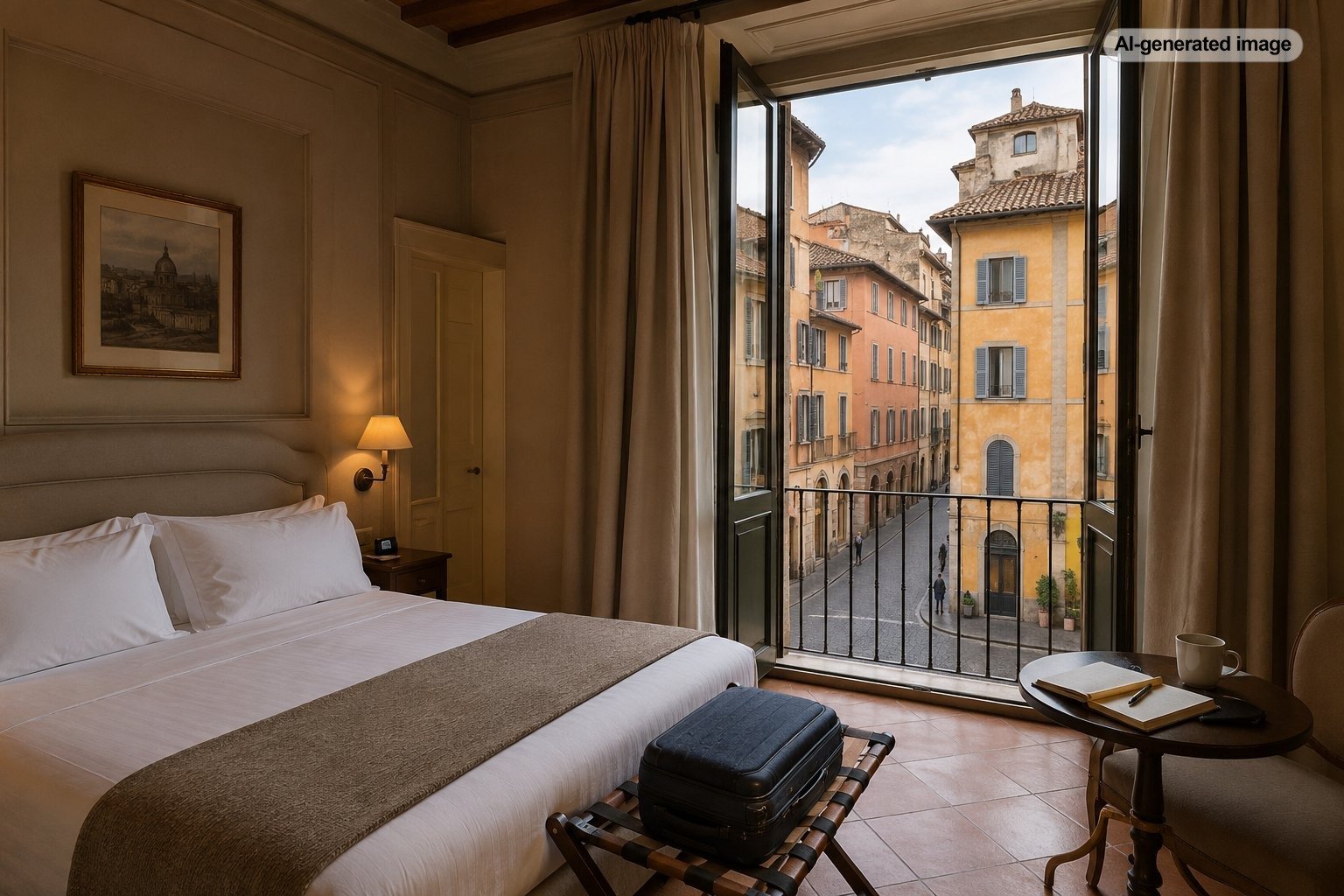
The tradeoffs can include busy pedestrian traffic, street noise, restricted vehicle access, and accommodations in older buildings with compact elevators or no elevator at all. Travelers with heavy luggage or mobility concerns should verify the entrance, elevator, stairs, and vehicle drop-off arrangements directly with the property.
Monti and the Colosseum area
Monti combines proximity to the Colosseum and Roman Forum with restaurants, cafes, and a more neighborhood-oriented atmosphere on many streets. It works well for travelers who want ancient Rome nearby without staying at the center of the Trevi-Pantheon corridor.
Distances to Vatican City and some western parts of the historic center can be longer than they appear on a map. The exact street matters because steep sections, traffic, and proximity to transit vary within the neighborhood.
Prati and the Vatican area
Prati can suit travelers prioritizing the Vatican Museums, St. Peter’s Basilica, wider streets, and a somewhat more orderly residential setting. It may also appeal to visitors who prefer evenings that feel less dominated by the densest sightseeing crowds.
However, staying close to the Vatican does not mean being close to every major Roman landmark. Reaching the Colosseum, Forum, and some central dining areas may require a longer walk or transit ride.
Trastevere
Trastevere is known for atmospheric lanes, restaurants, bars, and active evenings. It can be a strong choice for travelers who want dining and nightlife near their accommodations and do not mind walking or using surface transportation.
Noise varies substantially from one street to another. A room facing a busy lane, restaurant terrace, or late-night gathering point can feel very different from one on a quieter side street. Read recent room-specific feedback when possible rather than relying only on a general neighborhood description.
Termini and nearby districts
The area around Roma Termini can be practical for rail connections, airport transportation, early departures, and travelers taking several day trips. Accommodation options span a wide range, and some nearby streets offer straightforward access to Metro lines and buses.
The surroundings are more transportation-oriented than romantic, and the atmosphere can change noticeably within a few blocks. Review the precise location, walking route, late-arrival procedure, and proximity to the station entrance you expect to use.
Understand how much walking Rome requires
Rome is highly walkable in the sense that many important places can be connected on foot, but that does not mean walking is effortless. Cobblestones, broken pavement, hills, stairways, traffic crossings, heat, and long museum corridors can make a moderate distance tiring.
Comfortable, already-tested footwear is more useful than shoes chosen primarily for appearance. Travelers with limited mobility should investigate accessible entrances and elevators for each major site rather than assuming that a monument, church, hotel, or restaurant will have step-free access.
A practical itinerary alternates physically demanding visits with easier periods. For example, pair the Roman Forum with a relaxed lunch and a less structured evening instead of adding the Vatican Museums later that day. Likewise, a morning museum reservation can be followed by a neighborhood walk with flexible stopping points.
Use public transportation selectively
Rome’s transportation network includes Metro lines, buses, trams, and urban rail services. The Metro is useful for certain cross-city journeys, but it does not reach every street or attraction in the historic center. Buses may cover those gaps, although traffic and service conditions can affect journey times.
The official ATAC system provides current information about tickets, passes, routes, service conditions, and digital purchasing options. Review those details close to the trip rather than relying on an old blog post or screenshot. Validate or activate tickets as required and retain them for inspection.
Transit is most effective when it solves a specific problem, such as reaching the Vatican from the Colosseum area or returning to the hotel after a long day. For short journeys within the historic center, walking may be simpler than reaching a stop, waiting, and navigating the final blocks.
Plan airport transportation before arrival
Rome is served primarily by Fiumicino Airport and Ciampino Airport. The most sensible transfer depends on the airport, arrival time, luggage, group size, hotel location, and tolerance for transfers between trains, buses, taxis, or local transit.
Travelers arriving at Fiumicino can review official airport information covering trains, buses, taxis, car services, and rental vehicles. Ciampino has a different set of connections, so do not assume that instructions for one airport apply to the other.
Before choosing the least expensive option, consider the full journey. A rail or bus service to a central station may still leave a Metro ride, taxi trip, or difficult walk with luggage. A direct vehicle may be more practical for a family, a group splitting the cost, a late arrival, or accommodations located far from a convenient transit stop.
Ask the hotel whether vehicles can stop directly outside the entrance. Some properties sit on pedestrian streets or within traffic-restricted zones, which can require a short walk from the nearest legal drop-off point.
Reserve major attractions without overbooking the trip
Rome’s highest-demand sites may have timed-entry systems, limited availability, security procedures, or seasonal changes. Check official attraction websites before the trip and reserve the experiences that would be genuinely disappointing to miss.
Priorities often include the Colosseum and Roman Forum complex, the Vatican Museums, and selected archaeological sites or special exhibitions. St. Peter’s Basilica and major churches may have separate access procedures, dress expectations, religious services, or temporary closures that affect visits.
Leave reasonable time between reservations. A tightly timed sequence can unravel because of security lines, delayed transportation, a longer-than-expected museum visit, or the simple need to rest. One major reserved attraction per half-day is a more comfortable guideline than attempting to schedule several consecutive timed entries.
When considering a guided experience, look beyond the tour duration. Confirm the meeting location, group size, language, accessibility, cancellation terms, and whether admission is included. A tour can add valuable context to an archaeological site, while an independent visit may suit travelers who prefer flexibility and quiet observation.
Build the itinerary by area, not by fame
A map-based itinerary is usually more efficient than a list ranked by popularity. Group the Colosseum, Roman Forum, Palatine Hill, and Monti on one part of the trip. Combine the Pantheon, Piazza Navona, Campo de’ Fiori, and nearby central streets on another. Place Vatican City and Prati together rather than treating them as brief stops between distant attractions.
This approach also creates room for secondary places that fit naturally into the day. A church, market, viewpoint, garden, or neighborhood cafe can be added because it is nearby, not because the schedule demands another cross-city journey.
Travelers interested in food, architecture, religious history, archaeology, shopping, or contemporary culture should adjust the balance accordingly. A good Rome itinerary does not need to reproduce the same sequence followed by every first-time visitor.
Consider season, weather, and daylight
Rome can be visited throughout the year, but the practical experience changes with temperature, daylight, rainfall, school holidays, religious events, and crowd levels. Summer often requires earlier starts, midday breaks, water planning, and a lighter sightseeing pace. Cooler months may be more comfortable for walking but can bring shorter days and unsettled weather.
Shoulder periods can offer a useful balance, although no season guarantees low crowds or ideal conditions. Major holidays and events can affect accommodation availability, transportation, restaurant schedules, and access around religious or civic sites.
Check the forecast near departure and prepare for the conditions actually expected. A refillable bottle, sun protection, a compact rain layer, and a small day bag can be more useful than packing for an idealized version of the season.
Make dining plans with flexibility
Rome’s dining culture deserves time rather than being squeezed between attractions. Reserve a few priority restaurants, particularly for a special meal or a busy evening, but leave other meals open so the schedule can adapt.
Restaurants immediately beside major monuments may prioritize location and convenience. Walking several streets away can produce a different atmosphere, but distance alone does not guarantee quality. Review recent menus, opening days, reservation policies, and the style of service before committing.
Travelers with dietary restrictions should learn a few clear Italian phrases and contact restaurants when cross-contamination or ingredient details are medically important. Do not assume that every server will interpret a translated dietary label in the same way.
What travelers often overlook
- The exact hotel building matters. Historic charm may come with stairs, small elevators, limited soundproofing, or reception hours that differ from a conventional full-service hotel.
- Map distances can be misleading. A short route may involve crowds, hills, cobblestones, or a complicated crossing.
- Religious sites are active places of worship. Services, dress expectations, security, and special events may affect entry.
- Restricted vehicle access can complicate arrivals. Confirm where a taxi or transfer can legally stop.
- Popular fountains and piazzas are not controlled attractions. Visiting early or later in the evening may feel calmer, but conditions are never guaranteed.
- Entry and transportation rules change. Verify official information again shortly before travel.
Common Rome planning mistakes
The first is booking a hotel solely because it is labeled central. Central Rome covers several distinct areas, and a property’s street, transit access, noise exposure, and building layout are more informative than a broad location label.
The second is scheduling too many archaeological sites and museums back to back. Even highly motivated travelers can lose focus after hours of galleries, ruins, security lines, and walking.
The third is treating airport arrival as a minor detail. Knowing the airport, transfer method, station, final connection, and hotel check-in procedure can prevent confusion at the beginning of the trip.
The fourth is leaving every important attraction until arrival. Flexibility is valuable, but it should be reserved for neighborhood exploration, meals, and lower-priority stops rather than the one or two experiences that define the trip.
Frequently asked questions
How many days are enough for a first trip to Rome?
Four or five full days provide a comfortable introduction for many travelers. Three full days can work with stricter priorities, while a week allows slower sightseeing, additional neighborhoods, and a possible day trip.
Is it better to stay near Termini or in the historic center?
Termini is generally more practical for rail connections, airport transportation, and day trips. The historic center is usually more convenient for walking to major piazzas and monuments. Choose based on the trips you expect to make most often, not on a universal claim that one area is better.
Do visitors need a rental car in Rome?
Most city-focused visitors do not need one. Driving, parking, and restricted traffic zones can add complexity, while many central sights are reached on foot or by public transportation. A car may be useful for a broader road trip, but it can be collected after the Rome portion of the itinerary.
Should major Rome attractions be booked in advance?
Advance booking is sensible for high-priority attractions with timed entry or limited availability. Use official sites when possible and confirm the date, entry time, visitor name requirements, cancellation terms, and meeting point before purchasing.
What should travelers verify shortly before departure?
Check passport and visa requirements, official travel guidance, attraction reservations, airport transfers, transit service notices, hotel check-in instructions, weather, and any temporary closures affecting the planned dates.