Can Housekeeping Enter If You Leave a Privacy Sign on the Door All Day?
Yes, hotel housekeeping or other authorized staff may enter your room even when a privacy sign has been displayed on the door all day. The sign normally tells housekeeping that you do not want routine cleaning or interruptions, but it does not guarantee that nobody will enter. Hotels may retain the right to access occupied rooms for emergencies, guest welfare checks, maintenance concerns, or other circumstances covered by their policies. Exactly when they can do so depends on the property, its procedures, and applicable law.
For travelers who want to sleep late, work uninterrupted, recover from a long flight, or simply avoid daily cleaning, the distinction matters. A privacy sign is a useful request, but it is not the same as an agreement that your room will remain completely inaccessible to hotel employees.
Quick Answer: What Does a Hotel Privacy Sign Actually Mean?
- Routine housekeeping: Staff will generally avoid entering an occupied room while a visible Do Not Disturb or Privacy Please sign is displayed.
- All-day privacy: Leaving the sign outside for an entire day does not automatically guarantee uninterrupted privacy until the following morning.
- Welfare checks: Some properties reserve the right to check occupied rooms periodically, even when guests request privacy.
- Emergencies: A privacy sign does not prevent appropriate responses to fire alarms, suspected emergencies, or other urgent situations.
- Best precaution: Ask the front desk about the property’s room-entry policy and explain your preferred hours of privacy.
Why a Do Not Disturb Sign Does Not Completely Prevent Room Entry
Hotels have two responsibilities that occasionally conflict: respecting guest privacy and maintaining reasonable oversight of occupied rooms. A guest may reasonably expect housekeeping to skip cleaning when a privacy sign is displayed. The hotel, however, may still have operational or safety responsibilities that require staff access.
The important distinction is between declining an optional service and preventing all authorized room access. A privacy sign generally addresses the first situation, not necessarily the second.
For example, a business traveler might leave the sign outside from breakfast until bedtime while working on confidential documents. Under ordinary circumstances, housekeeping may simply skip the room. But if the property requires periodic room inspections, staff may eventually contact the guest to arrange access.
Hotels do not all follow one universal timetable. Some may conduct checks within a specified period, while others use procedures based on how long a room has been inaccessible, whether employees have communicated with the guest, and whether circumstances suggest a welfare concern.
Can a Hotel Enter After 24 Hours With a Privacy Sign?
At some hotels, yes. Certain properties reserve the right to inspect occupied rooms within a 24-hour period even when guests have requested privacy. However, 24 hours is not a universal hotel-industry rule, and travelers should not assume that every property follows the same inspection schedule.
An example appears in the published policy for Hyatt Centric San Juan – Isla Verde, which states that the property may enter occupied rooms at least once within a 24-hour period despite a guest’s privacy request. This is a property-specific policy, not evidence that every Hyatt hotel follows the identical procedure.
Other hotels may use different thresholds or give management discretion to decide when access is necessary. Some may attempt to reach the guest before entering. Others may have procedures that require physical inspection in defined circumstances.
The practical takeaway is simple: do not assume that keeping a privacy sign displayed for 24 hours creates a guaranteed period in which staff cannot enter. Ask your specific hotel whether it conducts mandatory room inspections and how those inspections are arranged.
What Happens When Housekeeping Finds Your Privacy Sign?
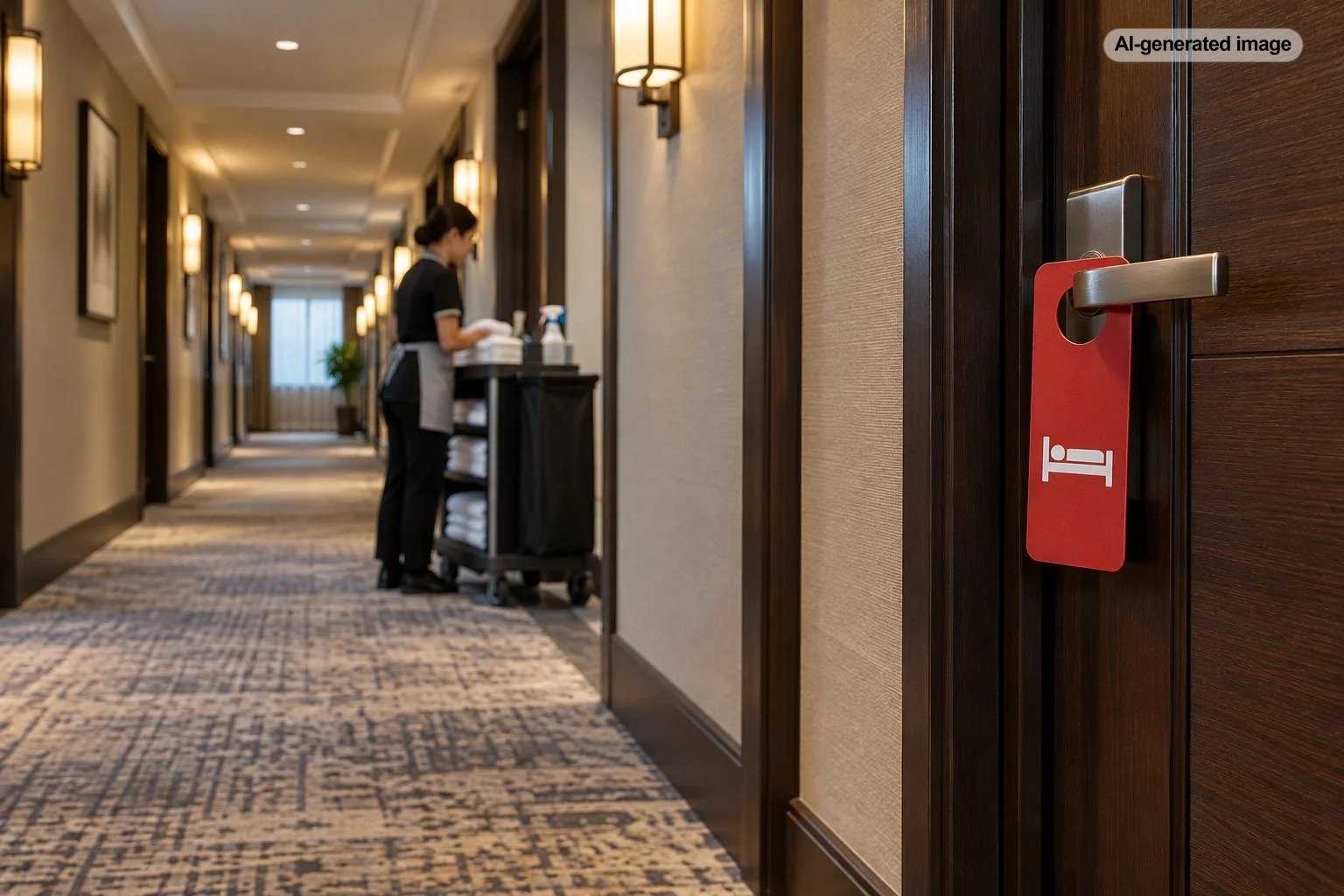
During routine cleaning rounds, an employee who sees a Do Not Disturb sign will generally treat the room as unavailable for standard service. The exact response depends on the hotel’s housekeeping schedule and internal procedures.
The employee may move on to another room, record that cleaning was declined, or leave a notice explaining how to request service later. If the sign remains displayed for an extended period, the situation may eventually be referred to a supervisor or the front desk.
Will housekeeping come back later?
Possibly, but a return visit should not be assumed. Housekeeping teams typically work within scheduled service periods, and a room that becomes available late in the day may not receive cleaning until the next scheduled opportunity.
If you remove the sign in the afternoon after displaying it all morning, the hotel may already have completed its regular cleaning rounds. Contacting the front desk is more reliable than expecting someone to notice the change immediately.
Will you lose your daily housekeeping service?
You may miss that day’s cleaning if the sign remains displayed throughout the normal service window. Whether housekeeping returns automatically the next day depends on the property and its service schedule.
Housekeeping frequency also differs across hotels. Hilton, for example, publishes different standard housekeeping frequencies for various hotel categories and regions, with adjustments possible under local requirements. Marriott advises guests to check housekeeping information for their specific property or ask the front desk.
Consequently, a skipped cleaning should not automatically be interpreted as poor service. The sign itself may have instructed staff to leave the room undisturbed.
When Can Hotel Staff Enter Despite a Privacy Request?
Although policies vary, several situations can justify contacting a guest or entering an occupied room despite a privacy sign.
Guest welfare checks
Hotels may have procedures for checking on a guest who has not been seen, contacted, or otherwise accounted for over an extended period. A prolonged privacy request can become relevant when combined with other circumstances that raise concerns about a guest’s well-being.
Such checks are different from ordinary cleaning. Their purpose is to assess a welfare concern rather than replace towels or make the bed.
Emergencies and urgent maintenance
Fire alarms, suspected water leaks, significant building-system problems, or other urgent conditions can require access that takes priority over a routine privacy request.
For instance, if water appears to be leaking into the room below yours, hotel personnel may need to investigate promptly rather than postpone access until you voluntarily remove the sign.
Required room inspections
Some hotels have room-entry procedures intended to confirm that an occupied room remains in acceptable condition and that the guest is safe. These inspections may operate independently of housekeeping preferences.
A traveler who has declined cleaning for several days should therefore distinguish between a hotel agreeing not to clean and agreeing not to inspect the room.
Checkout and room-status verification
Departure day introduces another complication. Staff need to establish when rooms have been vacated so cleaning and preparation for arriving guests can begin.
If a guest has already checked out, a sign left behind does not necessarily prevent staff from preparing the room. If the guest is still occupying the room before the agreed checkout time, the hotel should account for that occupancy when managing access.
Travelers with approved late checkout arrangements should confirm that the extension has been recorded and that the appropriate departments are aware of it.
What Is the Difference Between Do Not Disturb and No Housekeeping?
The wording on hotel door signs can be deceptively similar. Do Not Disturb, Privacy Please, Room Occupied, and No Service Needed may communicate related preferences, but their precise meaning depends on the property.
Do Not Disturb or Privacy Please generally communicates that the guest does not want routine interruptions. It may affect housekeeping visits, deliveries, or nonurgent service contacts.
No Housekeeping or No Service Needed primarily communicates that cleaning is unnecessary. It does not necessarily address every other reason staff might contact or enter the room.
Room Occupied indicates occupancy but should not be interpreted as an absolute prohibition on room access.
These differences matter most when you have a specific reason for requesting privacy. Someone sleeping after an overnight flight wants to avoid knocking and cleaning. Someone working with sensitive documents may be more concerned about unexpected physical access. Neither traveler should rely on the wording of a door sign without understanding the hotel’s actual procedures.
How to Request Privacy Without Creating Confusion
The most effective approach combines the door sign with a direct conversation when uninterrupted time is particularly important.
- At check-in: Ask whether the property has a required room-entry or welfare-check policy.
- Before a long period of privacy: Tell the front desk that you plan to keep the sign displayed and confirm whether staff will need access.
- For a specific time window: Explain when you would prefer not to receive routine service, such as during an afternoon video conference or while sleeping after an overnight journey.
- For an extended stay: Ask how frequently the hotel needs to inspect rooms even when housekeeping is declined.
- When you need supplies: Request fresh towels or toiletries separately and confirm how delivery will work while your privacy sign remains displayed.
If a hotel requires an inspection, ask whether staff can arrange a convenient time. Some properties may be willing to coordinate access, although that flexibility should not be assumed.
For example, a guest working remotely from 9 a.m. until 4 p.m. might prefer an inspection in the early evening. Communicating that preference gives the property an opportunity to accommodate the request without compromising its procedures.
Should You Use the Interior Door Lock or Security Latch?
When you are inside your room, using the provided interior lock, deadbolt, or security latch according to the hotel’s instructions can provide an additional measure of privacy.
However, the precise security features and staff-access arrangements differ by property. Some hotel doors have mechanisms that authorized personnel may be able to override in an emergency.
An interior latch should not be treated as a way to defeat legitimate safety procedures or required inspections. It is also not a substitute for communicating your preferences to hotel management.
If an unexpected person attempts to enter while you are inside, you can ask them to identify themselves without immediately opening the door. If you are uncertain about the person’s identity or reason for visiting, contact the front desk using the hotel’s established contact information.
What If Housekeeping Enters While You Are Sleeping or Changing?
An unexpected entry can be particularly uncomfortable when you are asleep, getting dressed, or expecting privacy. The appropriate response depends on what happened and whether the entry was authorized under the hotel’s policies.
If someone enters unexpectedly, clearly state that the room is occupied and ask them to leave unless there is an urgent reason for entry. Once the immediate situation is resolved, contact the front desk or manager to establish why access occurred.
Explain whether the privacy sign was visible, whether staff knocked or announced themselves, approximately when the entry happened, and whether you had previously communicated your preferences.
Ask management to clarify the property’s procedures and record your concern. If the entry involved a routine housekeeping mistake, the hotel may be able to address the problem through staff communication or additional service instructions.
If the hotel says the entry was a mandatory inspection, ask how such inspections are normally announced and whether future access can be coordinated.
An unexpected entry is not automatically proof of misconduct, but a privacy sign should not be treated as meaningless. The reason for entry and the manner in which it was handled are both relevant.
What Travelers Often Overlook About Hotel Privacy Signs
One overlooked detail is that refusing cleaning and refusing staff contact are not always the same thing. A guest who declines housekeeping might still receive a telephone call, written notice, or knock related to another hotel responsibility.
Another is that housekeeping schedules do not always align with a guest’s schedule. Removing a sign late in the afternoon may not result in same-day service, particularly if the hotel’s regular cleaning period has ended.
Guests also sometimes assume that a familiar international hotel brand follows identical procedures at every location. In practice, individual property policies, operating arrangements, and local requirements can affect the experience.
Finally, a privacy sign should not be used as the sole means of protecting valuable or confidential belongings. If you have sensitive materials or valuables in your room, use appropriate storage arrangements and understand that authorized hotel access may still occur.
Frequently Asked Questions
Can housekeeping enter if the Do Not Disturb sign is on?
Yes, in certain circumstances. Staff will generally avoid routine cleaning when the sign is displayed, but authorized entry may still occur for emergencies, welfare checks, inspections, or other reasons permitted under the property’s policies and applicable law.
Is a hotel required to knock before entering?
Knocking and announcing staff presence are common room-entry practices, but the precise requirements and exceptions depend on hotel procedures and applicable law. Emergency circumstances may be handled differently from routine service. Ask the property about its approach if this is an important concern.
Can I leave my privacy sign on for my entire hotel stay?
You can request privacy throughout your stay, but that does not necessarily mean staff will never need to enter. Some hotels require periodic access even when guests consistently decline housekeeping. Confirm the applicable policy rather than assuming the sign overrides it.
Will housekeeping clean my room if I remove the sign at night?
Usually, removing the sign after the regular cleaning window does not guarantee immediate service. Contact the front desk to request cleaning or supplies and confirm when they can be provided.
Can I ask the hotel to schedule its room inspection?
Yes. You can ask whether a required inspection may take place at a mutually convenient time. The hotel may be able to coordinate access, but scheduling flexibility depends on the property’s procedures and the reason for the inspection.
The Bottom Line: Privacy Signs Are Requests, Not Absolute Barriers
A hotel privacy sign is generally an effective way to decline routine housekeeping and reduce interruptions, but it does not make an occupied guest room completely inaccessible to authorized staff. Some properties reserve the right to conduct periodic checks, while emergencies and other legitimate circumstances may also require access.
For the smoothest stay, use the sign when you want privacy, communicate any extended or unusually specific preferences to the front desk, and ask about room-entry procedures before assuming you can remain entirely undisturbed. Understanding the distinction between optional housekeeping and necessary hotel access makes it easier to protect your privacy while avoiding unnecessary surprises.
Sources & Further Reading
- Hilton Help Center: Hilton’s Housekeeping Policy – Official information about standard cleaning frequency, service requests, and property-level adjustments.
- Marriott Help: Where Can I Find Information on Housekeeping Service at a Marriott Hotel? – Official guidance on locating property-specific housekeeping information and confirming details with the front desk.
- Hyatt Centric San Juan – Isla Verde: Hotel Policies – An example of an official property policy permitting periodic entry into occupied rooms despite a Do Not Disturb request.