Should You Avoid Hotel Rooms Near Stairwells?
A hotel room near a stairwell is not automatically a room to avoid, but travelers who are particularly sensitive to hallway noise may prefer another location. Stairwell doors can create intermittent noise as guests enter or leave, and the amount of foot traffic can vary considerably depending on the hotel’s layout, floor, and guest patterns.
For many travelers, the better question is not simply whether a room is beside a stairwell, but how heavily that particular stairwell is used. A quiet secondary staircase at the end of a corridor can be very different from a stairwell positioned beside elevators, meeting rooms, or a busy public area.
Quick answer: Should you avoid a room near a stairwell?
- Consider avoiding it if you are a light sleeper. The most noticeable issue is usually intermittent door and foot-traffic noise.
- Do not assume every stairwell is busy. Some receive little routine traffic compared with elevators and main corridors.
- Look at the whole floor plan. A stairwell beside elevators, vending machines, or other high-traffic areas can create more disturbance than the stairs alone.
- A mid-corridor room can be a useful quiet-room request. It may reduce exposure to elevator clusters, stair doors, and gathering points.
- Convenience may outweigh noise concerns for some travelers. A nearby staircase can make moving between adjacent floors straightforward when guests prefer not to use elevators.
Why rooms near stairwells can be noisier
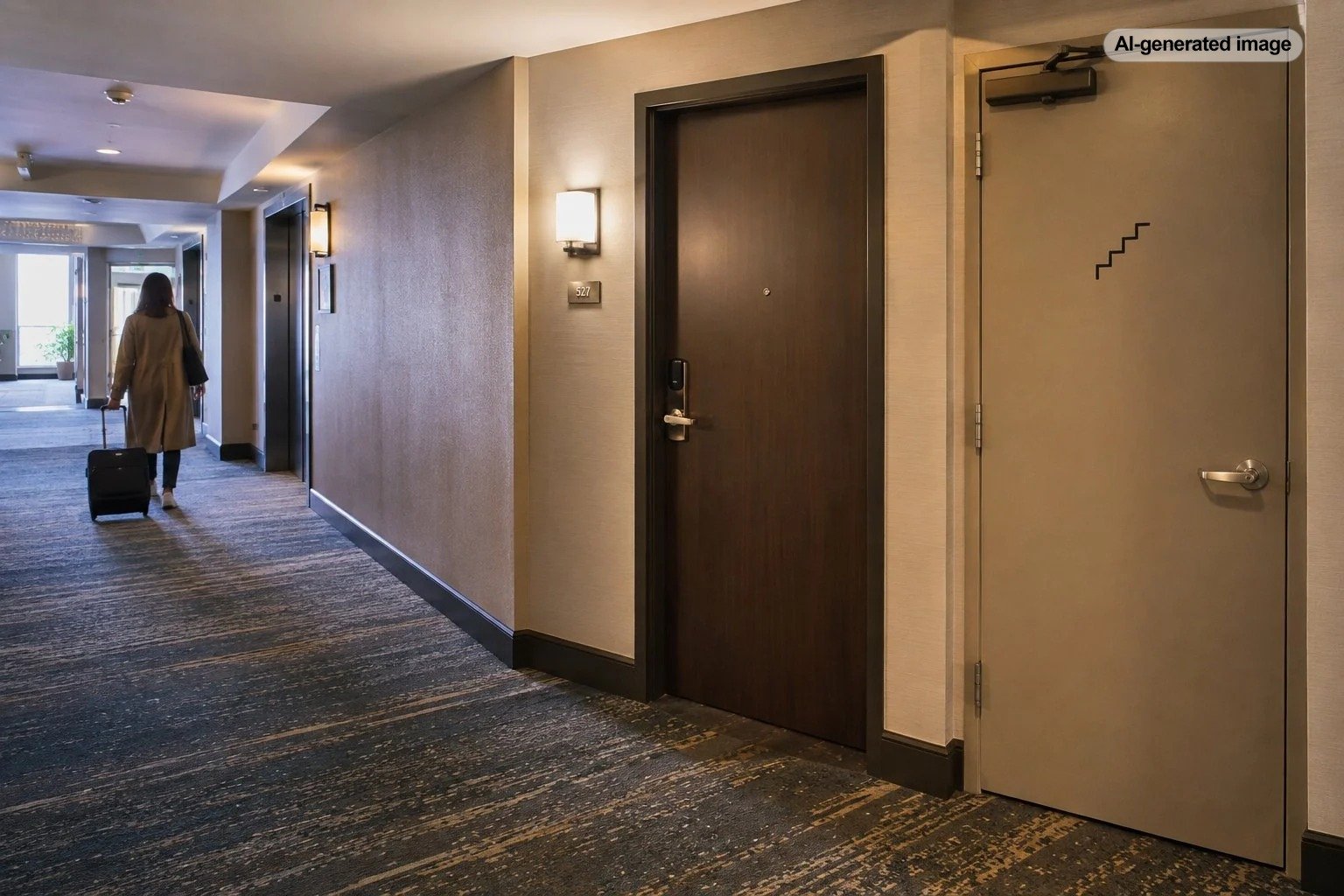
The principal concern is usually not the staircase itself. It is the door between the guest corridor and the stair enclosure. Guests using the stairs may open and close that door at different hours, and footsteps or conversations can briefly become audible in the hallway.
The effect depends heavily on construction. Some hotels have substantial corridor doors and effective acoustic separation, while in others a sudden door closing can be noticeable several rooms away. A traveler therefore cannot reliably judge the experience from a floor plan alone.
Traffic also matters. A staircase near a lobby, fitness area, meeting floor, parking connection, or other frequently visited part of a property may see considerably more use than one at the quiet end of an upper-floor corridor. During busy periods, groups returning to their rooms can also make otherwise quiet circulation areas temporarily louder.
A stairwell can sometimes be quieter than the elevator area
Avoiding the stairs does not necessarily mean obtaining the quietest room. Moving away from a stairwell may place a guest closer to elevators, where there can be a more consistent stream of people waiting, talking, arriving with luggage, or gathering before heading elsewhere in the hotel.
That is why a request for a room simply “away from the stairwell” can be less useful than explaining the real preference. If sleep is the priority, ask for a quiet room away from elevators, stair doors, ice machines, and other high-traffic areas. This gives the front desk more flexibility to choose an appropriate location within the available inventory.
When a room near the stairs is more likely to bother you
Some travelers have more reason than others to prioritize distance from a stairwell. Light sleepers, guests working unusual hours, and travelers who need uninterrupted daytime sleep may notice occasional corridor sounds more than someone who sleeps deeply.
A stairwell location may also be less appealing when several potential noise sources overlap. For example, a room beside a staircase that is also close to an elevator landing and an ice machine has a different noise profile from a room beside an isolated stairwell at the end of the hall.
You may prefer another room when:
- You are highly sensitive to doors closing in the hallway.
- The staircase appears to connect directly with a busy public floor.
- The room is also beside elevators, vending, or another circulation point.
- You plan to sleep during hours when other guests are likely to be moving around.
- You have previously found intermittent hotel corridor noise particularly disruptive.
When being near a stairwell can be convenient
There are also situations in which the location may be useful. Guests staying only one or two floors from a lobby, restaurant level, conference floor, or traveling companions may find stairs quicker than repeatedly waiting for an elevator.
Some travelers simply prefer stairs for short trips between floors. In a large hotel where elevators are centrally located, a nearby stairwell can also reduce the amount of corridor walking required for certain movements around the building.
For this reason, it is rarely necessary to treat a stairwell-adjacent room as inherently undesirable. The choice depends on whether potential intermittent noise or convenient access matters more for the particular stay.
Mid-hallway rooms often offer a useful compromise
Travelers who prioritize quiet commonly look for rooms farther from obvious circulation points. A mid-hallway position can be a practical compromise because it may provide some distance from both an elevator lobby and an end-of-corridor staircase.
There are exceptions. A mid-hallway room could still sit opposite housekeeping storage, an ice machine, or another frequently used door. A corner room could be quiet on one property yet sit directly beside a staircase on another. Room position should therefore be evaluated as a collection of nearby features rather than by one rule.
What to request before the hotel assigns your room
Specific wording is more useful than asking for the “best” room. Preferences vary, and the hotel may not know whether your priority is a view, short walking distance, elevator access, or quiet.
If noise is the concern, a clear request might be: “If available, I would prefer a quiet room away from elevators, stairwell doors, ice machines, and other high-traffic areas.”
Make the request before arrival when possible, but remember that room-location requests generally depend on the rooms available when assignments are made. It is also worth repeating the preference politely at check-in rather than assuming an earlier note guarantees a particular location.
Look beyond the stairwell when judging a room
Staircases are only one possible source of hotel noise. A room farther from the stairs can still be poorly positioned for a noise-sensitive traveler if it is near an elevator lobby, service door, ice machine, event area, or another heavily used part of the property.
External orientation matters as well. Depending on the hotel, a room facing a busy street or active outdoor area could be more disruptive than one beside a lightly used staircase. Conversely, a room in an internally quiet section of the building may still experience ordinary sounds from neighboring guest rooms.
The most useful approach is therefore to prioritize the overall environment instead of searching for a universally perfect room number.
What travelers often overlook
Noise tends to be intermittent near stairwells. Unlike a continuous mechanical hum, a stair door may be silent for long periods and then become noticeable when several people use it. Travelers react differently to these sudden sounds.
End-of-hall does not always mean quiet. End rooms can reduce passing corridor traffic, but some floor plans place staircases directly beside them.
Room requests should describe the goal. Asking for quiet gives hotel staff more options than rejecting one particular architectural feature.
A convenient room is not the same for every traveler. Someone with frequent trips between nearby floors may value staircase access, while someone planning uninterrupted sleep may place much greater value on separation from circulation areas.
FAQ
Are rooms beside stairwells always noisy?
No. Noise varies with the hotel’s construction, the amount of stair traffic, the position of the stair door, and other nearby activity. A lightly used stairwell may cause very little disturbance.
Is a room near the elevator worse than one near the stairs?
Not necessarily. Elevator areas often have more regular guest traffic, while staircase noise may be less frequent but more sudden. The quieter choice depends on the property’s layout and how guests move through it.
What is a good room location for a light sleeper?
A room away from major circulation and service areas is generally a sensible request. Rather than specifying one exact position, ask for a quiet room away from elevators, stair doors, ice machines, and other high-traffic points.
Should I request a room at the end of the hallway?
An end room can reduce the number of guests walking past your door, but check whether the end of the corridor also contains a stairwell or service area. End-of-hall placement is not automatically quieter.
Can I ask to change rooms if the stairwell is disruptive?
You can ask the front desk whether another room is available. Whether the hotel can accommodate the request will depend on occupancy, room type, and other operational considerations at that time.
Bottom line: You do not need to automatically avoid every hotel room near a stairwell. If you are sensitive to intermittent hallway noise, however, requesting some distance from stair doors is reasonable. The strongest request focuses on the broader goal: a quiet room away from the hotel’s busiest circulation and service areas.