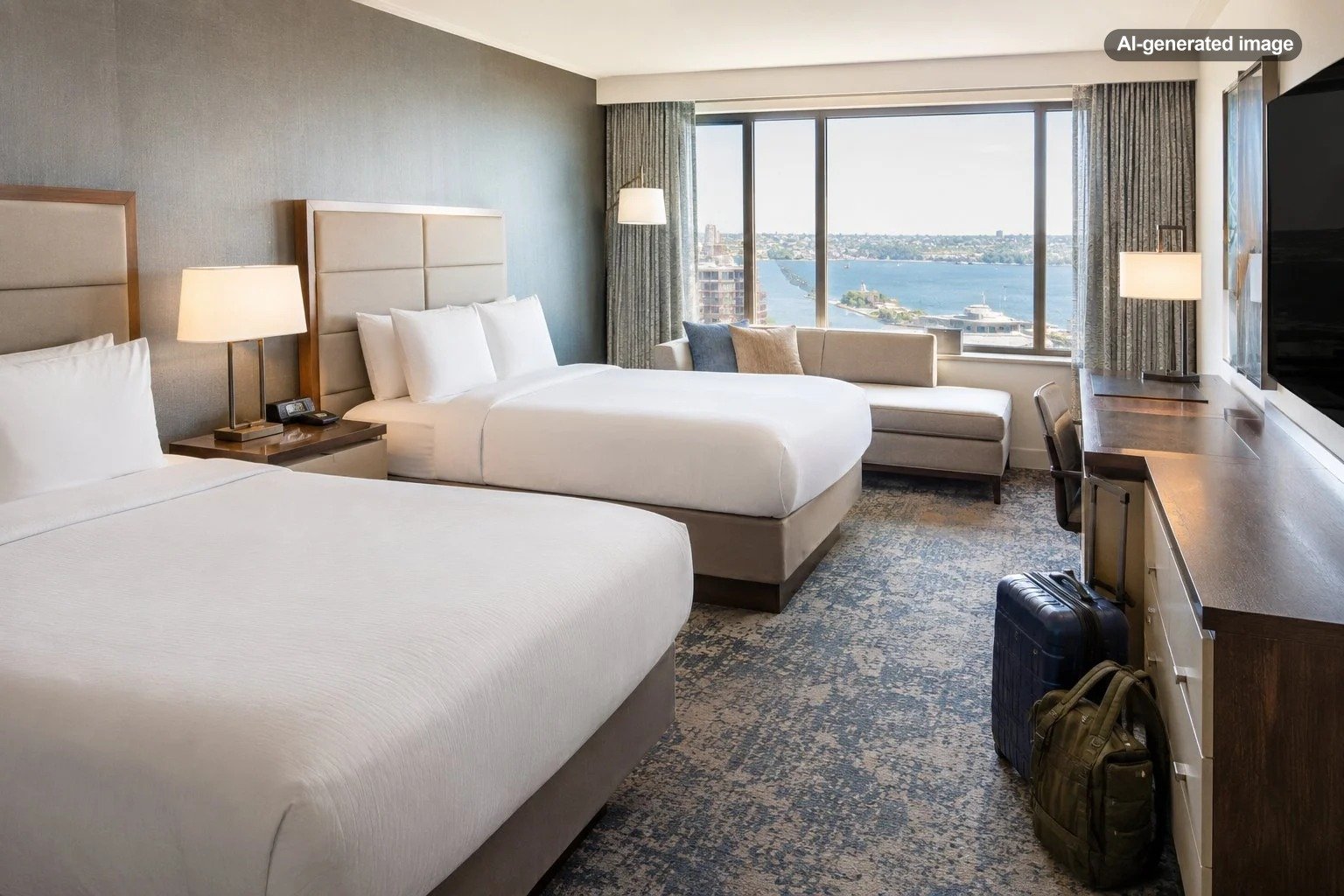
What Is the Best Hotel Room Setup for a Family of Five?
For most families of five, the best hotel room setup is either a true one-bedroom suite with a separate sleeping area or two guaranteed connecting rooms. A standard room with two queen beds may look large enough in photos, but it is often approved for only four guests and may not have space for an extra bed. The right choice depends on the children’s ages, the property’s occupancy rules, the length of the stay, and how much privacy the family needs.
The central rule is simple: book a setup that officially accommodates all five guests. Do not assume a sofa bed, rollaway, crib, or connecting door will be available unless the hotel confirms it for the exact room type and reservation.
Quick answer
- Best overall: A one-bedroom suite with two beds plus a sofa bed, provided the listed occupancy is at least five.
- Best for privacy: Two connecting rooms, especially for families with older children or different sleep schedules.
- Best for younger children: A suite with a bedroom separated by a door, so adults can stay awake after bedtime.
- Best for a short stay: A family room or larger studio that officially sleeps five.
- Usually the weakest option: A standard two-bed room that depends on an unconfirmed rollaway or an unofficial fifth sleeper.
Why a standard room often does not work
A room with two queen beds appears to provide enough sleeping surface for five people, especially when the children are small. The issue is not only comfort. Hotels set occupancy limits based on the room layout, local requirements, fire safety considerations, and the property’s own operating policies. A room that physically contains two large beds may still have a maximum occupancy of four.
Option 1: A true one-bedroom suite
A one-bedroom suite is often the most balanced setup for a family of five. The strongest configuration includes a bedroom with one or two beds, a living room with a sleeper sofa, and a door separating the two spaces. This arrangement creates two sleeping zones without requiring the family to reserve two separate rooms.
It works especially well when younger children go to bed earlier than the adults. Parents can talk, read, or watch television in the living area without keeping everyone awake.
The tradeoff is that the term suite is inconsistent. Some hotels use it for a larger open-plan room rather than a separate bedroom. Before booking, check the floor plan or room description for a closing door, the exact number and size of beds, and the maximum occupancy. A sofa shown in a photo is not necessarily a sofa bed.
Option 2: Two connecting rooms
Two connecting rooms are often the most comfortable choice for families with teenagers, long stays, or different sleep schedules. They typically provide more total floor space, more beds, and a second bathroom. The extra bathroom can be the deciding factor when five people need to get ready at the same time.
The main risk is the word connecting. Adjacent rooms are next to each other, while connecting rooms have an interior door between them. Some hotels treat connecting rooms as a request rather than a guarantee. Families should verify whether the connection is confirmed at booking, guaranteed by room category, or merely noted as a preference. If the children are too young to stay in a separate room without an interior connection, that detail is essential.
Affiliate disclosure: HotelInfo.com may earn a commission when you book or purchase through links on this page. This does not affect the price you pay. Learn more.
When comparing properties, families can browse family-friendly hotels on Hotels.com, then confirm the exact occupancy, bedding, and connecting-room policy directly with the selected property before arrival.
Option 3: A family room designed for five
Some hotels offer a family room with a combination such as two larger beds and a single bed, one larger bed plus bunk beds, or several fixed sleeping surfaces in one room. This can be a practical middle ground: simpler than booking two rooms and often more reliable than depending on a rollaway.
A family room is usually best for a short stay, a family that does not need much privacy, or travelers who want everyone in one space. Fixed beds are generally easier to plan around than temporary beds because the layout is part of the room category.
Option 4: An open-plan studio with a sofa bed
An open-plan studio can work when it officially sleeps five and includes two beds plus a sleeper sofa, or a similar combination. It may offer more space than a standard room and sometimes includes a small dining or kitchenette area.
The drawback is that everyone shares the same light, noise, and temperature. Once one person goes to sleep, the whole room may need to quiet down. Sofa-bed comfort and size also vary, so it is worth confirming whether the sleeper is suitable for one child or two and whether linens are included.
Option 5: A standard room with a rollaway
A standard room with two beds and a rollaway can be workable, but only when the hotel explicitly allows five guests in that room type and confirms that a rollaway can be placed there. Rollaways are often restricted because they can block walkways or reduce safe clearance around furniture.
The risks are substantial: the rollaway may be unavailable, the room may not permit one, or the final layout may leave almost no usable floor space. A portable crib is not a substitute for a bed unless it is appropriate for the child’s age and the hotel includes it within the permitted occupancy.
How to choose the right setup
Compare total cost, not just the room rate
A suite may cost more than a standard room but less than two rooms. Two connecting rooms may provide better value when they include four fixed beds and two bathrooms. Families should compare the total reservation terms, required fees, meal arrangements, and cancellation conditions rather than focusing only on the first displayed rate.
Think about bedtime and morning routines
A separate bedroom is especially valuable when young children sleep early. Two bathrooms matter when everyone needs to leave at the same time. A kitchenette may matter more for an infant or a child with a highly specific meal routine. The best layout is the one that removes the family’s most predictable point of friction.
Questions to ask before booking
- What is the maximum registered occupancy for this exact room type?
- What beds are fixed, and which are sofa beds, rollaways, or cribs?
- Is the bedroom truly separated by a closing door?
- If booking two rooms, is the connecting door guaranteed or only requested?
- Can a rollaway legally and physically fit in the selected room?
- Does the hotel count infants and small children toward occupancy?
- Will the room still have usable luggage space when every bed is open?
What families often overlook
The number of beds does not always equal the number of comfortable sleepers. A sofa bed may be narrow, a bunk may have age or weight restrictions, and a rollaway may reduce the room’s usable space. Likewise, a room advertised for five may assume that two children share a sofa bed.
Frequently asked questions
Can five people stay in a room with two queen beds?
Only if the hotel lists that exact room type for an occupancy of five. Two queen beds do not automatically make the room approved for five guests.
Is a suite always better than connecting rooms?
No. A suite is often better for younger children and shared family time, while connecting rooms are usually better for privacy, older children, and access to two bathrooms.
Can a hotel guarantee connecting rooms?
Some properties can guarantee them through a specific room category or booking process, while others record them only as a request. Confirm the property’s policy before relying on the connection.
Should children be included in the guest count?
Yes. Enter every traveler, including children, during the search and reservation process. The hotel determines how children and infants count toward the permitted occupancy.
What is the safest booking strategy for a family of five?
Choose a room or room combination that explicitly lists an occupancy of at least five, confirm the bedding configuration, and obtain written confirmation of any essential feature such as a connecting door, sleeper sofa, crib, or rollaway.
For most families, a true one-bedroom suite is the best starting point because it balances togetherness, privacy, and cost. Two guaranteed connecting rooms are the stronger choice when older children, longer stays, or morning logistics make extra space and a second bathroom more important.