One Week Morocco Itinerary
A well-planned one-week Morocco itinerary can combine historic cities, mountain scenery, fortified villages, and the Sahara without turning every day into a race. The most practical first-time route begins in Marrakech and ends in Fez, using a private driver, small-group tour, or rental car for the southern portion.
This itinerary includes two nights in Marrakech, a journey through the High Atlas and Dades Valley, a night near the Erg Chebbi dunes in Merzouga, and two nights in Fez. It is rewarding but active, with several long driving days. Travelers who prefer a slower vacation should skip the desert and divide the week between Marrakech, Essaouira, and Fez instead.
Planning snapshot
- Best fit: First-time visitors who want cities, mountain landscapes, and a Sahara experience in one trip
- Pace: Active, with two substantial road-transfer days
- Route: Marrakech, Dades Valley, Merzouga, and Fez
- Transportation: Driver, organized tour, or rental car between Marrakech and Fez
- Best flight strategy: Arrive in Marrakech and depart from Fez when workable
- Main tradeoff: Broad variety in exchange for limited downtime
Seven-day Morocco route at a glance
| Day | Base | Main focus |
|---|---|---|
| 1 | Marrakech | Arrival and an easy introduction to the medina |
| 2 | Marrakech | Historic sights, souks, gardens, and food |
| 3 | Dades Valley | High Atlas crossing, Ait Benhaddou, and southern landscapes |
| 4 | Merzouga | Todra area, desert arrival, and Erg Chebbi |
| 5 | Fez | Long transfer north through changing landscapes |
| 6 | Fez | Guided exploration of Fez el-Bali |
| 7 | Fez or departure | Gardens, crafts, a relaxed meal, and onward travel |
Day 1: Arrive in Marrakech and ease into the medina
Keep the first day deliberately light. Marrakech can feel intense immediately after a flight, particularly inside the medina, where narrow lanes, pedestrians, scooters, vendors, and delivery carts share limited space.
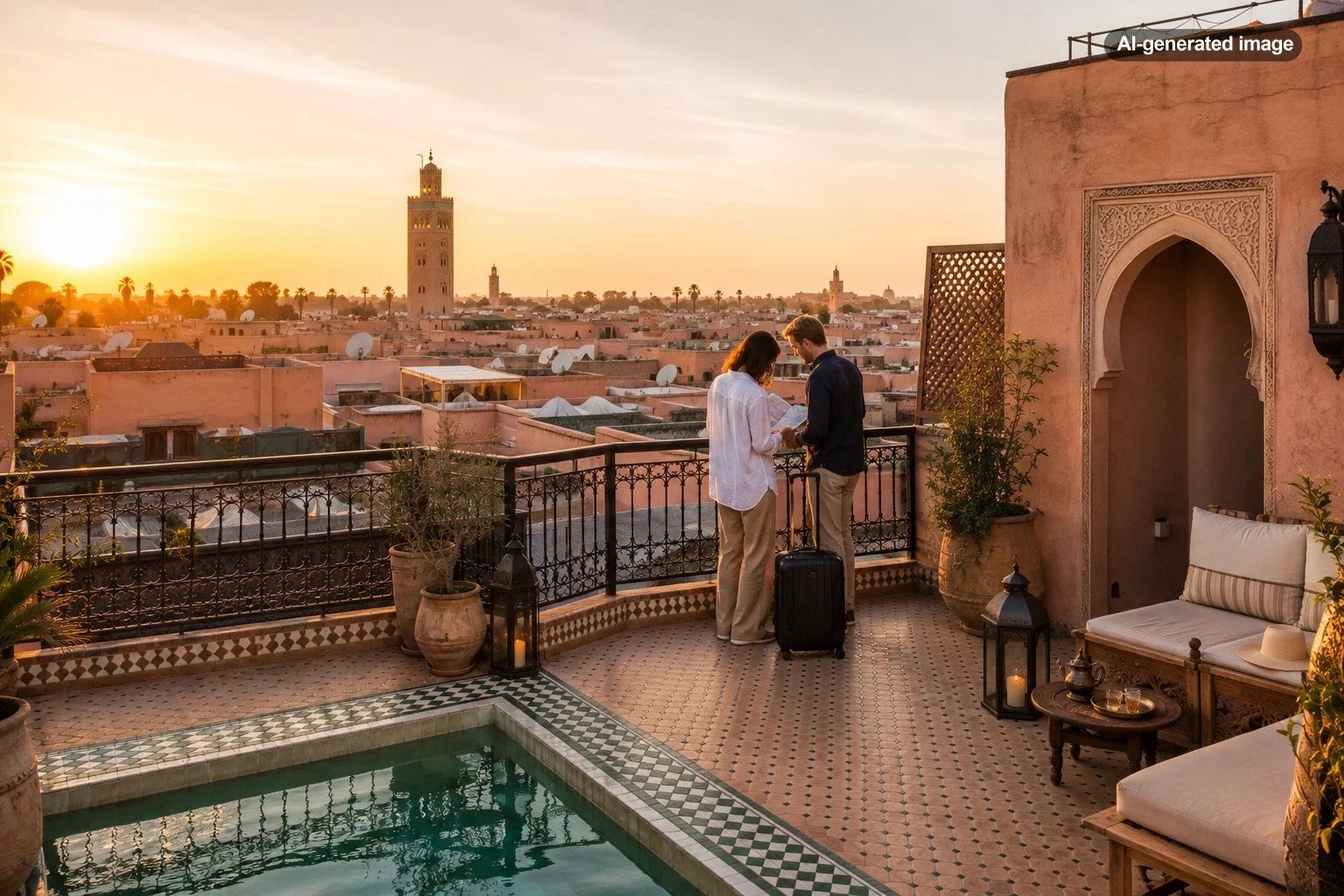
After checking into a riad or hotel, take a short orientation walk rather than attempting a full sightseeing circuit. Jemaa el-Fna and the surrounding souks provide an immediate introduction to the city, but it helps to note a few fixed landmarks and save your lodging location offline before wandering deeply into the lanes.
For dinner, choose either a calm rooftop restaurant or a traditional dining room near your accommodation. Travelers arriving late should arrange a transfer in advance and confirm the exact meeting point. Vehicles cannot reach every riad entrance within the medina.
Day 2: Explore Marrakech beyond the main square
Use the second day for Marrakech’s architectural and cultural contrasts. A guided morning walk can make the medina easier to understand and reduce time lost navigating between historic sites. Build the day around a limited number of priorities rather than attempting every palace, museum, market, and garden.
A balanced route might include the Bahia Palace area, the Saadian Tombs, the souks, and a garden visit. Some travelers will prefer the visual energy of the medina, while others may appreciate the wider streets, cafes, and contemporary atmosphere of Gueliz later in the afternoon.
Leave time for practical preparation before the desert journey. Withdraw cash, repack a smaller overnight bag if your operator permits it, buy water and snacks, and confirm the next morning’s pickup location. A large vehicle may collect you outside the medina rather than directly at your lodging.
Day 3: Cross the High Atlas and continue to the Dades Valley
Depart Marrakech early for the drive across the High Atlas. This is not merely a transfer day: the road introduces a different side of Morocco through mountain passes, villages, valleys, and progressively drier landscapes.
A common stop is Ait Benhaddou, a fortified settlement in the Ounila Valley. Allow enough time to cross the river area, walk through the lanes, and appreciate the setting without treating it as a quick photograph. Continue through or near Ouarzazate and toward the palm groves, kasbah landscapes, and rock formations associated with the Road of a Thousand Kasbahs.
Spend the night in the Dades Valley or a nearby area. A valley guesthouse offers more atmosphere than rushing onward to Merzouga after dark. The tradeoff is that you will still have another substantial drive the following day.
Day 4: Travel through the Todra region to Merzouga
Continue east toward Tinghir and the Todra area. Depending on the route, weather, road conditions, and your chosen tour, there may be time for a short walk near the gorge or through a palm-filled valley. Avoid accepting an itinerary that promises several lengthy hikes, multiple cultural visits, and an early desert arrival on the same day.
By late afternoon, continue to Merzouga, a village beside the Erg Chebbi dune field. Desert accommodations range from lodges near the dunes to tented camps reached by camel, four-wheel-drive vehicle, or a combination of the two. Confirm transportation, bathroom arrangements, meal inclusion, luggage handling, and the camp’s actual location before booking.
A camel ride is optional rather than essential. Travelers with back, hip, knee, or mobility concerns may prefer a vehicle transfer. Sand can also make wheeled luggage impractical, so bring only what you need overnight and protect cameras and electronics from dust.
Day 5: Make the long journey from Merzouga to Fez
Day five is the route’s biggest compromise. The journey from the desert region to Fez is long, and actual timing depends on stops, traffic, road conditions, and the season. Leave early and regard this as a landscape day rather than a sightseeing checklist.
The route typically passes through the Ziz Valley area and continues north through changing terrain toward the Middle Atlas. Meal and rest stops are important, but too many optional shopping visits can make an already demanding transfer feel longer.
Arrive in Fez in the evening and keep dinner simple. A riad inside Fez el-Bali creates an atmospheric stay, although travelers with heavy luggage or limited mobility may prefer accommodation near an accessible medina gate or in the newer part of the city.
Day 6: Discover Fez el-Bali with a knowledgeable guide
Fez rewards deeper attention. Its historic medina is denser and more complicated than Marrakech’s, so a qualified local guide can provide context while helping you move efficiently through the lanes.
A thoughtful visit may include Bab Boujloud, traditional craft quarters, historic religious and educational exteriors, fountains, funduqs, food markets, and views toward the tanneries. Access rules vary by site, and not every religious building is open to non-Muslim visitors, so rely on posted guidance and current local information.
Be cautious around unsolicited guidance and shopping detours. A workshop or cooperative can be genuinely informative, but a sales stop should not consume the day unless you are interested in purchasing. Ask your guide in advance how shopping visits are handled.
Day 7: Slow down in Fez before departure
Use the final morning for the parts of Fez that were easy to miss during the guided day. Jnan Sbil offers a calmer contrast to the medina, while the area around the Royal Palace gates and the mellah provides a different architectural perspective.
Alternatively, return to a craft district, enjoy a long lunch, book a cooking experience, or simply spend several hours observing daily life from a cafe or riad terrace. This lighter final day creates useful flexibility if earlier travel runs late.
For an early flight, consider moving to an airport-accessible hotel the previous evening or arranging a confirmed transfer. Passengers departing by train should check the current timetable directly rather than relying on an old blog post or screenshot.
Should you rent a car, hire a driver, or take a tour?
Small-group tour
A small-group tour is generally the simplest way to cover Marrakech, the southern valleys, Merzouga, and Fez within a week. It reduces logistical work and can offer reasonable value. The disadvantages are fixed stops, limited control over lodging, possible shopping detours, and less flexibility when you want to linger.
Private driver
A private driver offers the best balance of convenience and control for couples, families, and friends sharing costs. Confirm which expenses are included, whether the driver is also a licensed guide, the planned daily route, luggage limits, and the standard for overnight accommodations.
Rental car
A rental car provides independence but demands more concentration. Mountain roads, nighttime driving, parking near medinas, navigation, and long distances can make the trip tiring. Avoid planning to drive directly after an overnight flight, and do not assume that online travel-time estimates include meal stops, viewpoints, traffic, or roadwork.
What travelers often overlook
- An open-jaw flight can save time. Flying into Marrakech and out of Fez avoids spending much of the final day backtracking.
- The desert is not close to Marrakech. A genuine Erg Chebbi visit requires substantial road travel and should not be treated as a casual day trip.
- One desert night is brief. It provides the experience of the dunes but leaves little time for extended exploration or rest.
- Medina lodging involves access tradeoffs. A beautiful riad may require walking through narrow lanes with luggage.
- Season affects comfort. Heat, cold desert nights, rain, snow in mountain areas, and daylight hours can alter the practical rhythm of the route.
A slower alternative without the Sahara
Travelers who dislike long road days should use three nights in Marrakech, two nights in Essaouira, and two nights in Fez, connecting the cities through an appropriate combination of road and rail travel. This version sacrifices the dunes and southern valleys but offers more time for meals, neighborhoods, gardens, coastal walks, and unstructured exploration.
Another option is to spend the entire week between Marrakech and the Atlas region. This works especially well for travelers interested in design, food, wellness, hiking, or a relaxed riad stay rather than geographic coverage.
Frequently asked questions
Is one week enough for Morocco?
One week is enough for a focused introduction, but not for seeing every major region. Choose either a city-and-desert route or a slower combination of two or three destinations.
Can you visit Marrakech, the Sahara, Fez, and Chefchaouen in seven days?
It is technically possible, but the schedule becomes dominated by transportation. Chefchaouen is better added when you have at least nine or ten days, or when you remove one of the southern overnight stops.
How many nights should you spend in Marrakech?
Two nights is the practical minimum for this route. Three nights is preferable when arrival day is late, you want a cooking class or hammam, or you prefer slower sightseeing.
Is the desert portion suitable for children?
It can be, but families should evaluate driving tolerance, heat, cold nights, food needs, car-seat arrangements, and camp access. A private itinerary is usually easier to adjust than a fixed group tour.
Do you need a guide in Marrakech and Fez?
A guide is not mandatory, but a reputable guide can add context and reduce navigation difficulties. Guidance is particularly useful in Fez el-Bali, where the network of lanes is extensive.