How to Choose a Glass-Igloo Hotel for Northern Lights Viewing
Choosing a glass-igloo hotel for Northern Lights viewing involves more than finding an attractive room with a transparent roof. The most important considerations are the hotel’s geographic location, surrounding light pollution, actual sky visibility from the accommodation, and the time of year. A beautifully designed igloo surrounded by trees or outdoor lighting may provide a less satisfying viewing experience than a simpler cabin with an unobstructed view of the northern sky.
The ideal glass-igloo hotel combines a dark location with practical room design, comfortable sleeping conditions, and enough flexibility to watch the aurora outdoors when necessary. The Northern Lights are a natural phenomenon, so no accommodation can guarantee a display. Choosing carefully can, however, make the experience considerably more enjoyable when conditions cooperate.
Quick Answer: What Makes a Good Glass-Igloo Hotel?
- Location: Prioritize northern destinations with favorable aurora-viewing conditions rather than choosing solely by hotel appearance.
- Sky exposure: Look for an unobstructed view through the glass roof, preferably including the northern horizon.
- Light pollution: Favor properties with limited artificial lighting around the accommodation.
- Room comfort: Confirm heating, ventilation, privacy features, and the arrangement of the bed beneath the glass.
- Stay length: Allow several nights when possible, since cloud cover and auroral activity can change considerably between evenings.
Start With the Destination, Not the Igloo Design
The first decision is where to travel. Glass-roofed accommodations are available in several northern destinations, but their locations do not all provide the same viewing opportunities.
Finnish Lapland is particularly well known for purpose-built aurora accommodations, including glass igloos, panoramic cabins, and glass-roofed suites. Destinations such as Saariselka, Inari, Levi, and the wider Rovaniemi region offer different combinations of accessibility, outdoor activities, and proximity to relatively dark landscapes.
The Finnish Meteorological Institute identifies northern Lapland as an especially favorable region for aurora viewing. It also emphasizes that clear skies are essential. This distinction matters because a hotel farther north may offer favorable geographic conditions without providing a better view on a particular cloudy night.
Remote Wilderness Versus Accessible Resort Areas
A remote property may have darker surroundings and fewer nearby buildings. It can be appealing to travelers who want quiet evenings, expansive scenery, and a stronger sense of separation from developed areas.
However, remote accommodations may require longer transfers and more advance planning for meals or activities. Accessibility becomes particularly important when arriving after dark or traveling during periods of challenging winter weather.
A property closer to a town or established resort area may offer more convenient transportation, dining, and organized excursions. The tradeoff can be additional artificial lighting or a less open horizon.
Neither setting is automatically superior. The important question is whether the specific accommodation provides a useful view of the night sky while meeting the traveler’s practical needs.
Examine the Actual View From the Glass Roof
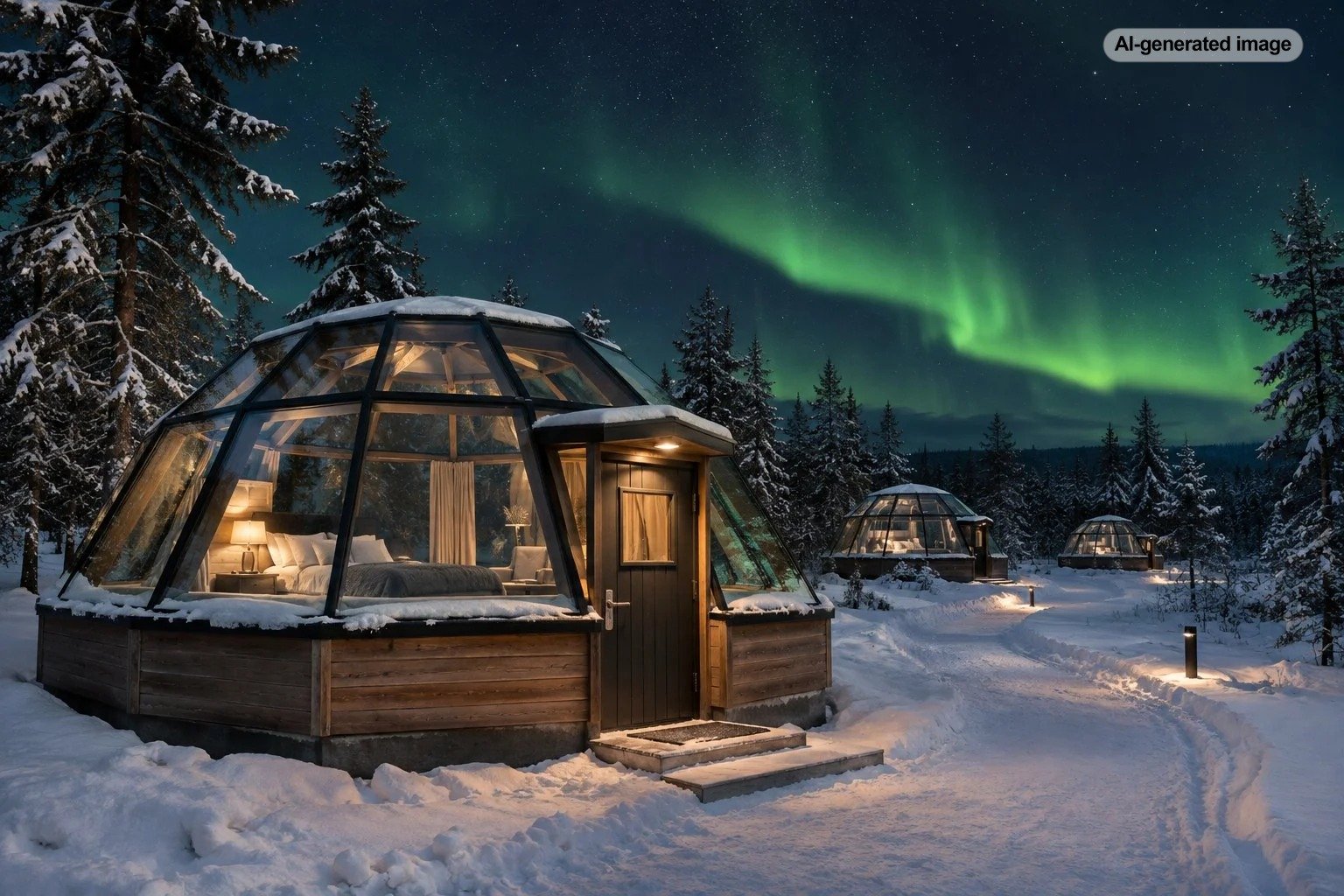
The expression glass igloo describes several different accommodation designs. Some have curved transparent ceilings, while others resemble conventional cabins with large panoramic windows or partially glazed roofs.
These differences affect how easily guests can observe the sky from bed.
Glass Coverage and Bed Position
One of the most useful details to investigate is the relationship between the bed and the transparent section of the roof.
In some layouts, guests can look directly upward while lying comfortably. Other rooms require sitting up, turning toward a window, or moving to a particular part of the accommodation.
Look for photographs showing the room from the bed rather than relying exclusively on exterior promotional images. A wide-angle photograph of a glass dome does not necessarily show what a guest can see while reclining.
Check the Northern Horizon
The Northern Lights can appear directly overhead during strong displays, but less extensive displays may remain closer to the northern horizon.
For this reason, a useful glass-igloo view is not simply a large patch of sky. It should ideally include a reasonably open northern outlook, without substantial obstruction from buildings, trees, or terrain.
When comparing rooms, ask whether different units face different directions and whether the hotel can explain the sky exposure from a particular accommodation category.
Understand the Difference Between Glass Roofs and Panoramic Windows
A glass-roofed room makes overhead viewing especially convenient. A cabin with a large vertical window may instead frame a distant horizon or surrounding landscape more effectively.
For travelers who value comfort and scenic views throughout the day, a panoramic cabin may be just as appealing as a traditional glass igloo. Those specifically hoping to watch auroras while lying in bed should prioritize overhead visibility.
Evaluate Light Pollution Around the Property
Artificial light can reduce the contrast between a faint aurora and the surrounding night sky. This can matter even when the hotel is located in a relatively remote region.
Pathway lighting, illuminated buildings, neighboring accommodation units, parking areas, and outdoor decorative lights may all affect what guests see through the glass.
Interior reflections are another consideration. A bright bedside lamp or television can reflect in the glass and make the night sky more difficult to observe.
Before reserving, consider asking the hotel:
- Are the igloos positioned away from strongly illuminated communal areas?
- Can nearby exterior lighting be dimmed during nighttime viewing hours?
- Are certain accommodation units more exposed to artificial light than others?
- Is there an accessible outdoor viewing area with a darker, more open outlook?
A property that provides both comfortable indoor viewing and a convenient outdoor alternative may be more practical than one relying entirely on its transparent roof.
Choose the Right Season for Northern Lights Viewing
Seasonal timing influences darkness, weather, landscape conditions, and the overall character of a glass-igloo stay.
In Finnish Lapland, the Northern Lights viewing season generally extends from late August into early April, when sufficiently dark nights return. The season varies by latitude, and actual visibility depends on weather and auroral activity.
| Period | Potential advantages | Practical tradeoffs |
|---|---|---|
| Late August to October | Darkness returns, autumn scenery, and possible aurora reflections on unfrozen water | Snow-covered scenery is not assured; weather can be variable |
| November to January | Long nights and, depending on location and weather, a winter landscape | Limited daylight, potentially severe cold, and popular holiday travel periods |
| February to March | Winter scenery, increasing daylight for daytime activities, and favorable seasonal aurora potential | Cold conditions remain possible; demand may be substantial |
| Early April | Some northern locations retain dark viewing hours | Shorter nights progressively reduce the viewing window |
Travelers primarily interested in a snowy Arctic setting may prefer the winter months. Those focused on balancing aurora opportunities with more daylight for other activities may find late winter particularly appealing.
It is important not to confuse a long night with a guaranteed clear sky. A shorter, cloud-free evening can be more productive than an entire night beneath heavy cloud cover.
Consider Heating, Ventilation, and Window Clarity
Glass-igloo accommodation must balance large transparent surfaces with comfortable interior temperatures. Because guests may spend long periods watching the sky without leaving their beds, room comfort deserves careful attention.
Heating and Temperature Control
Confirm how the accommodation is heated and whether guests can adjust the temperature independently. A hotel describing its igloos as suitable for winter use does not necessarily provide identical heating arrangements in every room category.
Travelers sensitive to temperature changes should ask whether the sleeping area remains comfortable during especially cold weather and whether additional bedding is available.
Condensation, Frost, and Snow
Transparent roofs can lose their viewing advantage when condensation, frost, or accumulated snow obscures the glass.
Some accommodations incorporate systems intended to help maintain roof visibility, but the technology and its effectiveness vary. Do not assume every glass igloo has an actively heated roof or an automatic snow-clearing system.
Ask whether the glass is designed to remain clear in winter conditions, how snow is managed, and what assistance is available if visibility becomes obstructed.
Ventilation and Interior Reflections
Ventilation affects indoor comfort and may influence condensation. Ask whether windows or vents can be adjusted and how temperature and humidity are managed.
It is also worth checking whether interior lighting can be completely switched off while retaining any necessary bedside controls. Dimmable lighting can make the transition between comfortable room use and nighttime sky observation easier.
Decide How Much Privacy You Need
The transparent surfaces that make glass igloos appealing can also introduce privacy concerns.
Depending on the layout, neighboring guests, pathways, or shared facilities may be visible from the accommodation. A room that looks secluded in a promotional photograph may feel less private when the surrounding units are occupied.
Check whether the property offers blinds, curtains, privacy screens, or sections of opaque glazing. Also consider whether using these features blocks the portion of the roof intended for aurora viewing.
For couples seeking a quiet retreat, spacing between units may be as important as the size or architectural style of the accommodation.
Look for Aurora Alerts and an Outdoor Viewing Alternative
One of the most useful services a glass-igloo hotel can offer is a reliable way to notify guests when auroral activity becomes visible.
Some accommodations provide alerts through in-room systems, mobile messages, or staff notifications. These services should be verified directly because availability and operating procedures differ.
Ask whether alerts are based on local observations, forecasts, or a combination of both. An alert indicating increased geomagnetic activity does not necessarily mean the sky above the property is clear.
It is useful to have somewhere to step outside when a display occurs. Glass can introduce reflections, while a nearby open viewing area may provide a wider field of vision.
For guests willing to travel beyond the property, organized aurora excursions may offer additional flexibility when weather conditions differ across an area. Tours cannot guarantee a sighting, but the ability to move toward clearer skies can be valuable.
How Many Nights Should You Book in a Glass Igloo?
A single night can be memorable, but it provides only one opportunity for the weather and auroral activity to cooperate.
For travelers whose primary objective is seeing the Northern Lights, planning several nights in the destination is generally more sensible than relying on one evening. A stay of three or four nights provides additional opportunities, although it still cannot guarantee clear skies or a display.
That does not necessarily mean every night must be spent in an expensive glass-roofed room.
A practical strategy is to combine one or two nights in a glass igloo with additional nights in conventional accommodation nearby. This can provide the distinctive sleeping experience while preserving flexibility in the overall lodging budget.
Travelers using this approach should consider transfer arrangements between properties and whether changing rooms will interfere with daytime activities.
Understand What the Room Rate Actually Includes
Glass-igloo hotels often command attention because of their architecture and setting. The accommodation experience, however, can differ substantially from a conventional full-service hotel.
Before booking, review what is included in the selected rate and room category. Relevant questions include whether breakfast is provided, where meals are served, whether transfers are available, and whether outdoor activities are arranged separately.
Also confirm the bathroom configuration. A glass-roofed cabin may contain a private bathroom, but bathroom layout, shower arrangements, and available facilities should never be assumed from the accommodation’s exterior appearance.
If a longer Arctic stay is planned, travelers can compare additional lodging formats through a service such as Homes & Villas by Marriott Bonvoy, where relevant vacation-rental options may be available. This is an alternative accommodation search rather than a dedicated glass-igloo booking service; availability, features, policies, and rates depend on the individual property.
What Travelers Often Overlook Before Booking
Several less obvious details can influence whether a glass-igloo stay meets expectations.
- Room-specific photographs: Confirm that the images represent the category being booked, not a larger or differently positioned accommodation.
- Snow management: Ask how the hotel handles snow or ice that interferes with roof visibility.
- Exterior lighting: Determine whether nearby buildings and walkways remain illuminated through the night.
- Sleep quality: Consider how darkness, early sunrise, room temperature, and nearby guest activity may affect rest.
- Arrival logistics: Check the practical arrangements for reaching the property, particularly after dark.
- Cancellation terms: Review the actual booking conditions rather than assuming poor aurora weather qualifies for a refund.
- Outdoor access: Verify whether there is a convenient viewing area beyond the igloo itself.
The most expensive or visually dramatic accommodation is not automatically the best choice. A well-positioned, comfortable room with sensible lighting and good operational support may deliver a stronger overall experience.
How to Make the Final Choice Between Two Glass-Igloo Hotels
When two properties look similarly appealing, compare them in the order most relevant to the trip.
First, compare geographic location and sky conditions. A northern location with limited surrounding development may be more useful for aurora-focused travel than a more accessible setting with substantial artificial lighting.
Second, compare the specific room views. A property advertising panoramic glass architecture may still have individual units with different orientations or obstructions.
Third, compare the practical experience. Heating, privacy, snow management, meals, transportation, and nighttime alerts can matter substantially during a multi-night stay.
Finally, compare the total booking conditions. Consider accommodation costs alongside transfers, meals, excursions, cancellation flexibility, and the number of nights needed for the trip.
For travelers prioritizing the aurora itself, sky visibility and location should usually outweigh decorative room features. For those celebrating a special occasion, architectural design, dining, privacy, and comfort may carry more weight.
Frequently Asked Questions
Can you really see the Northern Lights from bed in a glass igloo?
Yes, when the aurora is visible in the sky above the accommodation and the glass provides an unobstructed view. The experience depends on the room’s orientation, roof design, nearby lighting, weather, and auroral activity. Not every glass igloo provides the same view from its bed.
Are glass igloos better than regular hotels for Northern Lights viewing?
Glass igloos offer the convenience of watching the sky from a warm room. They do not inherently improve the likelihood of auroral activity or clear weather. A conventional hotel near a dark, open viewing area can be equally suitable for travelers comfortable spending time outdoors.
Is December a good month to stay in a glass igloo?
December offers long periods of darkness in northern Finland and can suit travelers seeking a winter atmosphere. However, cloud cover remains an important limitation. February and March may appeal to travelers who want a combination of winter scenery, increased daylight, and aurora-viewing opportunities.
Do glass-igloo hotels guarantee Northern Lights sightings?
No. Northern Lights visibility depends on natural conditions beyond the hotel’s control. Travelers should be cautious about interpreting promotional photographs or references to aurora frequency as promises of a sighting during a particular stay.
Should you book more than one night in a glass igloo?
Multiple nights improve the opportunity to experience suitable viewing conditions, but they are not essential for everyone. Travelers balancing cost and experience may prefer a shorter glass-igloo stay combined with additional nights in nearby accommodation.
Choose the Viewing Experience, Not Just the Photograph
The best glass-igloo hotel for Northern Lights viewing is one whose location, room design, and practical features support the experience you actually want. A transparent roof is only one part of that equation.
Prioritize a dark setting, an open view of the sky, comfortable indoor conditions, and enough flexibility to respond to changing weather. When those fundamentals are in place, the glass-igloo concept becomes more than an unusual accommodation design: it offers a distinctive and convenient way to enjoy an Arctic night, whether the aurora appears or not.
Sources & Further Reading
- Finnish Meteorological Institute: Auroras in Finland – Geographic differences in aurora visibility, seasonal conditions, and practical viewing guidance.
- Visit Finland: Northern Lights in Finland – Seasonal travel context, Finnish Lapland, and glass-roofed accommodation experiences.
- Visit Finland: Best Times to See the Northern Lights – Seasonal viewing considerations, clouds, darkness, and aurora activity.
- NOAA Space Weather Prediction Center: Tips on Viewing the Aurora – Scientific guidance on geomagnetic activity, timing, and viewing conditions.