Connecting Cruise Cabins vs. Family Suite: Which Is Better?
Choosing between connecting cruise cabins and a family suite is less about luxury than how your family will actually use the space. Two connecting cabins often provide better sleeping separation, additional bathroom facilities, and more personal space for families with older children. A well-designed family suite can be more appealing for parents with young children, travelers who want a shared living area, or groups interested in premium accommodations.
For many families of four to six, connecting cabins are the more practical starting point. However, a family suite can be the better choice when its layout includes genuinely separate bedrooms, suitable bathroom arrangements, and enough space for everyone to spend time together. The right answer depends on the specific ship, cabin configuration, total booking cost, and ages of the travelers.
Quick Answer: Connecting Cabins or a Family Suite?
- Choose connecting cabins when separate sleeping spaces and two bathrooms are priorities.
- Choose a family suite when you want a comfortable shared living space, potentially upgraded amenities, or a more residential layout.
- For teenagers: Connecting cabins usually offer more independence and privacy while keeping the family close.
- For younger children: Either option can work, but parents should prioritize direct interior access, supervision, and actual sleeping arrangements.
- For larger families: Compare maximum occupancy carefully. Not every room labeled family or suite accommodates six or more guests.
The most useful comparison is not two standard rooms versus the largest suite on the ship. It is the total cost and functionality of two specific connecting cabins versus one specific suite available on the same sailing.
What Is the Difference Between Connecting Cruise Cabins and a Family Suite?
Connecting cruise cabins
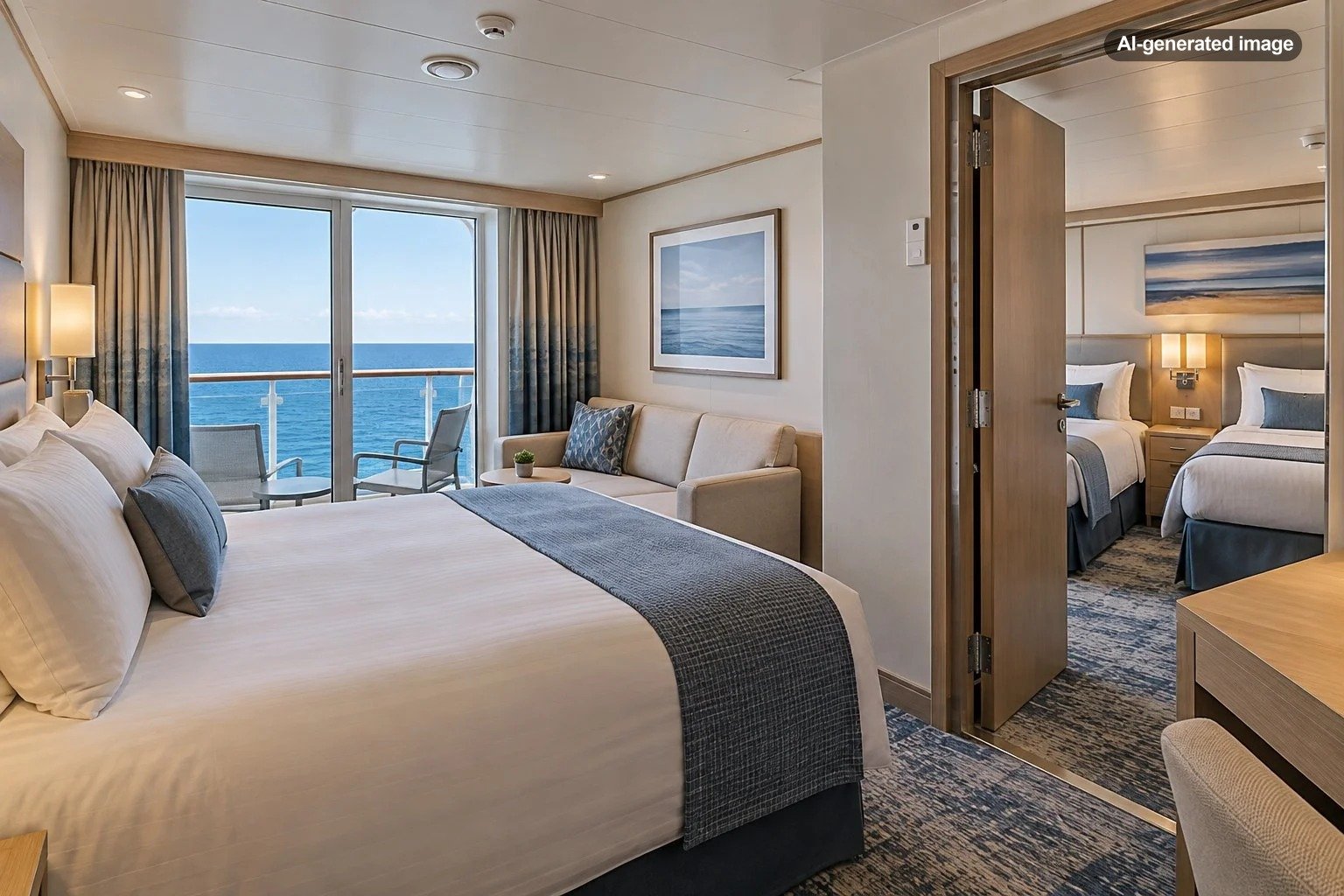
Connecting cabins are two separate staterooms with an interior doorway between them. Each typically retains its own corridor entrance, sleeping arrangements, storage, and bathroom. Guests can use the connecting doorway to move between the rooms without entering the public hallway.
This arrangement gives a family two distinct spaces. Parents can close the connecting door when appropriate for privacy or keep it open while everyone is awake. The cabins are still individual accommodations, so they may have separate reservation details, onboard accounts, or assigned occupants.
Connecting is not the same as adjoining. Adjoining cabins may simply sit next to each other without an interior doorway. That distinction matters particularly when traveling with children.
Family suites
A family suite generally offers more space or a different layout than a standard cabin, but the term is not standardized across cruise lines. One suite might include a separate bedroom and living room. Another might consist of a large open-plan room with a sofa bed and additional fold-down sleeping accommodations.
Some suites include multiple bathrooms, dining areas, larger balconies, or access to special onboard services. Others primarily offer more floor space without providing meaningful sleeping privacy.
The critical question is whether the suite has separate rooms or merely more square footage. A spacious suite with everyone sleeping in one area can feel less private than two modest connecting cabins.
Connecting Cruise Cabins vs. Family Suite: Side-by-Side Comparison
| Consideration | Connecting cabins | Family suite |
|---|---|---|
| Sleeping privacy | Two separate rooms | Depends on bedroom layout |
| Bathrooms | Usually two | One or more |
| Shared living space | Limited unless cabins have sitting areas | Potentially more comfortable |
| Storage | Distributed between cabins | Varies by suite design |
| Cost | Often worth comparing for value | May command a substantial premium |
| Premium benefits | Based on cabin category | May include suite-specific services |
| Best fit | Families prioritizing privacy and bathrooms | Families prioritizing shared space and suite features |
Which Option Gives Your Family More Usable Space?
Square footage is useful, but it rarely tells the full story. Two cabins might offer more combined floor area than a family suite, yet that area is divided by walls and a doorway. Conversely, a suite with a dedicated living room might feel considerably more spacious during the day.
Consider a family of five traveling with three children. In connecting cabins, the family could distribute luggage, clothing, toiletries, and sleeping arrangements between two rooms. Each room also provides a separate place for someone to read, rest, or change clothes.
In a family suite, the same travelers might have a generous sitting area during the day. However, if the sofa becomes a bed at night and an additional berth folds down from the wall, much of that open space could disappear.
Before booking, examine the floor plan in its nighttime configuration. Identify every sleeping surface, determine whether the main bed can be separated into twins if necessary, and check how much walking space remains when all beds are in use.
For a suite, look specifically for a bedroom door, rather than assuming that a curtain or partial divider provides complete privacy.
Why Two Bathrooms Can Matter More Than a Larger Room
Bathrooms are among the most overlooked considerations when comparing family cruise accommodations.
For families of five or six, two separate bathrooms can make mornings significantly easier. Multiple people can shower, brush their teeth, and get ready for dinner without relying on a single room.
This becomes particularly valuable on port-intensive itineraries, when everyone may want to shower and change within a relatively short period after returning from shore.
However, do not automatically assume that a suite has only one bathroom or that every second bathroom includes a shower. Some family-oriented staterooms and suites feature split bathrooms, additional half-baths, or more than one full bathroom.
Disney Cruise Line, for example, describes split bathroom facilities in most of its standard staterooms. Carnival also identifies certain Deluxe Ocean View accommodations with an additional half-bath. These examples illustrate why the actual bathroom configuration is more informative than the room category name.
Which Is More Affordable: Two Connecting Cabins or One Suite?
Connecting cabins can be less expensive than a larger family suite, but there is no universal pricing rule. Cruise fares depend on the ship, departure date, cabin category, availability, and number of occupants.
A common mistake is comparing the advertised starting price of one standard cabin against the total price of a suite. That overlooks the cost of booking the second cabin and the way passenger fares are calculated.
Compare the total cost for everyone
Request a complete quote for both arrangements using the same sailing, passenger ages, and comparable fare conditions. Check:
- Total cruise fare for all guests, not just a per-person starting rate.
- Taxes, fees, and any required charges.
- Gratuities and their treatment under the selected fare or package.
- Included dining, beverages, Wi-Fi, and other services.
- Deposits, payment terms, and cancellation conditions.
- Any suite benefits that would otherwise require an additional purchase.
Two cabins may involve different fare calculations from one suite because of how guests are distributed between accommodations. A suite may cost more but include benefits that matter to the family. Those benefits should be valued according to what travelers would actually use, rather than their advertised prestige.
An interior connecting pair can be a particularly useful comparison against a larger suite for families who primarily use their accommodation for sleeping. On the other hand, travelers planning to spend substantial time in their room may find a comfortable suite worth the additional expense.
Best Choice for Families With Babies and Young Children
Parents with babies or preschool-age children should evaluate sleeping visibility, nighttime movement, and supervision before focusing on amenities.
A family suite with a separate bedroom may allow parents to put young children to bed while using a nearby living area. This is especially convenient when adults want to read or talk without disturbing sleeping children.
Connecting cabins can provide similar separation while giving the family an additional bathroom. However, parents must consider the connecting door, corridor doors, and how children will be supervised.
Ask the cruise line whether the interior connecting door can remain open in the desired configuration and whether there are any restrictions on door use. Confirm the locations of cribs, sofa beds, fold-down berths, and other sleeping surfaces.
Do not assume an infant can be added beyond the cabin’s stated maximum occupancy simply because the child will sleep in a crib. Occupancy limits still apply, and approved sleeping arrangements must be confirmed for the specific booking.
Best Choice for Families With Teenagers
Connecting cabins are often especially attractive for families traveling with teenagers. Separate rooms give older children greater privacy while allowing parents and children to remain directly connected.
Teenagers may keep different sleep schedules, spend more time getting ready, or want a quiet place away from younger siblings. Having a second bathroom can make the arrangement considerably more comfortable.
However, the reservation must comply with the cruise line’s minimum-age and room-occupancy requirements. Some cruise lines require an adult to be officially assigned to each cabin under certain circumstances, even when the family intends to use the rooms differently during the voyage.
Confirm the permitted arrangements with the cruise line before purchasing. Do not assume that parents can reserve one room for themselves and another exclusively for minors.
What About Families of Five, Six, or More?
Family size frequently determines which arrangements are available before preferences even enter the discussion.
Family of five
A family of five may have several choices. Depending on the ship, a larger standard stateroom, family-oriented cabin, suite, or connecting pair might accommodate the group.
The most important comparison is whether the fifth sleeping position is comfortable and whether the family can manage the available bathroom space.
Family of six
For six travelers, connecting cabins often deserve serious consideration. Many ordinary staterooms cannot accommodate six people, and suites with sufficient approved occupancy may be more limited.
Disney Cruise Line states that its largest Concierge-level suites can sleep seven guests, while other cabin categories have different occupancy limits. This demonstrates that a large enough suite may exist, but it does not mean that every suite can accommodate a family of six.
Seven or more travelers
For larger family groups, multiple cabins may provide more flexibility than searching exclusively for one exceptionally large suite.
Travelers should compare connecting pairs, groups of nearby cabins, and larger specialty accommodations. If more than two cabins are needed, the deck arrangement becomes especially important because not every neighboring group of rooms has internal connecting doors.
Are Connecting Cruise Cabins Guaranteed to Connect?
No. Booking two cabins near each other does not automatically guarantee an interior connection.
When connecting access is essential, select two specific cabins shown as a connecting pair on the ship’s deck plan and verify the relationship before completing the reservation.
Disney Cruise Line provides a connecting-stateroom selection process that allows travelers to identify available pairs. The company also notes that connecting accommodations cannot be guaranteed under certain restricted-fare reservations.
Other cruise lines may use different symbols, booking systems, or fare restrictions. Some allow passengers to request connecting rooms, while others permit selection of an identified connecting pair during booking.
Check whether your fare allows a specific cabin assignment and what happens if the cruise line changes your accommodation before departure.
For families who depend on direct internal access, a guaranteed connecting pair is more important than a vague promise that rooms will be nearby.
Do Family Suites Include Better Perks?
Some family suites come with additional services, but these vary considerably by cruise line and suite category.
Possible benefits include priority embarkation arrangements, access to designated lounges, expanded room service options, specialty dining benefits, or assistance from dedicated suite personnel.
These are possibilities rather than standard inclusions. A room marketed as a family suite may offer few additional services beyond its floor plan, while a premium suite elsewhere on the same ship may include extensive privileges.
Evaluate benefits individually. A family that spends most of its time at the pool, kids’ club, or on excursions might gain little from a premium private lounge. Another family may appreciate a quieter onboard retreat, particularly during a longer voyage.
Suite privileges can also depend on the precise category purchased. Never assume that every accommodation containing the word suite qualifies for the same benefits.
Balconies, Location, and Noise: Details Worth Checking
Even when the layout seems ideal, location can affect the comfort of a cruise cabin.
Check the decks immediately above and below the proposed cabins. Accommodations beneath entertainment venues, busy public decks, or heavily used service areas may experience more activity at certain times.
Consider the distance to elevators, stairways, and children’s facilities. A convenient central location can reduce walking for families, although high-traffic corridors may also be busier.
If choosing connecting balcony cabins, confirm whether the balcony divider can be opened and whether doing so is permitted on that specific ship. An interior connecting door does not establish that the outdoor spaces can be combined.
Similarly, a family suite with one large balcony may be preferable to two cabins with separate outdoor spaces, especially when the family wants to sit together. Balcony access should always be considered alongside appropriate supervision of children.
How to Compare Cabins Before You Book
Start by selecting an itinerary and ship, then compare the actual accommodation options available on that sailing. Avoid relying entirely on generic cabin-category descriptions from a different vessel.
Use this checklist before making the final decision:
- Verify occupancy: Confirm that every traveler, including infants, is included within the permitted capacity.
- Inspect the floor plan: Locate beds, bathrooms, interior doors, and any movable partitions.
- Check exact cabin numbers: Verify connecting-door symbols rather than relying on neighboring room numbers.
- Review sleeping configurations: Determine where every person will sleep when all berths are prepared.
- Compare bathrooms: Count full bathrooms, showers, and separate toilet facilities.
- Examine deck location: Look at surrounding cabins, public spaces, and nearby high-traffic areas.
- Compare complete quotes: Include relevant fees, fare conditions, and meaningful suite benefits.
- Confirm reservation rules: Check adult assignments, cabin guarantees, and what happens if a room changes.
It can also help to compare alternative ships if the first choice has limited connecting accommodations. A different vessel on a similar itinerary may offer a substantially better arrangement for the same family.
Affiliate disclosure: HotelInfo.com may earn a commission when you book or purchase through links on this page. This does not affect the price you pay. Learn more.
When evaluating different ships and departure dates, travelers can browse cruises with Expedia to explore itinerary options before confirming specific cabin layouts, occupancy rules, and final fares with the booking provider or cruise line.
Frequently Asked Questions
Are two connecting cruise cabins usually cheaper than a family suite?
They can be, particularly when comparing standard interior or ocean-view cabins against premium suites. However, pricing depends on the sailing, occupancy distribution, cabin category, and available fares. Compare complete family totals rather than advertised starting prices.
Can you leave the door open between connecting cruise cabins?
Connecting staterooms have an interior doorway designed to provide access between the rooms. The exact door arrangement and permitted use should be confirmed with the cruise line. Do not assume the door can be secured open in every configuration.
Do connecting cruise cabins have two bathrooms?
Usually, yes. Because connecting accommodations are two separate staterooms, each generally has its own bathroom. The fixtures and bathroom layouts may differ by cabin category, so check the ship’s floor plan.
Is a family suite better for a family of six?
Not necessarily. A family suite with enough approved sleeping capacity, separate bedrooms, and suitable bathrooms may be excellent. However, two connecting cabins can provide better privacy and flexibility, especially when the suite offers only one bathroom or an open sleeping layout.
Can children stay in a connecting cabin without an adult?
Policies vary by cruise line and reservation circumstances. Some booking arrangements require an adult to be assigned to each stateroom. Confirm the applicable age and occupancy requirements directly before booking, even if the cabins have an internal connecting door.
Final Verdict: Which Cruise Accommodation Should You Choose?
Connecting cruise cabins are often the stronger practical choice for larger families, teenagers, and travelers who value two bathrooms and separate sleeping areas. They can create a more functional family arrangement without requiring everyone to share a single room.
A family suite is worth choosing when its actual floor plan offers meaningful shared living space, comfortable bedroom separation, and amenities your family will use. A thoughtfully designed suite may be particularly appealing for younger children, extended time onboard, or travelers who prioritize a shared residential-style environment.
The most reliable approach is to compare two specific connecting cabins with one specific family suite on the same ship and sailing. Confirm the sleeping arrangements, bathroom facilities, guaranteed room connections, total fare, and relevant policies. The best family accommodation is the one that makes everyday life onboard easier, not necessarily the one with the most impressive category name.
Sources & Further Reading
- Disney Cruise Line: Connecting Staterooms – Official explanation of connecting-room bookings and availability restrictions.
- Disney Cruise Line: Maximum Stateroom Occupancy – Official guidance on occupancy and larger suites.
- Disney Cruise Line: Stateroom Help – Information about room arrangements and split bathrooms.
- Carnival Cruise Line: Staterooms – Official descriptions of connecting cabins, suite features, and family accommodation options.