Where to Stay in Bologna for Food, Porticoes, and Easy Train Day Trips
Bologna rewards travelers who choose their hotel location carefully. Its celebrated food culture, extraordinary network of porticoes, and excellent railway connections make it an appealing base for exploring Emilia-Romagna and beyond. The right address can place traditional restaurants within a few minutes’ walk while keeping Bologna Centrale convenient for excursions to Florence, Modena, Parma, and Ferrara.
For most first-time visitors, the best place to stay in Bologna is the historic center between Piazza Maggiore and Via dell’Indipendenza. This area provides convenient access to the Quadrilatero food market, atmospheric streets lined with porticoes, and many of the city’s principal landmarks. Travelers planning frequent train excursions may prefer the northern end of Via dell’Indipendenza or the streets immediately south of Bologna Centrale, where station access becomes significantly easier without sacrificing the opportunity to explore the center on foot.
The important distinction is how you intend to spend your days. A food-focused weekend favors the medieval center, while three consecutive railway excursions make a station-adjacent hotel considerably more practical. Bologna is compact enough to accommodate both approaches, but the balance between atmosphere, walking distance, and convenience varies noticeably by neighborhood.
Where to Stay in Bologna: Quick Recommendations
- Best for food-focused first visits: Art Hotel Commercianti, beside Piazza Maggiore and close to the Quadrilatero.
- Best for a refined luxury stay: Grand Hotel Majestic gia Baglioni, on Via dell’Indipendenza.
- Best for design and central convenience: Hotel Metropolitan, on a side street near Via dell’Indipendenza.
- Best for romantic city breaks: Hotel Touring, toward the southern historic center.
- Best for a quieter residential atmosphere: Hotel Porta San Mamolo, near the southern edge of the center.
- Best balance of central sightseeing and railway access: Hotel Internazionale.
- Best for upscale comfort near the station: Royal Hotel Carlton.
- Best for families combining trains and city sightseeing: NH Bologna de la Gare.
- Best for frequent early train departures: Starhotels Excelsior, opposite Bologna Centrale.
Bologna Planning Snapshot
- Suggested stay: Three to four nights for a combination of Bologna sightseeing and one or two day trips.
- Best overall lodging area: The historic center around Piazza Maggiore and Via dell’Indipendenza.
- Best food neighborhood: The Quadrilatero and surrounding medieval streets.
- Best for train excursions: Bologna Centrale and the northern Via dell’Indipendenza corridor.
- Transportation: Walking and trains work well for most city-focused itineraries.
- Budget positioning: Options range from comparatively moderate station hotels to luxury historic properties, with significant variation by date.
Art Hotel Commercianti: Best for Food and Historic Bologna
Area: Piazza Maggiore and the medieval center. Positioning: Upscale boutique.
Art Hotel Commercianti is especially well placed for travelers who want Bologna’s food culture to shape their daily routine. Set within a historic building near the Basilica of San Petronio, the hotel puts guests close to Piazza Maggiore, the Quadrilatero market area, traditional food shops, and the narrow lanes where Bologna’s culinary identity is most immediately visible.
The property emphasizes its historic architecture, including vaulted ceilings and exposed wooden beams. Its central pedestrian-area setting makes it appealing to couples, architecture enthusiasts, and visitors who would rather explore at an unhurried pace than organize their day around public transportation.
Staying here allows breakfast, sightseeing, lunch, and an evening restaurant reservation to unfold within a relatively small part of the city. The surrounding covered streets also make spontaneous walks particularly rewarding.
The tradeoff: Bologna Centrale is farther away than it would be from a station-area hotel. Travelers with large suitcases or several early rail departures should plan the station journey carefully. Its historic location can also involve pedestrian access considerations, especially when arriving by car.
Grand Hotel Majestic gia Baglioni: Best for Classic Luxury
Area: Central Via dell’Indipendenza. Positioning: Luxury.
Grand Hotel Majestic gia Baglioni occupies an eighteenth-century palazzo on one of Bologna’s principal historic streets. Its traditional interiors, period furnishings, and distinguished architectural setting make it a strong choice for travelers who want their accommodation to feel closely connected to the city’s cultural heritage.
The location is particularly useful because it sits between two important parts of a Bologna itinerary. Piazza Maggiore, the Quadrilatero, and the principal historic sights are nearby, while the route north toward Bologna Centrale remains straightforward.
For travelers arranging a special occasion, an extended cultural visit, or a luxury city break, the hotel offers a more formal setting than Bologna’s smaller independent properties. Its historic surroundings are part of the appeal rather than simply a backdrop.
The tradeoff: This is a premium accommodation choice, and travelers interested mainly in a comfortable sleeping base for intensive sightseeing may find its luxury positioning unnecessary. Guests with reduced mobility should also review the hotel’s specific accessible entrance arrangements, as its main historic entrance includes stairs.
Hotel Metropolitan: Best for Design and Walkability
Area: Via dell’Orso, near Via dell’Indipendenza. Positioning: Upscale design hotel.
Hotel Metropolitan provides a practical middle ground between the medieval core and the railway station. Located on a side street near Via dell’Indipendenza, it offers convenient access to shopping streets, restaurants, and cultural attractions without placing guests directly on one of the busiest pedestrian thoroughfares.
The hotel’s contemporary design focus distinguishes it from properties that lean heavily on Bologna’s traditional architecture. Its accommodation options include rooms, suites, and apartments, making it worth considering for couples, design-minded travelers, and visitors comparing longer-stay configurations.
Its position works particularly well for an itinerary that alternates between leisurely days in Bologna and occasional railway excursions. You can spend an evening near Piazza Maggiore without committing to a hotel at the southern end of the old center.
The tradeoff: The hotel is not directly beside Bologna Centrale, and it lacks the immediate market-side location of Art Hotel Commercianti. Travelers whose main priority is catching the earliest possible trains should consider a property farther north.
Hotel Touring: Best for Couples and Relaxed Evenings
Area: Southern historic center, near the courthouse. Positioning: Upscale boutique.
Hotel Touring is a particularly appealing option for couples who want to enjoy Bologna as a city rather than merely use it as a transportation hub. Its location near the southern side of the historic center offers access to Piazza Maggiore, restaurants, and the streets leading toward Giardini Margherita.
The hotel features a panoramic rooftop terrace overlooking Bologna’s rooftops. For travelers who enjoy returning to their accommodation after dinner and spending a little more time outdoors, that is a meaningful distinction from hotels designed primarily around station access.
The area also suits visitors interested in the southern portion of the old city, including quieter streets and routes that extend beyond the most concentrated sightseeing district.
The tradeoff: Bologna Centrale is substantially farther away than it is from hotels near Piazza XX Settembre. This matters when carrying luggage or planning multiple rail departures. Rooftop facilities and seasonal services should be checked for the intended travel dates.
Hotel Porta San Mamolo: Best for a Quieter Historic-Center Stay
Area: Vicolo del Falcone, southern Bologna. Positioning: Upscale boutique.
Hotel Porta San Mamolo offers a different interpretation of central Bologna accommodation. Rather than maximizing proximity to the busiest commercial streets, it provides a more residential-feeling base near the southern edge of the historic center.
The property has been restyled while retaining elements of its traditional character. Its room descriptions include accommodations overlooking an internal garden courtyard or Bologna’s rooftops, giving travelers options beyond the typical street-facing city hotel experience.
This location may particularly appeal to returning visitors, couples seeking a more relaxed neighborhood atmosphere, or travelers planning substantial walking time rather than tightly scheduled train excursions.
It is also a useful option for visitors who appreciate being near the city’s southern neighborhoods and prefer spending their evenings away from the densest concentration of shops and sightseeing traffic.
The tradeoff: The railway station is less convenient on foot, and travelers should not assume the property is entirely free from urban noise. The actual room orientation and accessibility arrangements remain important booking considerations.
Hotel Internazionale: Best Balance of Food and Train Access
Area: Northern Via dell’Indipendenza. Positioning: Upper-moderate to upscale.
Hotel Internazionale is one of the most practical choices for travelers who want to divide their time between Bologna’s restaurants and regional rail excursions. Located on Via dell’Indipendenza, it sits along the corridor connecting Bologna Centrale with the historic center.
This is an excellent compromise when an itinerary includes early sightseeing in another city followed by dinner back in Bologna. Guests can reach the station without crossing the entire medieval center, yet the central shopping streets, porticoes, and restaurant districts remain accessible on foot.
The hotel presents a traditional interior style rather than the contemporary design emphasis of Hotel Metropolitan. Its positioning is suited to travelers seeking a conventional city-hotel experience with a particularly useful location.
The tradeoff: It is less immediately immersed in the Quadrilatero than a hotel beside Piazza Maggiore. Travelers seeking a highly intimate boutique atmosphere may prefer a smaller property, while those prioritizing the shortest possible station walk can stay even farther north.
Royal Hotel Carlton: Best for Upscale Station Convenience
Area: Via Montebello, near Bologna Centrale. Positioning: Upscale.
Royal Hotel Carlton is a strong choice for travelers who prefer the comfort and services of a larger hotel while retaining access to the historic city. Its position near Bologna Centrale makes it useful for business trips, multi-city itineraries, and visitors who expect to use trains frequently.
The property features extensive accommodation and meeting facilities, alongside a restaurant, bar, garden, and wellness facilities. These services can be especially welcome after long days of travel or sightseeing.
For a traveler arriving from Florence or Milan and spending several nights exploring the region, the hotel provides an attractive alternative to staying directly in the station forecourt area.
The tradeoff: The setting is less closely connected to the medieval market streets than accommodation around Piazza Maggiore. Those hoping to step directly into Bologna’s most atmospheric food lanes every evening should expect a longer walk.
NH Bologna de la Gare: Best for Families and Practical Day Trips
Area: Piazza XX Settembre, near Bologna Centrale. Positioning: Upper-moderate to upscale.
NH Bologna de la Gare is particularly useful for families and small groups who want a convenient station location without giving up access to central Bologna. The property is close to the railway station and provides a straightforward starting point for travel throughout the region.
Its accommodation range includes rooms intended for families, including interconnecting configurations. This is worth investigating when traveling with children or multiple adults, because booking appropriate room arrangements can be more important than choosing the most atmospheric street.
The location is also practical for visitors attending business events while reserving some time for sightseeing. Piazza Maggiore and the surrounding historic center remain reachable on foot, although they are not immediately outside the entrance.
The tradeoff: Guests spend more time walking to the Quadrilatero and Santo Stefano than they would from a hotel in the medieval core. Family-room configurations, connections, and any accessibility requirements should be confirmed for the actual reservation.
Starhotels Excelsior: Best for Frequent Train Departures
Area: Directly opposite Bologna Centrale. Positioning: Upscale station hotel.
Starhotels Excelsior makes the clearest case for prioritizing railway convenience. Positioned opposite Bologna Centrale, it minimizes the distance between your accommodation and one of northern Italy’s most important rail connections.
That becomes especially valuable when planning consecutive day trips, carrying substantial luggage, or arriving late after a long journey. It is also convenient for travelers continuing to another Italian city immediately after their Bologna stay.
The hotel has a conventional full-service character, including dining and meeting facilities, rather than the intimate atmosphere associated with smaller historic-center properties.
The tradeoff: The streets around the station have a different atmosphere from Bologna’s medieval core, with more transportation activity and less immediate exposure to historic market life. Travelers spending nearly all their time exploring Bologna itself may prefer to stay farther south.
Comparing Bologna’s Best Areas to Stay
These neighborhoods each offer a different balance between food, historic surroundings, and railway convenience.
| Area | Best for | Main tradeoff |
|---|---|---|
| Piazza Maggiore and Quadrilatero | Food, landmarks, first visits | Longer station walk |
| Central Via dell’Indipendenza | Balanced city and train access | Busy shopping corridor |
| Santo Stefano and southern center | Atmosphere, couples, walking | Farther from railway station |
| Bologna Centrale area | Day trips, business, luggage | Less medieval character |
Where to Stay for Bologna’s Food Scene
Bologna’s culinary appeal is one of the strongest arguments for sleeping in the historic center. The city is associated with fresh egg pasta, tortellini, tagliatelle al ragu, mortadella, and traditional dishes built around the agricultural traditions of Emilia-Romagna.
The Quadrilatero for markets and traditional food shops
The Quadrilatero is the most obvious starting point for a food-focused stay. Its streets near Piazza Maggiore contain historic food shops, market counters, and places to sample regional specialties.
For travelers who imagine beginning the day with coffee, exploring food shops before lunch, and returning for dinner without using transportation, Art Hotel Commercianti is especially appealing.
Santo Stefano for atmospheric evenings
The area around Piazza Santo Stefano offers a different balance. It combines attractive historic streets with restaurants and wine bars, making it particularly appealing for visitors who enjoy walking between dining stops.
Its position favors immersion in the city over immediate railway access. A hotel toward the southern center is more appropriate for a leisurely weekend than for a tightly scheduled sequence of day trips.
Via dell’Indipendenza for a practical compromise
The central section of Via dell’Indipendenza works well when food is important but not the sole purpose of the trip. Visitors can reach the market area and traditional restaurants while maintaining a relatively convenient route toward the station.
It is worth remembering that the most famous food streets are not necessarily the only places to eat well. A strong itinerary leaves room for traditional trattorias outside the main market lanes, particularly in less heavily visited parts of the center.
How Bologna’s Porticoes Affect Where You Should Stay
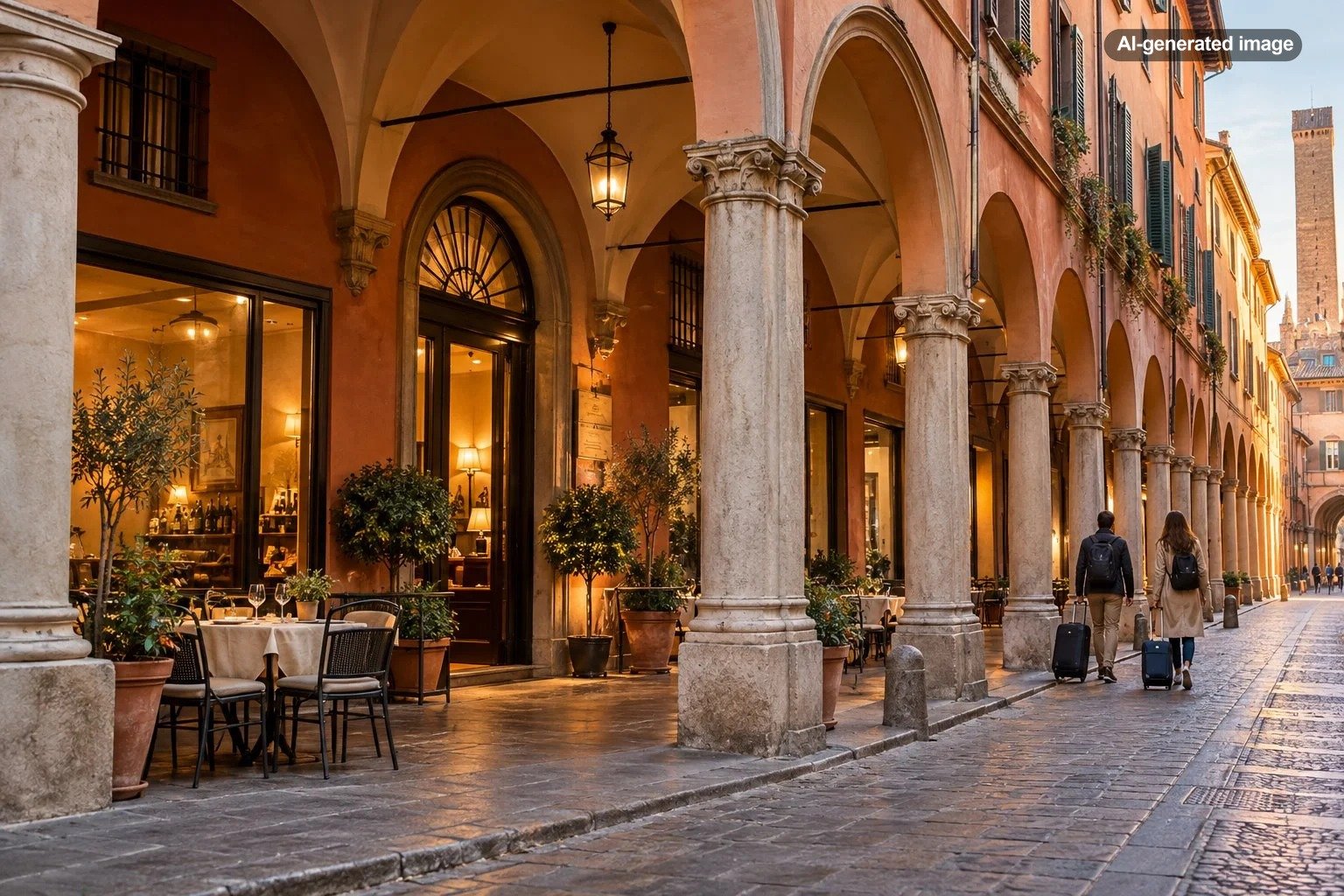
Bologna’s porticoes are not simply decorative architectural features. Their covered walkways define the experience of moving through the city and help make walking an appealing option in a variety of weather conditions.
Selected sections of the porticoes received UNESCO World Heritage recognition in 2021. The wider network extends through the historic center and into surrounding districts, connecting commercial streets, university areas, civic landmarks, and residential neighborhoods.
Staying near Piazza Maggiore or Via dell’Indipendenza allows visitors to experience the porticoes during ordinary daily activities rather than making them a separate sightseeing excursion.
However, covered streets do not guarantee a continuously sheltered journey. Road crossings, uncovered squares, and interrupted sections remain part of the walking experience. Visitors should also expect paving changes and occasional uneven surfaces in older streets.
For guests with mobility concerns or heavy luggage, hotel entrance access, elevator arrangements, and the actual route from Bologna Centrale deserve more attention than the presence of porticoes alone.
Best Train Day Trips From Bologna
Bologna Centrale connects the city with regional and high-speed rail services, making it possible to see several distinctive destinations without changing hotels. Exact journey times, service frequency, and ticket conditions depend on the route and departure selected.
Modena: Food traditions and a manageable excursion
Modena is a natural choice for travelers interested in regional food culture. Its historic center, traditional balsamic vinegar heritage, and restaurants provide a rewarding contrast to Bologna without requiring a complicated itinerary.
It is a sensible first day trip for visitors who want time for a relaxed meal rather than an ambitious sightseeing schedule.
Parma: A deeper look at Emilia-Romagna’s food heritage
Parma is particularly attractive to visitors interested in Parmigiano Reggiano, Prosciutto di Parma, and the region’s gastronomic traditions. The historic center is suitable for an independent visit, while specialized food-production experiences require additional planning because many producers are located outside the city.
A train trip to Parma does not automatically provide convenient access to rural dairies or curing facilities. Travelers wanting those experiences should arrange transportation and visits separately.
Florence: Renaissance art and a different city atmosphere
Florence is one of the strongest arguments for using Bologna as a railway base. High-speed services connect the cities, allowing travelers to spend a substantial part of the day exploring Renaissance landmarks before returning to Bologna.
Advance planning is especially useful when visiting museums with timed entry. Florence is also a destination where trying to see too much in a single day can diminish the experience.
Ferrara: Renaissance streets and a calmer pace
Ferrara offers an appealing change of atmosphere, with broad streets, historic architecture, and a city center suited to walking or cycling. It works well for visitors looking for a less intensive excursion than Florence.
The station is outside the most concentrated historic sightseeing area, so account for the onward walk or local transportation.
Ravenna: Mosaics and Byzantine heritage
Ravenna is especially rewarding for travelers interested in art and early Christian architecture. Its celebrated mosaic sites provide an experience quite different from Bologna’s arcades and medieval streets.
Train schedules and connections deserve closer attention for this excursion than for some shorter regional journeys. Allow enough time to visit the principal sites without making the return journey unnecessarily rushed.
Do You Need a Rental Car in Bologna?
For an itinerary centered on Bologna’s historic neighborhoods and train-accessible cities, a rental car is generally unnecessary. Much of the old city is best explored on foot, and driving introduces parking arrangements, traffic restrictions, and access considerations that are easily avoided by using trains.
Bologna has restricted traffic zones, commonly referred to as ZTL areas. Drivers should not assume a hotel reservation automatically grants unrestricted access. Anyone arriving by car should obtain the property’s current vehicle-access instructions before entering central streets.
A rental car becomes more relevant if the itinerary extends to countryside accommodations, producers outside the cities, or destinations poorly served by convenient public transportation. Travelers planning that kind of regional extension can compare available rental vehicles through Expedia before deciding whether to collect a car in Bologna or elsewhere.
What Travelers Often Overlook When Booking in Bologna
Train station proximity is not the whole journey
Bologna Centrale has different access points and platform areas, including facilities used by high-speed trains. The walk from a hotel entrance to the correct departure platform can be longer than the distance to the station building suggests.
For an early departure, allow extra time to find the correct platform and move through the station, particularly when traveling with luggage.
Central does not always mean quiet
The medieval center contains lively restaurants, pedestrian streets, commercial activity, and student-oriented neighborhoods. These can be attractive features during the day but less desirable for light sleepers.
Ask whether the room faces a busy street, courtyard, or internal section of the building. Double glazing and room location can matter more than a hotel’s general description of the neighborhood.
A historic building may have accessibility limitations
Some of Bologna’s most appealing accommodation occupies centuries-old structures. Staircases, small elevators, entrance steps, and irregular floor plans can create practical challenges.
Travelers requiring step-free access should confirm the entire route from the street to the reserved room, not merely whether an elevator exists.
Hotel location matters more when changing cities frequently
Someone spending four nights in Bologna with one excursion to Modena has different needs from someone making three consecutive early train departures.
In the first scenario, a hotel near Piazza Maggiore may offer the more rewarding experience. In the second, the time saved by staying near Bologna Centrale becomes an important part of the accommodation decision.
Seasonal weather can affect walking plans
Bologna can experience warm summers, cooler periods, and rainy days. Its porticoes provide useful shelter in many streets, but travelers will still encounter uncovered sections.
A compact weather layer is helpful for itineraries involving substantial walking. For travelers who prefer a packable outer layer, the Cole Haan Signature Women’s Packable Rain Jacket is one option to consider, with the fabric specifications, fit, and degree of weather protection worth checking before purchase.
Frequently Asked Questions About Where to Stay in Bologna
What is the best area to stay in Bologna for the first time?
The historic center around Piazza Maggiore and Via dell’Indipendenza is the most versatile choice. It places major sights, restaurants, shopping streets, and many porticoes within walking distance. Visitors prioritizing repeated train trips should consider the northern portion of this corridor.
Is it better to stay near Bologna Centrale or Piazza Maggiore?
Choose Piazza Maggiore for a short food-and-culture visit with limited rail travel. Choose Bologna Centrale for frequent early departures, heavy luggage, or an itinerary that treats Bologna primarily as a base for exploring other cities. Northern Via dell’Indipendenza offers a practical middle ground.
How many nights should you stay in Bologna?
Two nights can provide a satisfying introduction to the historic center and local food. Three or four nights allow a more relaxed stay with one or two day trips. Additional nights are worthwhile when planning several excursions throughout Emilia-Romagna.
Can you stay in Bologna and take a day trip to Florence?
Yes. Bologna and Florence are connected by high-speed rail, making a day excursion feasible. The main consideration is whether a single day provides enough time for the museums, neighborhoods, and restaurants you want to experience. Book popular timed-entry attractions separately and verify the train schedule for your dates.
Is Bologna walkable without a car?
Much of Bologna’s historic center is well suited to walking, particularly around Piazza Maggiore, the Quadrilatero, Santo Stefano, and Via dell’Indipendenza. The porticoes make many routes more comfortable, although uneven paving, longer distances, and interrupted covered sections should be considered. Local transportation is useful for farther destinations.
Which Bologna Hotel Location Should You Choose?
The strongest Bologna accommodation decision begins with the type of trip rather than the hotel’s prestige. If meals, markets, architecture, and evening walks are central to the visit, Art Hotel Commercianti, Grand Hotel Majestic gia Baglioni, and Hotel Metropolitan place those experiences within easy reach.
If you prefer a more relaxed romantic setting or a quieter part of the historic center, Hotel Touring and Hotel Porta San Mamolo offer worthwhile alternatives. For an itinerary divided between Bologna and nearby cities, Hotel Internazionale offers a particularly balanced location.
Travelers who expect to use Bologna Centrale repeatedly should give serious consideration to Royal Hotel Carlton, NH Bologna de la Gare, and Starhotels Excelsior. Their railway convenience can outweigh the atmospheric advantages of sleeping deeper within the medieval center.
Ultimately, Bologna works especially well when accommodation supports the rhythm of the visit: good food within walking distance, time to experience its remarkable porticoes, and easy transportation whenever the wider region calls.
Sources & Further Reading
- Bologna Welcome: UNESCO Porticoes – Official information about the city’s portico heritage.
- Art Hotel Commercianti: Official Website – Historic building, location, and property details.
- Grand Hotel Majestic gia Baglioni: Official Website – Luxury hotel positioning, historic property, and accommodation.
- Hotel Metropolitan: Official Website – Location, design positioning, and accommodation options.
- Hotel Touring: Official Website – Location, rooftop terrace, and guest facilities.
- Hotel Porta San Mamolo: Official Website – Property characteristics, accommodation, and location.
- Hotel Internazionale: Official Website – Via dell’Indipendenza location and hotel information.
- Royal Hotel Carlton: Official Website – Location and hotel facilities.
- NH Bologna de la Gare: Official Website – Station access, accommodation, and hotel facilities.
- Starhotels Excelsior: Official Website – Station-side location and hotel information.