How to Avoid a Hotel Room Beside the Service Elevator
A hotel room beside a service elevator can look perfectly ordinary in photographs while being noticeably less peaceful than another room in the same building. Unlike guest elevators, service elevators may carry housekeeping carts, laundry, supplies, maintenance equipment, and other operational traffic throughout the day. The simplest way to reduce the risk is to request a room away from service elevators, housekeeping closets, and staff circulation areas before arrival, then confirm the location when checking in.
Not every service elevator is noisy, and not every neighboring room will experience disruption. Building construction, elevator design, staff traffic, corridor layout, and room insulation all matter. The important distinction is that requesting a high floor or a room away from guest elevators does not necessarily address noise from service areas.
Quick Answer: How to Avoid a Room Near a Service Elevator
- Make a specific request: Ask for a guest room away from service elevators, housekeeping closets, linen storage, and staff work areas.
- Contact the property directly: Request a location preference after booking instead of relying exclusively on a general quiet-room note.
- Confirm at check-in: Ask whether the assigned room shares a wall with a service elevator shaft or faces a frequently used staff corridor.
- Inspect the room before unpacking: Listen for mechanical vibration, rolling carts, slamming doors, and repeated corridor activity.
- Request another room promptly: If the location is disruptive, explain the specific noise and ask whether an alternative is available.
Why Service Elevators Can Be a Source of Hotel Noise
Guest elevators are generally positioned for convenient access to public corridors and accommodations. Service elevators are designed around hotel operations, connecting areas used by housekeeping, maintenance, food service, and other departments. Their placement may be less obvious to guests.
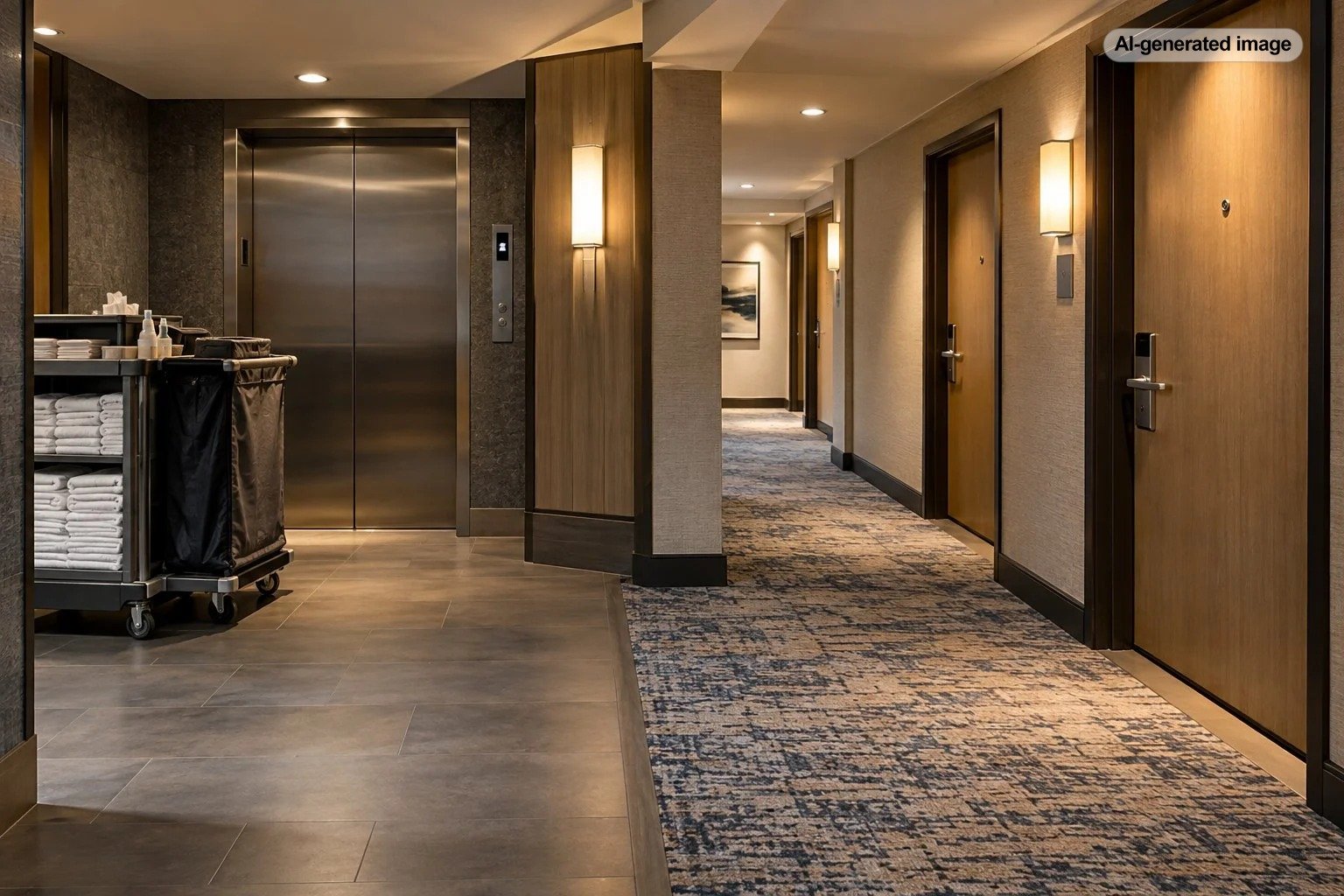
The possible disturbance is not limited to the elevator motor. Depending on the property’s design, guests may hear carts moving across hard flooring, staff entering and leaving service spaces, doors closing, or equipment passing through adjacent corridors.
Some disturbances are intermittent and relatively minor. Others can become repetitive when hotel staff are preparing rooms, moving linens, or supporting events. Because these activities follow operational needs, they may not align with a guest’s preferred sleeping or working hours.
Mechanical Noise Versus Corridor Noise
Mechanical noise may include low-frequency humming, vibration, or sounds associated with elevator movement. Corridor noise is different: rolling wheels, conversation, cart handling, and service doors opening or closing.
This distinction matters when requesting another room. Moving farther from the elevator shaft may address vibration, while moving away from the service corridor may be more effective for cart and door noise.
A room can also be relatively quiet at bedtime but become busier during housekeeping operations the following morning. A brief inspection during a quiet period cannot reveal every potential disturbance.
Ask About Service Areas Before You Book
Most hotel booking interfaces focus on room categories, bed configurations, views, and amenities rather than the exact location of staff facilities. A floor plan may not be available publicly, and an advertised room category generally does not establish where its individual rooms sit.
If a quiet room is particularly important, contact the hotel before completing a nonrefundable reservation. Ask whether the property can accommodate a preference for a room away from service elevators and back-of-house operations.
The most useful questions are specific:
- Can a room be requested away from both guest and service elevators?
- Are any guest rooms directly adjacent to housekeeping closets or service corridors?
- Does the reserved room category include locations near staff work areas?
- Can the preference be added to the reservation and reviewed before arrival?
- Are quieter locations available within the same room category?
Hotel staff may not be able to share internal floor plans or identify the exact position of every operational area. A practical location preference is usually more useful than demanding detailed access to staff-only layouts.
Remember that a room request is not necessarily a confirmed assignment. Unless the property explicitly guarantees a particular room or location, availability and operational requirements may determine the final assignment.
Use Precise Language When Requesting a Quiet Room
The phrase ‘quiet room’ leaves considerable room for interpretation. A front-desk employee might understand it as a room away from the street, a nightclub, or the main guest elevators. Another employee might prioritize distance from an event venue or public gathering area.
For service-elevator concerns, describe the actual location you hope to avoid.
Suggested request: ‘I would appreciate a quiet room that is not next to a service elevator, housekeeping storage room, service door, or frequently used staff corridor. If possible, I would prefer a room that does not share a wall with these areas.’
This wording is polite, specific, and flexible. It explains the preference without assuming that any particular part of the building is defective or that staff can guarantee an exact room.
If you need uninterrupted sleep because of an early departure, a work schedule, or recovery between travel days, mentioning that context can help the hotel understand why the request matters.
Do Higher Floors or Corner Rooms Help?
Travelers frequently request a high floor or corner room because these locations can feel more removed from busy public spaces. Either preference may help under some circumstances, but neither reliably eliminates service-elevator noise.
High Floors
A high floor may reduce exposure to street traffic, entrances, or certain public facilities. However, service elevators in multistory hotels may serve upper guest-room floors as well as lower ones. A high-floor room directly beside a service elevator or housekeeping area can still experience operational noise.
Corner Rooms
Corner rooms can sometimes have fewer adjoining guest rooms, depending on the floor plan. That does not mean they are automatically isolated from service infrastructure. An elevator shaft, utility area, or service room may occupy a nearby section of the building.
Rooms at the End of a Corridor
End-of-hall rooms may have less guest foot traffic if few people need to walk past them. But in some layouts, service doors or staff circulation routes are also located near corridor ends.
The better approach is to request separation from the specific noise source rather than rely on floor height, room orientation, or corridor position alone.
What to Check When You Arrive at the Hotel
Check-in is a useful opportunity to confirm a room location before settling in. Even when you requested a quiet room in advance, the assignment may have changed because of housekeeping schedules, maintenance, departures, or occupancy.
Before accepting the key, ask a straightforward question: ‘Is this room located near a service elevator or housekeeping work area?’
If the receptionist cannot immediately tell, they may be able to consult a floor plan or speak with another staff member. The amount of location information available to front-desk staff varies by property.
Once upstairs, look for reasonable environmental clues without entering restricted spaces. Staff-only doors, housekeeping carts, linen storage signs, and frequent equipment movement can indicate nearby service activity. None necessarily proves that the room itself will be noisy.
Inside the room, listen briefly with the door closed. Pay attention to repeated thuds, vibration against an adjoining wall, corridor traffic, or a service door closing nearby. Check from the bed as well as the entryway, since sound can be more apparent in one part of the room.
When the hotel is busy, it is generally easier to address a location concern before unpacking than after spending several hours in the room.
How to Ask for a Different Room Without Creating Conflict
If the room is immediately adjacent to an active service area, contact the front desk as soon as the concern becomes clear. There is no need to make a dramatic complaint or assume the property should have known the room would be unsuitable.
Explain what you observed and what alternative would solve the problem. For example: ‘The room appears to be beside a staff service area, and I can hear carts and the service door repeatedly. Is there another room in the same category farther from that area?’
This gives the employee a concrete problem to address. A request based only on the room being near an elevator may be less persuasive if no disturbance has occurred, although it is still reasonable to express a strong location preference.
If another room is available, confirm that it is not beside a different service area before moving. A replacement on the same floor could simply shift the concern from one corridor to another.
Hotels may be more limited in their options when fully occupied, during major events, or when certain rooms are unavailable for operational reasons. A move, upgrade, discount, or other accommodation should not be assumed or treated as an entitlement.
What If the Noise Starts After You Have Gone to Bed?
A service-elevator location may not become problematic until the night or following morning. Late deliveries, operational changes, or early housekeeping activity can produce sounds that were absent during check-in.
Start by contacting the front desk and describing the noise, its approximate location, and whether it is continuous or intermittent. The hotel may be able to determine whether the source is temporary or whether a room move is the more realistic solution.
If moving immediately would be inconvenient, ask whether an alternative room could be considered later. However, do not assume that a quiet room will still be available the following day.
Earplugs or background noise may help with ordinary ambient sounds, but they are less dependable for strong structural vibration, repetitive door impacts, or cart noise transmitted through floors and walls.
For a short stay, relocating promptly may be worthwhile. For an extended stay, it may be especially important to solve the underlying location problem rather than manage repeated disturbances night after night.
How to Spot Potential Service-Elevator Problems in Hotel Reviews
Guest reviews can provide clues about room-location issues, although their usefulness depends on how specific the reviewer was.
Instead of relying exclusively on an overall rating, search review text for terms such as ‘service elevator,’ ‘housekeeping closet,’ ‘staff door,’ ‘linen carts,’ ‘rolling carts,’ ‘service corridor,’ and ‘elevator vibration.’
Distinguish between isolated complaints and repeated descriptions of the same area. One guest may be particularly sensitive to noise, and a temporary maintenance issue might not reflect normal conditions. Several detailed comments about the same floor or location can be more informative, especially when they describe comparable sounds.
Also distinguish guest-elevator complaints from service-elevator complaints. Noise from crowds returning to their rooms is not the same as repeated back-of-house activity.
Room numbers mentioned in older reviews may no longer correspond to the same room arrangement or operational use. Renovations and staffing practices can change. Treat reviews as signals worth investigating, not as verified floor-plan documentation.
What Travelers Often Overlook About Hotel Room Noise
Service elevators are only one possible source of disturbance. A room away from the service elevator could still be adjacent to an ice machine, a connecting door, a mechanical room, or a busy guest corridor.
Travelers sometimes make the opposite mistake and request too many restrictions simultaneously. Asking for the highest floor, a particular view, a corner location, a specific bed type, and separation from every elevator may leave the hotel with very few eligible rooms.
Prioritize your actual needs. If uninterrupted sleep matters more than the view, say so. If you are traveling for work and need a quiet environment during daytime hours, clarify that the concern includes daytime service activity, not just nighttime noise.
Another overlooked distinction is between a room next to an elevator shaft and one near the elevator landing. Shaft-related vibration can affect a shared wall, while landing-related disturbance may occur through the guest-room door or surrounding corridor.
Finally, remember that hospitality staff need access to elevators and service areas to keep the property operating. The goal is not to eliminate normal hotel activity but to choose a room where that activity is less likely to interfere with your stay.
Should You Choose a Different Type of Accommodation?
For travelers who are especially sensitive to operational noise, property layout may deserve as much attention as room amenities. Hotels with large housekeeping operations, extensive meeting facilities, or complicated back-of-house circulation can have different sound patterns from smaller properties, although size alone does not predict quietness.
A smaller hotel may have fewer service elevators but could place housekeeping storage close to guest rooms. A resort may offer more separation between buildings while introducing other activity, such as maintenance vehicles or early landscaping work.
An apartment-style accommodation or vacation rental may offer a different layout, but it introduces its own considerations, including neighboring units, building elevators, cleaning arrangements, and variable sound insulation. None of these lodging types guarantees a quieter environment.
When exploring alternatives, focus on sleeping-area placement, building layout, guest reviews, and the operator’s ability to answer location questions before reservation.
Frequently Asked Questions
Are service elevators usually louder than guest elevators?
Not necessarily. Mechanical noise depends on the elevator system and building construction. Service elevators may create additional surrounding activity because staff use them to move carts, supplies, and equipment. In some hotels, that corridor activity is more noticeable than the elevator itself.
Can I request a room away from service elevators when booking online?
Yes, if the reservation process provides a special-request field. Write a specific location preference and contact the property directly if the issue is important. A request entered online does not automatically mean the hotel has guaranteed it.
Is a room beside a housekeeping closet always noisy?
No. Some closets receive limited traffic, and good door design and sound insulation can reduce disturbance. Other locations may experience repeated cart movements and staff activity. The impact depends on the closet’s function, the building layout, and operating patterns.
Can I change rooms after discovering service-elevator noise?
You can ask the hotel for a different room. Whether a move is possible depends on available inventory, reservation conditions, and the property’s procedures. Explain the specific disturbance and request a comparable room farther from the service area.
Does choosing a luxury hotel guarantee that service areas will be quieter?
No. Higher-end properties may incorporate sophisticated building systems and thoughtful layouts, but room placement and sound transmission can vary within any hotel category. A specific location request remains worthwhile regardless of the property’s market position.
The Most Reliable Strategy for a Quieter Hotel Room
Avoiding a hotel room beside the service elevator requires more than selecting a high floor or checking a general quiet-room box. The most effective strategy combines an advance location request, direct communication with the property, confirmation at check-in, and a brief room assessment before unpacking.
Focus on the actual sources of possible disruption: elevator shafts, staff circulation routes, service doors, and housekeeping storage. Be precise about which sounds would interfere with your stay, but remain flexible about other room preferences.
No room-location strategy can guarantee complete silence. However, a clear request and an early conversation with hotel staff can substantially improve your chances of finding accommodations that suit your sleeping schedule and comfort needs.