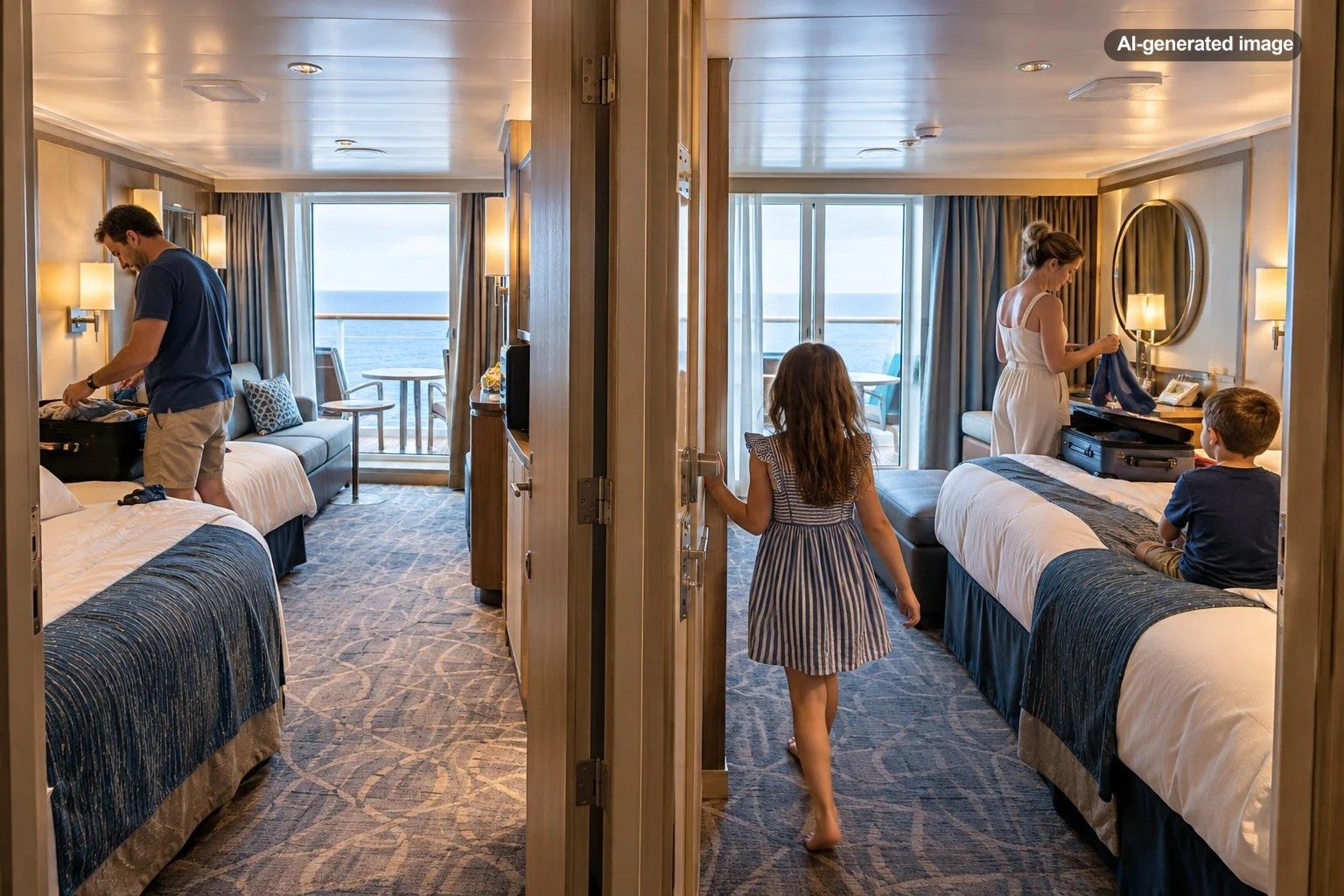
Can Cruise Lines Guarantee Connecting Cabins for Families?
Yes, cruise lines can allow families to reserve specific connecting cabins, but a confirmed reservation is not the same as an unconditional guarantee that the arrangement can never change. The most reliable approach is to select two available staterooms with an interior connecting door, confirm their exact cabin numbers, and obtain written booking confirmation. Simply requesting connecting rooms or booking two cabins in the same category does not establish that they will connect.
This distinction matters when parents are traveling with young children, grandparents need convenient access to family members, or two households want separate sleeping areas without relying on a public hallway. Understanding the difference between reserving specific cabins and accepting a cruise line’s assigned accommodation can prevent an inconvenient surprise.
Quick Answer: What Can Families Actually Secure?
- Specific connecting cabins: Some cruise lines let travelers select an available connecting pair during booking. This provides substantially more certainty than making a general request.
- Requested connecting cabins: A preference noted on a reservation is not necessarily a confirmed cabin assignment.
- Guarantee-category bookings: These ordinarily guarantee an accommodation category rather than specific cabin numbers or proximity to other travelers.
- Written confirmation: Both cabin numbers and their connecting configuration should be verified before finalizing the reservation.
- Absolute guarantees: Cruise lines may retain reassignment rights under their booking conditions, even when specific rooms have been reserved.
Connecting, Adjoining, and Nearby Cabins Are Different
The terminology used during booking deserves close attention. A connecting cabin has an interior doorway linking it to another stateroom. When the connecting door is unlocked, guests can move between the two accommodations without entering the ship’s corridor.
Adjoining cabins are generally understood to be immediately next to one another, but that description does not necessarily mean an interior door exists. Two cabins may share a wall while remaining completely separate. Nearby cabins can be farther apart, perhaps across the hallway or several doors away.
For parents who expect children to sleep in a separate stateroom, the difference is particularly important. Having to enter a public corridor to reach a child’s room is materially different from opening an interior connecting door.
Some ships also have balcony partitions that may be opened under certain conditions. This feature is not equivalent to an interior connecting doorway, and availability varies by ship and sailing. Families should not treat a shared balcony as a substitute for verified interior access.
How Cruise Lines Handle Connecting Cabin Reservations
Disney Cruise Line
Disney Cruise Line provides a particularly clear example of reserving a connecting pair. Its official booking guidance explains that travelers can add a second stateroom, activate the Connecting Staterooms option, and view available connecting accommodations. Selecting one cabin in the pair also selects its corresponding connecting cabin.
This arrangement helps families identify actual connecting inventory rather than merely submitting a preference. However, Disney also states that connecting stateroom availability cannot be guaranteed for restricted-fare reservations. Families should distinguish its standard room-selection process from fares that leave cabin selection to the cruise line.
Royal Caribbean
Royal Caribbean offers connecting staterooms on applicable ships and promotes them as an option for families requiring additional space. Its family accommodation guidance also recognizes that two smaller connecting rooms may sometimes provide a practical alternative to one larger suite.
Nevertheless, the booking method matters. Royal Caribbean’s published guarantee-stateroom policy states that guests choosing a guarantee category may receive their cabin assignment later and might not be placed near other traveling parties. Travelers who require connecting rooms should therefore choose specific available cabins rather than assuming that a guarantee-category reservation will preserve the desired arrangement.
For any cruise company, cabin availability and booking rules should be checked against the exact ship, itinerary, departure date, and fare selected. A feature available on one vessel should not automatically be assumed available on another.
Why a Guarantee Cabin Is Not a Guaranteed Connecting Cabin
The word guarantee creates considerable confusion in cruise reservations because it commonly refers to a cabin category rather than a particular room location.
Under a guarantee-category arrangement, a traveler typically purchases the right to an accommodation meeting the booked category’s conditions while allowing the cruise line to select the exact stateroom. Depending on the fare and operator, the assignment might not be finalized until relatively close to departure.
This arrangement can appeal to passengers who are flexible about deck position and cabin location. It is less appropriate for families whose plans depend on two rooms sharing an internal doorway.
Consider a family of four reserving two guarantee-category balcony cabins. Even if both reservations are linked and the travelers request adjacent rooms, the eventual assignments could be on different decks. The cabins might satisfy the purchased category requirements without meeting the family’s preferred layout.
By contrast, selecting cabins 8120 and 8122, for example, after verifying that the ship’s deck plan identifies them as a connecting pair offers a much clearer reservation arrangement. Those numbers are illustrative, not a claim about any particular vessel.
The tradeoff is straightforward: accepting flexible cabin assignment may offer a different fare structure, while choosing exact connecting cabins provides greater control over a feature that may be essential to the trip.
How to Book Connecting Cruise Cabins With Greater Confidence
Start With the Ship’s Actual Deck Plan
Before choosing a sailing solely on price or itinerary, inspect the cruise line’s official deck plan. Look for the symbol identifying connecting staterooms and confirm that both cabins are in a configuration suitable for your traveling party.
A connecting doorway does not establish that every cabin can accommodate any number of passengers. Occupancy limits, available beds, and accessibility features must be checked separately.
Select Both Cabin Numbers Together
When the booking system allows specific cabin selection, identify the complete connecting pair before committing to either room. If booking online does not clearly display both accommodations, consider speaking directly with the cruise line or a knowledgeable cruise advisor.
Ask the representative to verify that both rooms are available simultaneously, confirm that they connect internally, and explain any restrictions affecting the reservation.
Review Both Reservations Before Paying
Families sometimes discover that only one reservation reflects a selected cabin while the second has been placed into a flexible-assignment category. Check both booking records carefully rather than assuming that two reservations made during the same transaction have identical terms.
Confirm the ship name, departure date, cabin numbers, categories, guest assignments, and connecting configuration. Where separate booking references exist, ask whether the reservations can be linked for coordination.
Keep a Written Record
Save the booking confirmation and a copy of the relevant deck plan. If a representative confirms the connecting arrangement by telephone, request written confirmation that identifies both room numbers.
Written documentation cannot eliminate every operational reassignment possibility, but it gives travelers a precise record of what was booked and helps resolve discrepancies before sailing.
What Happens if the Cruise Line Changes Your Cabin?
Even a reservation with specific room numbers may be affected by operational circumstances. A cabin could become unavailable because of maintenance, accommodation requirements, or another shipboard issue. The cruise line’s contract determines the extent of its reassignment rights and any applicable remedies.
If an assignment changes, contact the cruise line promptly and explain why the connecting arrangement is essential. Request another verified connecting pair instead of accepting two separate rooms described simply as nearby.
Before agreeing to an alternative, check whether it changes the room category, sleeping capacity, accessibility, or arrangement required for children. Ask for revised written confirmation and clarification of available options under the booking terms.
Families should not assume that a cabin upgrade is necessarily an improvement. Two separate higher-category rooms may be less useful than the originally selected connecting accommodations. Royal Caribbean, for example, warns that guests participating in certain upgrade arrangements may be separated from other reservations.
Should Families Choose Two Connecting Rooms or One Larger Cabin?
Connecting accommodations are attractive because they can offer two bathrooms, additional storage, separate sleeping areas, and a practical way to move between rooms. For families with different sleep schedules, those advantages can be significant.
A family suite or larger cabin may be preferable when parents want everyone within one accommodation, when suitable connecting inventory is unavailable, or when the larger room provides a more comfortable sleeping configuration.
For example, parents traveling with two teenagers might value the privacy and bathroom arrangements of connecting rooms. Parents with a toddler may prefer one sufficiently spacious cabin rather than depending on a second room, even when a connecting door is available.
Multigenerational families may favor connecting cabins for convenience, but grandparents who value quiet or independence might prefer nearby cabins without a shared interior door.
There is no universally superior arrangement. Compare the total reservation cost, bed configuration, bathroom count, accessibility, and individual travelers’ needs rather than evaluating cabin square footage alone.
Important Details Families Often Overlook
Children May Face Separate Occupancy Rules
Cruise lines have minimum-age and stateroom occupancy policies that can affect how families assign children to rooms. Some operators provide exceptions when minors occupy qualifying connecting or adjacent accommodations with their parents or guardians nearby. Exact conditions vary by cruise line, departure region, and booking circumstances.
Confirm the applicable policy before distributing family members across reservations. A connecting doorway does not automatically establish that every proposed child occupancy arrangement is permitted.
Accessible Connecting Cabins Require Additional Planning
Travelers needing accessible accommodations should verify both the accessibility features and the connection between rooms. An accessible cabin next to a standard room is not necessarily part of an internally connecting pair.
Last-Minute Booking Reduces Choice
Connecting cabins represent a specific subset of a ship’s accommodation inventory. Once one room in a pair has been reserved independently, the remaining cabin may no longer serve a family requiring both rooms.
Booking earlier can improve the opportunity to select a complete pair, although no particular booking window ensures availability.
Not Every Upgrade Is Family-Friendly
Before accepting an upgrade offer, ask whether both original cabin assignments will remain intact. Individually processed upgrades may move one reservation without the other, potentially eliminating the connecting arrangement.
When Comparing Sailings, Check Cabin Inventory First
Families often begin cruise planning by comparing destinations, ship amenities, and departure dates. When connecting cabins are essential, the booking sequence should be slightly different: identify appealing sailings, verify that each has an appropriate connecting pair, and only then compare the complete accommodation costs and fare conditions.
Affiliate disclosure: HotelInfo.com may earn a commission when you book or purchase through links on this page. This does not affect the price you pay. Learn more.
Travelers exploring several departure dates can compare available sailings with Expedia Cruises before confirming connecting-room inventory and the exact reservation conditions directly with the cruise provider or booking representative.
This sequence may mean choosing a different departure date or cabin category. For a family that needs internal access between rooms, however, the accommodation configuration can be more important than a modest difference in fare or a preferred deck location.
Frequently Asked Questions
Can I request connecting cabins after booking?
Yes, travelers can ask about changing an existing reservation to connecting cabins. Whether the request can be fulfilled depends on remaining availability, fare rules, possible change charges, and the cruise line’s procedures. A request alone does not confirm the change.
Does linking two cruise reservations guarantee nearby rooms?
No. Linking reservations can help coordinate travel arrangements, but it does not automatically secure neighboring or connecting staterooms. Verify each cabin assignment independently.
Can connecting cabin doors remain open during the cruise?
Connecting doors are designed to provide internal access, but the precise door arrangement and operating procedures depend on the ship. Guests should ask onboard staff about unlocking or securing the doors and should not interfere with door hardware.
Are connecting cabins always more expensive?
Not necessarily. Total costs depend on the ship, sailing, category, occupancy, and fare conditions. Two connecting standard cabins may cost less or more than a larger family accommodation. Compare complete booking totals rather than assuming one arrangement is cheaper.
What if no connecting cabins are available?
Consider another departure date, a different ship, or a family-sized cabin that accommodates everyone. Adjoining rooms without an interior door may work for adults traveling together, but families with young children should first confirm supervision needs and the cruise line’s occupancy requirements.
The Most Reliable Booking Strategy
Families seeking connecting cruise cabins should prioritize a confirmed pair of specific staterooms over a general accommodation request. Choose a ship with suitable connecting inventory, verify the interior doorway on its official deck plan, review both cabin assignments, and preserve written confirmation.
Most importantly, do not confuse a guarantee-category fare with a promise of connecting rooms. The former generally protects an accommodation category; the latter requires confirming a specific physical arrangement. Although cruise operators may retain reassignment rights, careful room selection and clear documentation provide the strongest practical foundation for a well-organized family cruise.
Sources & Further Reading
- Disney Cruise Line: Reserving Connecting Staterooms – Official guidance on selecting connecting pairs and restricted-fare limitations.
- Royal Caribbean: What Is a Guarantee Stateroom? – Official explanation of guarantee-category assignments and the possibility of families being separated.
- Royal Caribbean: The Best Staterooms for Families – Guidance comparing connecting rooms and larger family accommodations.
- Royal Caribbean: Stateroom Upgrades for Groups – Explanation of how upgrades may separate linked reservations.
- Disney Cruise Line: Choosing Specific Staterooms – Official distinction between selected cabins and assigned accommodations.