Plunge Pool Room vs. Swim-Up Room at an All-Inclusive Resort: Which Is Better?
If you are choosing between a plunge pool room and a swim-up room at an all-inclusive resort, the biggest difference is usually privacy versus access to a larger shared pool. A plunge pool is generally reserved for your accommodation, while a swim-up room typically opens directly onto a pool that may be shared with neighboring rooms. Neither is automatically better: the right choice depends on how you expect to use the water, how much privacy matters, and whether you prefer a secluded terrace or a more social resort-pool atmosphere.
The terminology is not perfectly standardized across resorts. Before paying for either upgrade, read the exact room description and look for phrases such as private pool, shared pool, direct pool access, and exclusive use. A glamorous room-category name does not always tell you who else can enter the water outside your terrace.
Quick answer: plunge pool or swim-up room?
- Choose a plunge pool room if privacy, quiet, and having your own water space are the priorities.
- Choose a swim-up room if you want direct access to a larger pool and do not mind sharing it with other guests.
- For couples: a genuinely private plunge pool often feels more secluded, although the terrace itself may still be visible from other rooms or walkways.
- For frequent swimmers: a swim-up pool is generally more useful because plunge pools can be too small for meaningful swimming.
- Before booking: verify whether the pool is private or shared, its location, terrace visibility, pool hours, and any restrictions that matter to your trip.
The fundamental difference is who uses the pool
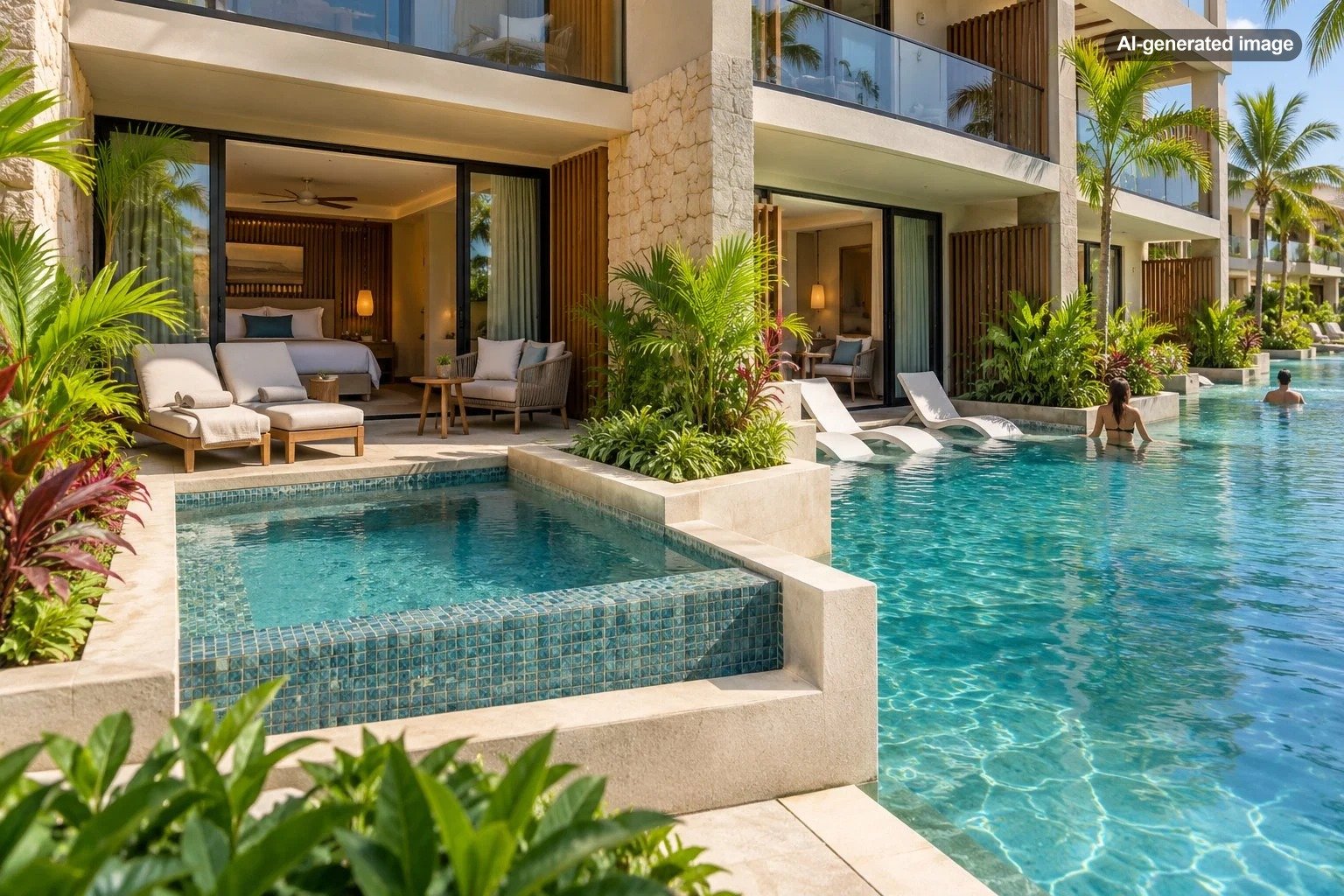
A plunge pool room normally has a compact pool attached to its terrace, patio, villa, or suite. When a resort specifically describes that pool as private, it is intended for the occupants of that accommodation rather than guests staying in neighboring rooms.
A swim-up room works differently. Its defining feature is direct access from the accommodation to a pool. In many resorts, several rooms line the same elongated pool, lagoon, or interconnected swimming area. You may have your own terrace and steps into the water, but the water itself can be communal.
That distinction affects nearly everything else about the experience: privacy, atmosphere, the size of the swimming area, and how much interaction you have with neighboring guests.
Privacy: plunge pools usually have the advantage
If privacy is the main reason you are considering a pool-access room, start by investigating the plunge pool categories. Having a pool assigned exclusively to your room removes the most obvious source of interaction: other guests swimming directly past your terrace.
However, private pool does not necessarily mean visually private. A plunge pool may sit beneath balconies, face another building, border a resort walkway, or have only partial screening between neighboring terraces. A couple booking an anniversary or honeymoon trip should therefore look beyond the word private and study the physical layout.
Swim-up rooms are generally less secluded because the pool can function as a shared space. Someone may swim past while you are reading on your terrace, and neighboring guests may spend considerable time outside their rooms. Some travelers enjoy that lively atmosphere; others find it defeats the purpose of upgrading to a special room.
Swimming: a swim-up room is usually more practical
A plunge pool is designed primarily for cooling off, lounging, and relaxing. The dimensions vary considerably, but the word plunge is an important clue: these pools can be compact.
A swim-up room may connect to a considerably larger swimming area. If your ideal morning involves getting into the water and actually swimming rather than simply sitting in it, this can be a meaningful advantage.
Do not assume every swim-up pool is suitable for long laps, though. Resort designs range from narrow channels to broad pools, and some sections exist mainly to provide water access outside the rooms.
Convenience is excellent with both room types
Both categories solve one familiar resort inconvenience: you do not need to gather your things and walk across the property whenever you want to get in the water. Your room, bathroom, clothes, sunscreen, and personal belongings remain just a few steps away.
A plunge pool gives you that convenience in a self-contained space. A swim-up room combines it with direct participation in a larger pool environment. Travelers who expect to move frequently between the room and water may appreciate either upgrade far more than travelers who plan to spend most days at the beach, on excursions, or elsewhere around the resort.
Atmosphere: secluded retreat versus social pool
Plunge pools tend to make the accommodation itself more of a destination. You can return from lunch or an excursion, step outside, and relax without heading back into the main resort environment. That can be particularly appealing to couples, travelers who value quiet downtime, and guests who deliberately spend more time in their room category because they paid for the upgrade.
Swim-up rooms tend to blur the boundary between your room and the resort pool scene. Depending on the layout, you may see and hear neighboring guests, conversations, splashing, and general pool activity. For sociable travelers, that can be part of the appeal rather than a drawback.
Comparison at a glance
| Consideration | Plunge pool room | Swim-up room |
|---|---|---|
| Pool use | Often exclusive to the room when specifically labeled private | Often shared with neighboring rooms |
| Privacy | Usually stronger, depending on terrace visibility | Usually lower because guests may pass through the pool |
| Swimming space | Typically compact | Often larger |
| Atmosphere | More secluded | More communal |
| Best fit | Relaxing, cooling off, private downtime | Frequent pool use and easy access to shared water |
What travelers often overlook before booking
Terrace exposure
Look at the rooms above, beside, and across from the category you are considering. A plunge pool can technically be private while remaining completely visible to other guests. Similarly, a swim-up terrace may have substantial screening even though the pool itself is shared.
Sun and shade
The orientation of the building can strongly influence how enjoyable a private pool feels. A shaded plunge pool may be pleasant in very hot weather but less appealing if you were picturing hours of sunny lounging. Conversely, an exposed terrace can become uncomfortable during the hottest part of the day.
Ground-floor location
Swim-up rooms frequently need to sit at pool level. Consider whether you normally prefer elevated rooms for views or separation from pedestrian areas. Direct pool access is useful, but you may be trading away some of the characteristics you would otherwise prefer in a higher-floor room.
Children and room restrictions
Open water immediately outside an accommodation requires additional consideration for families with young children. Resorts may also impose age, occupancy, or room-category restrictions. Check the current property’s rules rather than assuming that every pool-access category can accommodate your party.
Pool operating rules
Do not assume direct access means unrestricted access at every hour. Resorts can have rules covering swimming times, maintenance, glassware, inflatables, noise, and other pool use. These details matter if the main reason you are upgrading is the ability to use the water whenever you return to your room.
When a plunge pool room makes more sense
A plunge pool is usually the stronger fit when the room itself will be an important part of the vacation. It works particularly well for travelers who envision quiet mornings, afternoon cooling-off sessions, or relaxing outside without participating in the main pool atmosphere.
It can also be the more appealing setup for couples seeking separation from other guests. Just verify the sightlines first. The difference between a private pool and a private-feeling pool can be substantial.
When a swim-up room makes more sense
A swim-up room is compelling when easy pool access matters more than exclusivity. If you expect to spend hours in the water, a larger shared pool can be much more useful than a compact plunge pool. You can step directly from your terrace into the resort experience without carrying everything to a distant pool deck.
It may also suit travelers who enjoy a more social atmosphere and do not mind seeing neighbors nearby. In that case, the shared nature of the pool is part of the experience rather than a compromise.
Questions to ask before paying for either upgrade
- Is the water outside the room exclusively for this accommodation or shared with other rooms?
- Can guests from elsewhere in the resort access the same pool?
- Is the terrace visible from upper floors, neighboring rooms, or public walkways?
- Is the pool intended mainly for lounging, or is it large enough for actual swimming?
- Are there designated pool-use hours?
- Does the room category have age or occupancy restrictions?
- Does the terrace receive substantial sun or shade during the day?
FAQ
Is a plunge pool completely private?
Only if the resort’s current room description confirms that the pool is for the exclusive use of that accommodation. Even then, visual privacy can vary significantly according to the building layout.
Do strangers swim past swim-up rooms?
They can when multiple rooms share the same pool. Some properties restrict a pool to occupants of the surrounding swim-up rooms, while other layouts differ. Verify exactly who can use the water before booking.
Are plunge pools large enough to swim in?
Some are larger than others, but plunge pools are generally intended for dipping, cooling off, and relaxing rather than conventional swimming. Check dimensions or current room details if pool size is important.
Which room type is better for couples?
Couples prioritizing privacy will often prefer a genuinely private plunge pool. Couples who spend much of the day swimming and enjoy a livelier atmosphere may prefer a swim-up room.
Is the upgrade worthwhile at an all-inclusive resort?
It depends on how much time you will use it. Travelers who regularly return to the room for swimming and relaxation can get substantial practical value from direct water access. If most days will be spent at the beach, on excursions, or around the main resort facilities, a standard room may be sufficient.
The better choice depends on how you want to use the water
The simplest decision rule is this: choose a private plunge pool when exclusivity and quiet matter most, and choose a swim-up room when direct access to a larger pool matters more than privacy. Neither label guarantees a particular experience, so the layout deserves as much attention as the room name.
Before booking, verify whether the pool is private or shared, who can access it, how exposed the terrace is, and whether the pool is actually large enough for what you have in mind. Those details are far more useful than deciding based on photographs or the category name alone.