How Private Are Private-Pool Rooms at All-Inclusive Resorts?
A private-pool room at an all-inclusive resort can offer excellent seclusion, but the word private usually describes who is allowed to use the pool, not necessarily who can see it. Some suites have enclosed courtyards surrounded by walls or dense landscaping. Others have pools that are reserved for one room but remain visible from neighboring balconies, resort pathways, restaurants, beaches, or upper floors.
That distinction matters, particularly for honeymooners, couples planning a quiet retreat, and travelers who expect their outdoor space to feel as secluded as the room itself. Before paying a premium for a private pool, look beyond the room-category name and study the actual layout.
Quick answer: how private is a private-pool room?
- Pool access may be private without visual privacy. A pool can belong exclusively to your room while still being overlooked by other guests.
- Enclosed courtyard pools usually provide more seclusion. Walls, privacy screens, mature landscaping, and detached villa layouts can reduce sightlines.
- Swim-up rooms are different. They frequently connect to a pool or water channel shared with neighboring rooms.
- Room location matters as much as room type. Ground-floor paths, buildings above, restaurants, beaches, and service areas can all affect privacy.
- Recent guest photos can reveal more than promotional images. Look specifically for wide-angle views showing neighboring rooms and surrounding buildings.
Private pool does not always mean visually secluded
Hotel terminology can create expectations that the architecture does not necessarily support. When a resort calls a pool private, the most dependable interpretation is generally that the pool is assigned to a particular room, suite, or villa rather than being a general resort pool.
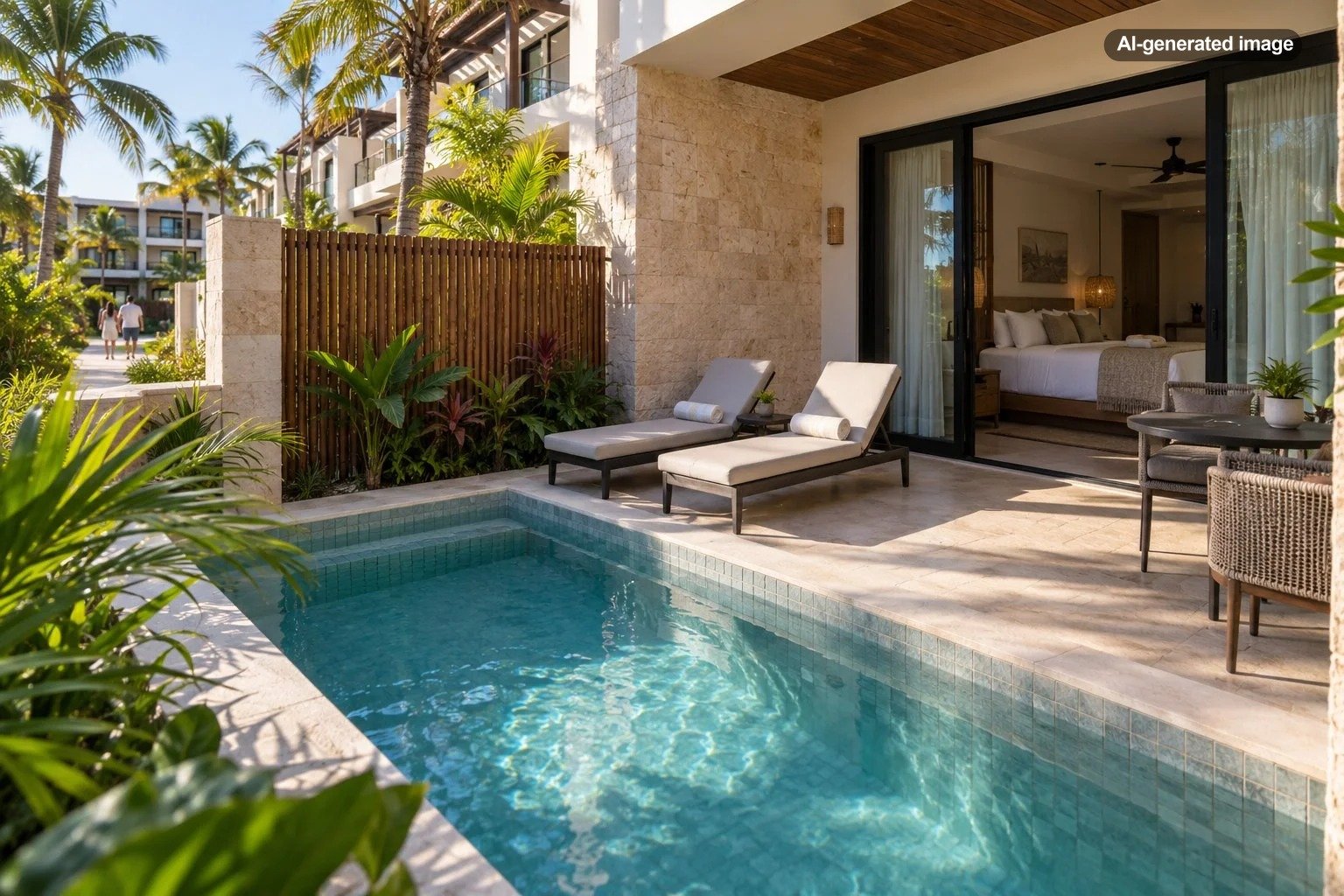
Visual seclusion is a separate question. Imagine a row of ground-floor suites, each with its own small pool and terrace. Guests in the neighboring suites may not be permitted to enter your pool, yet the spaces might be divided only by a short wall or landscaping. Guests on floors above may also have a direct view down toward the pool.
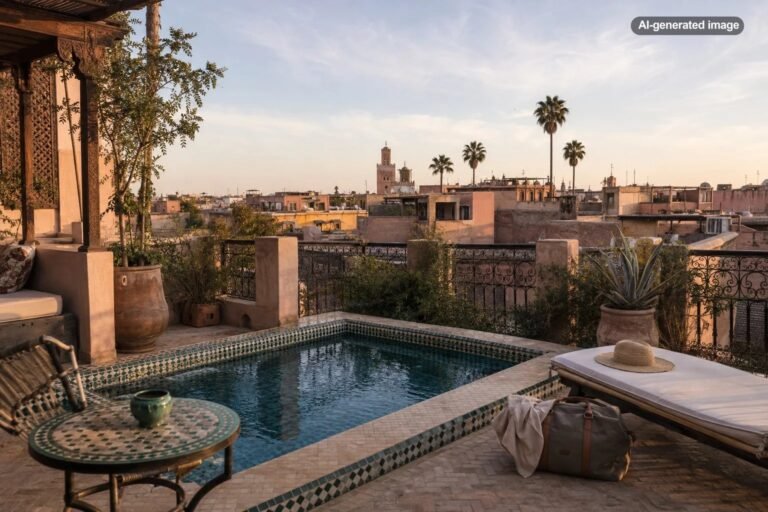
At the opposite end of the spectrum, some layouts place the pool inside a courtyard or behind substantial screening. In that design, both access and sightlines may feel genuinely private.
Know the difference between private pools, plunge pools, and swim-up rooms
These room types can look similar in booking photographs, but they provide different experiences.
| Room feature | Typical setup | Privacy consideration |
|---|---|---|
| Private pool | Pool designated for one room, suite, or villa | Exclusive use does not guarantee screened views |
| Private plunge pool | Smaller pool intended mainly for cooling off and relaxing | Privacy depends heavily on terrace and building design |
| Swim-up or swim-out room | Direct water access from the room or terrace | Water is often shared with other rooms |
This is why travelers seeking seclusion should not automatically treat a swim-up suite as an alternative to a private-pool suite. Swim-up accommodations can be highly convenient, but the social experience may resemble a small shared pool rather than a personal retreat.
Check whether upper floors overlook the pool
One of the easiest privacy issues to miss is vertical sightlines. A ground-floor private pool may look beautifully screened when photographed from terrace level, while balconies on the second or third floor have clear views of it.
Study exterior photographs of the entire building rather than relying exclusively on close-up pool images. If several floors rise directly behind the private-pool rooms, complete visual privacy may be unlikely unless the architecture includes roofs, screens, overhangs, or other barriers.
This matters most for travelers who want to sunbathe, dine outside, or spend much of the day around the pool without feeling exposed to neighboring rooms.
Look for paths, beaches, restaurants, and common areas nearby
A pool can be screened from adjacent rooms and still face a surprisingly active part of the resort. Pedestrian paths may run along the front of a terrace. Beachgoers may pass nearby. A pool could face a garden used as a shortcut between resort buildings, or sit close to a restaurant or another shared facility.
Consider what surrounds the accommodation on every side. Rooms at the edge of a property, detached villas, and enclosed courtyard layouts can feel different from private-pool rooms positioned along central resort routes.
Landscaping can improve privacy, but it is difficult to judge from one photograph
Tropical landscaping is frequently used to separate outdoor spaces. Dense hedges, palms, fencing, stone walls, and privacy screens can make neighboring pools feel considerably more secluded.
However, promotional photography can emphasize the most flattering angle. A photograph taken toward a hedge may exclude an open side facing another building. Landscaping can also vary between individual rooms within the same category.
Look for multiple photographs showing the terrace from different directions. Recent traveler photographs can be particularly useful for understanding the relationship between neighboring rooms, balconies, pathways, and vegetation.
Ask the resort specific questions instead of asking whether the pool is private
If privacy is an important reason for booking the room, a general question such as “Is the pool private?” may simply confirm that other guests cannot use it. Ask questions that address what you actually want to know.
- Can guests in rooms above see directly into the pool or terrace?
- Can neighboring guests see the pool from their terraces?
- Does a public or service pathway pass the pool?
- Is the outdoor area enclosed by walls, fencing, or landscaping?
- Are some rooms within this category more secluded than others?
- Does resort staff regularly need to enter the terrace or pool area for service?
When individual room assignments cannot be guaranteed, it is still useful to know whether there are meaningful differences within the category.
Consider the tradeoff between privacy and the view
Greater seclusion can come with a compromise. A high wall or dense hedge may prevent other people from seeing the pool, but it can also obstruct an ocean, garden, or sunset view.
Conversely, a dramatic infinity pool facing the sea may feel wonderfully open precisely because there is little screening. Travelers often need to decide which matters more: an expansive outlook or a protected outdoor space.
Couples who plan to spend most of the trip around their pool may prioritize enclosure. Travelers who mainly want a convenient place to cool off while preserving a broad ocean view may prefer a more open design.
Families should consider privacy and pool access separately
For families, having water immediately outside the room can be extremely convenient, but it also deserves additional consideration. Doors leading directly from indoor living space to a pool can make access unusually easy.
Parents and caregivers should examine the room layout and ask the resort about barriers, locks, gates, or other relevant features rather than assuming a private pool is configured in a particular way. Pool arrangements differ widely among properties and room categories.
Other details can matter once you actually use the pool
Privacy may attract travelers to the room category, but several practical details can determine how useful the pool feels during the stay. Pool dimensions vary considerably, and the phrase “private pool” does not indicate whether the water is large enough for meaningful swimming or primarily suited to sitting and cooling off.
Water temperature can also affect how often travelers use a small pool, particularly in destinations or seasons with cooler evenings. Heating arrangements, operating practices, maintenance access, and permitted pool-use times can vary by property. If any of these details are important, confirm them directly rather than assuming they are included with the room category.
How to judge privacy before booking
The most reliable approach is to evaluate the room like a piece of architecture rather than an amenity checkbox. Start with the resort’s room description, then look at the overall building configuration and recent photographs.
Pay attention to where the camera is facing. Try to determine what exists behind the photographer, above the terrace, and on both sides of the pool. Satellite or property-layout imagery may also help you understand whether the accommodation sits near a beach, central path, restaurant, or other active resort area.
If the trip depends heavily on seclusion, contact the property before booking and describe the specific type of privacy you want. “No shared pool” and “nobody can see our pool area” are very different requests.
What travelers often overlook
The biggest mistake is assuming every room within a private-pool category has an identical setting. Resorts can place the same room category in several buildings or orientations. One pool might face a quiet garden while another faces a frequently used path.
Travelers also sometimes confuse exclusivity with isolation. A private pool can still be part of a dense resort complex. Conversely, a relatively small pool enclosed by thoughtful landscaping may feel significantly more secluded than a larger, more impressive pool exposed to neighboring balconies.
FAQ
Can other guests use a private pool attached to your resort room?
A pool specifically designated as private is generally intended for the associated accommodation, but travelers should check the property’s description and policies for the exact room category. A swim-up pool may instead be shared among several rooms.
Are private-pool rooms good for honeymoons?
They can be particularly appealing to couples who value quiet time at their accommodation. If visual seclusion is important, confirm the sightlines rather than relying on the word “private” alone.
Are swim-up rooms as private as private-pool rooms?
Usually they are conceptually different. Swim-up rooms commonly provide direct access to a shared pool or channel, while a private-pool room provides water designated for one accommodation. The precise arrangement depends on the resort.
How can you tell whether balconies overlook a private pool?
Look for photographs showing the entire accommodation building, not just the pool. Multiple floors positioned directly above ground-level pool rooms are an important clue. Asking the resort about sightlines is the clearest way to confirm the setup.
Is a private-pool room worth paying more for?
It depends on how much time you expect to spend at the room and what the upgrade actually provides. Travelers who value personal outdoor space may appreciate it considerably, while guests who plan to spend most of the day at the beach, main pools, restaurants, and activities may use it less. The key is confirming that the pool’s size, setting, and level of seclusion match what you expect before booking.