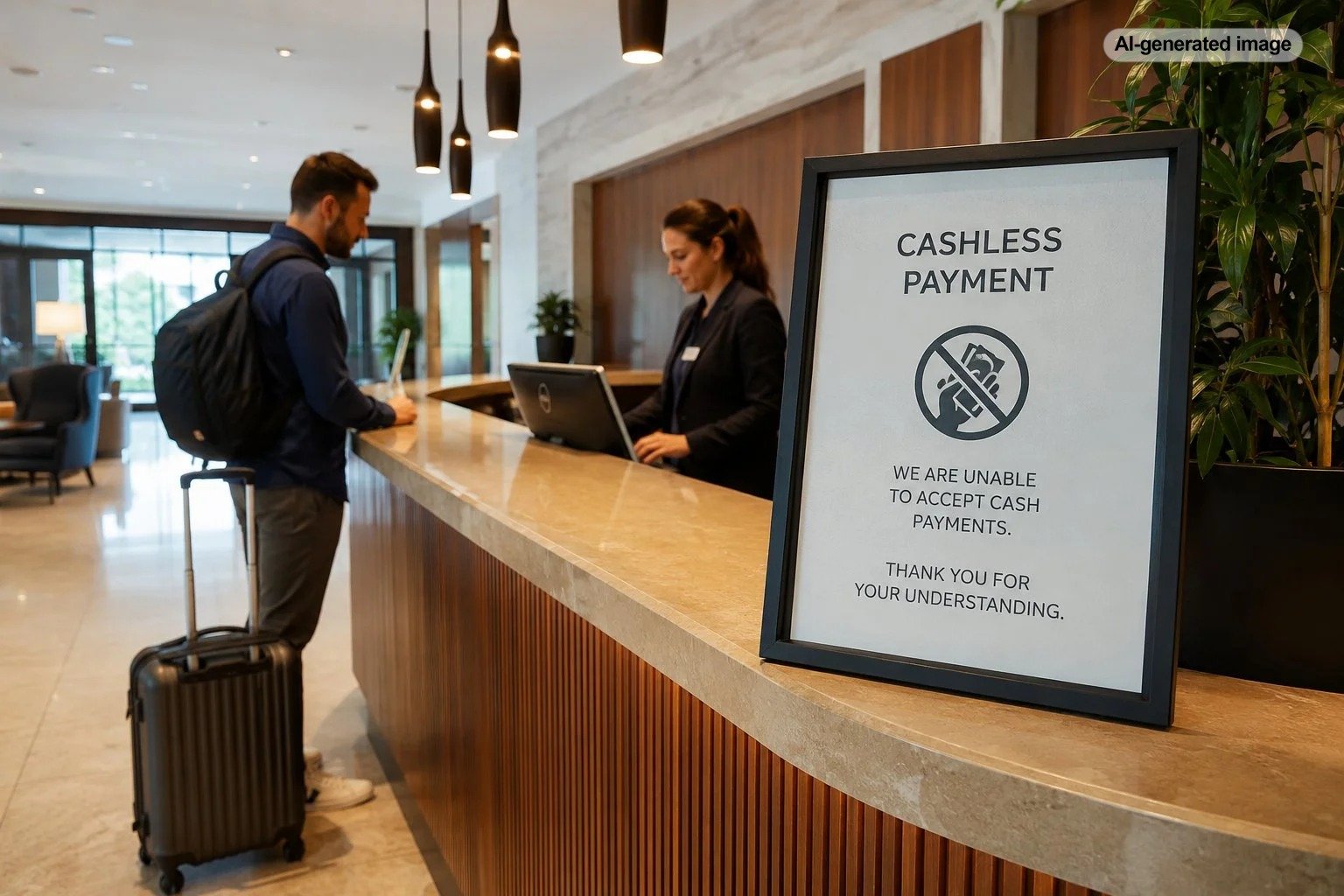
Can a Hotel Refuse Cash at Check-In?
Yes, a hotel can often refuse cash at check-in in the United States, but the answer depends on where the hotel is located and what local law requires. Federal law does not generally force a private business to accept cash for goods or services, even though U.S. currency is legal tender. State and local governments can impose different cash-acceptance rules.
For travelers, there is another important distinction: a hotel may have separate rules for paying the room bill, guaranteeing a reservation, and providing a deposit or payment method for incidental charges. Being able to pay the final balance in cash does not necessarily mean cash alone will satisfy every check-in requirement.
Quick answer
- There is no general federal requirement forcing private U.S. businesses to accept cash.
- State or local law may require hotels to accept cash in some jurisdictions.
- A hotel may distinguish between payment for the room and a card or deposit required for incidentals, subject to applicable law.
- Do not assume that a cash-friendly hotel will let you check in without another acceptable payment method.
- If you plan to travel without a credit or debit card, confirm the hotel’s current policy directly before arrival.
Why legal tender does not automatically mean every hotel must take cash
The phrase legal tender is sometimes misunderstood. Under federal law, U.S. coins and currency are legal tender for debts, public charges, taxes, and dues. That does not create a universal federal rule requiring every private business to accept cash in every transaction.
The Federal Reserve explains that there is no federal statute requiring a private business, person, or organization to accept currency or coins as payment for goods or services. Private businesses generally may establish their own cash policies unless a state or local law says otherwise.
This is why a hotel in one city may legally operate with a card-focused payment policy while a hotel elsewhere may be subject to a law requiring cash acceptance. Travelers should treat hotel payment rules as both a property-policy question and a local-law question.
Paying in cash and checking in with cash are not always the same thing
A common source of confusion is the difference between paying the lodging charge and meeting all requirements at the front desk. A hotel stay can involve several separate financial steps.
Paying for the room
A property may permit the lodging balance to be settled in cash. Depending on its policy and applicable law, that payment might be accepted at arrival, at departure, or under another arrangement communicated to the guest.
Guaranteeing the reservation
The reservation itself may have been secured using a payment method before arrival. A hotel’s rules for guaranteeing a booking are not necessarily identical to its rules for settling the final bill.
Covering incidentals or other potential charges
Hotels may also establish procedures for charges that are not known when the guest first checks in. The important practical point is that cash acceptance for the room does not by itself tell you what else the property will require at check-in. Travelers who do not carry a conventional payment card should ask specifically what forms of payment or deposit the hotel accepts for every part of the stay.
Local cash-acceptance laws can change the answer
State and municipal rules can impose requirements beyond the federal baseline. New York City provides a particularly clear example. According to the New York City Department of Consumer and Worker Protection’s current Hotel Licensing Law FAQ, hotels in the city must accept cash from customers, subject to specified exceptions. The guidance says hotels may refuse bills above $20 and may refuse cash for certain telephone, mail, or internet-based transactions unless the transaction takes place at the hotel. It also describes conditions under which an on-site device that converts cash to a prepaid card may be used.
That does not mean the New York City rule applies nationwide. It illustrates why a blanket statement such as “hotels never have to take cash” or “all hotels must accept legal tender” is too broad. Local rules matter, and they can change.
What to ask the hotel before traveling with cash
If cash will be your primary payment method, asking only “Do you accept cash?” may not give you enough information. A more useful conversation covers the entire arrival process.
- Can I pay the room balance in cash? Ask whether cash is accepted at check-in, checkout, or both.
- Do I need a credit or debit card to check in? A property may distinguish between paying the room charge and satisfying another check-in requirement.
- Is there a separate deposit or authorization requirement? Ask what forms of payment are accepted for it rather than assuming cash will qualify.
- Does the policy apply to my reservation type? A reservation arranged through another channel may involve payment terms established before arrival.
- Are there restrictions on cash denominations? Local law or property procedure may affect which bills are accepted.
For an important trip, consider obtaining the answer in writing through an official hotel email or reservation messaging channel. Policies can change, and a written response gives you something more precise to reference than a general assumption about the brand or hotel industry.
What travelers often overlook
A hotel brand and an individual property may not always present payment details in exactly the same way. When the issue could determine whether you can check in, verify the policy for the specific property where you are staying rather than relying on an unrelated location.
Prepaid reservations do not necessarily eliminate every arrival requirement. Paying for the room before the trip may resolve the lodging charge while leaving other check-in procedures in place.
Debit cards, prepaid cards, and cash can be treated differently. Do not assume that a hotel describing itself as accepting one automatically accepts the others for the same purpose.
Local consumer laws are not uniform. A policy that is permissible in one jurisdiction may be restricted in another. If a hotel appears to refuse cash despite a local cash-acceptance rule, check the applicable government guidance rather than relying on general advice found online.
What should you do if a hotel says it will not accept your cash?
First, determine what the hotel is actually refusing. The issue might be cash for the room charge, cash for a deposit, a particular denomination, or cash for a transaction that was arranged remotely. Those are different situations.
Ask the front desk to clarify the property’s current policy and what alternative payment methods are accepted. If you believe a local cash-acceptance law applies, consult the relevant state or municipal consumer-protection agency. Avoid assuming that federal legal-tender rules alone require the hotel to reverse its policy.
FAQ
Is a hotel required to accept U.S. currency because it is legal tender?
Not under a general federal cash-acceptance requirement. The Federal Reserve states that private businesses generally may set their own policies unless state or local law provides otherwise.
Can I pay cash at checkout even if a hotel requires another payment method at check-in?
Possibly, but this is property-specific and may also be affected by local law. Confirm both the check-in requirement and the accepted methods for settling the final bill before traveling.
Can a city require hotels to accept cash?
Yes. New York City, for example, currently requires hotels to accept cash from customers subject to stated exceptions and rules. Other jurisdictions may have different requirements.
Should I travel to a hotel with only cash?
Only after confirming the specific property’s requirements. Ask whether cash is accepted for the room, whether another payment method is required at arrival, and whether any separate deposit procedure applies.
Does a prepaid hotel stay mean I will not need a payment method at check-in?
Not necessarily. Prepayment addresses the charges covered by that reservation, but the property may have additional arrival procedures. Verify them directly before your trip.