Mediterranean Cruise vs. Land Vacation for First-Time Europe Travelers
For a first trip to Europe, the choice between a Mediterranean cruise and a land vacation is really a choice about pace and control. A cruise makes it easier to sample several destinations while keeping the same room, while a land trip gives you more time to experience individual cities and shape each day around your interests.
Neither format is automatically better. First-time travelers who want simpler logistics, a structured itinerary, and several destinations in one vacation may prefer a cruise. Travelers who care more about lingering over dinner, exploring after dark, changing plans, and understanding fewer places in greater depth will usually find a land vacation more satisfying.
Quick answer: which trip style fits you?
- Choose a Mediterranean cruise if you want to see several coastal destinations without repeatedly changing hotels.
- Choose a land vacation if you want more control over your schedule and more time in each city.
- A cruise can simplify logistics, but port schedules determine when you arrive and when you must return to the ship.
- A land trip involves more transportation planning, yet it gives you the freedom to stay overnight in every destination.
- Compare total trip costs rather than headline prices, because either style can accumulate optional expenses.
Mediterranean cruise vs. land vacation at a glance
| Consideration | Mediterranean cruise | Land vacation |
|---|---|---|
| Packing | Unpack once for the sailing | May involve several hotel changes |
| Destination time | Often limited to scheduled port calls | You decide how long to stay |
| Transportation | Ship handles travel between cruise ports | Traveler coordinates trains, flights, cars, or transfers |
| Evenings | Often spent aboard the ship | Spent in the destination |
| Flexibility | Lower once the itinerary is underway | Higher, especially with a lightly planned itinerary |
Why a Mediterranean cruise can work well for a first Europe trip
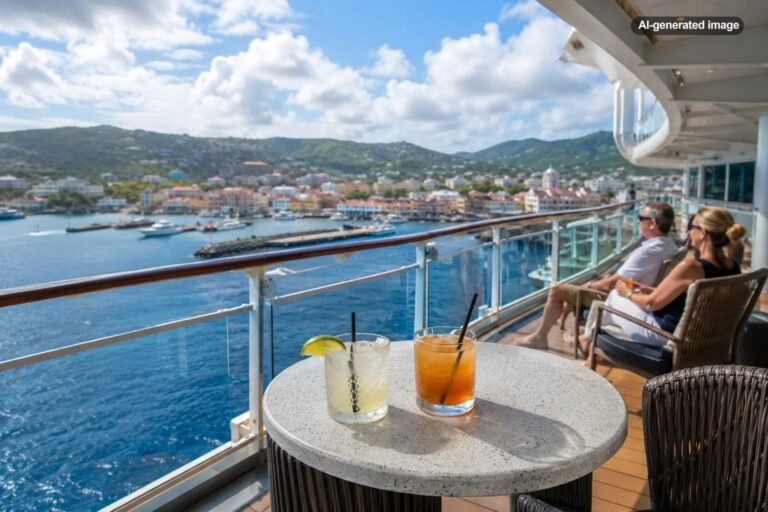
The biggest advantage is logistical simplicity. Current Mediterranean cruise programs illustrate how one sailing can connect several ports in different countries or regions. Instead of checking out of hotels, carrying luggage to stations, and navigating a new transportation system every few days, you return to the same cabin after each port visit.
This structure can be particularly appealing to families, multigenerational groups, and travelers who find frequent hotel changes tiring. Meals and entertainment are also concentrated aboard the ship, so you have a familiar base between sightseeing days.
A cruise can also function as an introduction to the Mediterranean rather than an attempt to experience each destination comprehensively. A first-time traveler might discover which cities, islands, or regions deserve a longer return trip later.
Affiliate disclosure: HotelInfo.com may earn a commission when you book or purchase through links on this page. This does not affect the price you pay. Learn more.
If the cruise format sounds appealing, you can compare available sailings with Expedia to see how departure ports, trip lengths, and destinations differ. Cruise fares, taxes, gratuities, onboard charges, itineraries, and cancellation rules vary, so compare the complete trip details rather than focusing on one advertised figure.
Where cruising can feel limiting
The tradeoff is time. A ship determines your arrival and departure window, and port calls do not necessarily provide enough time to understand a major European city. Some destinations associated with a cruise port also require additional travel after leaving the ship, reducing the hours available for sightseeing.
You may also miss one of the pleasures of European travel: watching a destination change over the course of a day. Land travelers can experience early mornings before day visitors arrive, take an unhurried afternoon break, and stay out for dinner without thinking about a ship departure.
Cruise itineraries can also change for operational, weather, or other reasons. Travelers who consider one specific port essential should recognize that a cruise itinerary is not the same as a guaranteed independent visit to that destination.
Why a land vacation offers a deeper experience
A land trip gives you control over both the calendar and the clock. Instead of spending a portion of a day in Rome, Barcelona, Athens, or another major destination, you might stay several nights and divide your sightseeing into manageable pieces.
This matters when your interests extend beyond major landmarks. You can choose a neighborhood restaurant without watching the time, explore a market in the morning, return to your hotel for a break, or change the next day’s plans because you discovered a museum, neighborhood, or nearby town that interests you.
Land travel also makes inland destinations far easier to incorporate. A Mediterranean cruise naturally emphasizes ports and coastal access, while a rail- or road-based itinerary can connect cities and regions without regard to whether they sit beside the sea.
Where a land trip demands more planning
Freedom creates additional decisions. You may need to select several hotels, understand station or airport transfers, manage luggage between destinations, and coordinate transportation reservations. That can be rewarding for travelers who enjoy planning, but overwhelming for someone who wants a vacation with fewer moving parts.
The most common mistake is trying to recreate a cruise itinerary on land by changing cities almost every day. Although European transportation networks make multi-city travel possible, constantly checking out, transferring, checking in, and orienting yourself can consume a surprising amount of the trip. A land vacation generally becomes more enjoyable when you choose fewer bases and give each one enough time.
Which option costs less?
There is no reliable universal winner because the cost structure is different. A cruise bundles transportation between ports and typically includes a range of meals and onboard activities, but travelers may pay separately for gratuities, specialty dining, drinks, internet access, shore excursions, transfers, and other optional services depending on the sailing.
A land vacation separates those expenses more visibly. Hotels, intercity transportation, local transit, meals, attractions, and activities are usually booked independently. That creates more opportunities to economize, but it also means travelers must assemble the total themselves.
For a fair comparison, build two complete trip estimates for the same dates. Include airfare, lodging or cruise fare, transportation, meals not included, sightseeing, insurance if purchased, and realistic incidental spending. A cheaper base fare does not necessarily produce a cheaper vacation.
Who should choose a Mediterranean cruise?
A cruise is strongest for travelers who value convenience over spontaneity. It can suit people who want to sample multiple Mediterranean destinations, travelers who dislike repeated hotel changes, families who appreciate having onboard activities available, and groups whose members have different interests.
It is a weaker fit if your main goal is cultural immersion in one or two places. If you already know that you want three full days in Florence, late dinners in Barcelona, or time to explore smaller towns from a fixed base, a cruise schedule may feel restrictive.
Who should choose a land vacation?
A land vacation is strongest for independent travelers who want control over their days. It is especially compelling when the trip revolves around a small number of cities, food and nightlife, museums, inland regions, day trips, or simply experiencing neighborhoods beyond the main sightseeing hours.
It can be less appealing for travelers who dislike transportation logistics or become stressed by frequent changes in hotels and unfamiliar surroundings. In that case, the solution does not have to be a cruise: a slower land itinerary using one or two bases can provide more independence without constant movement.
The hybrid option first-time travelers often overlook
You do not necessarily have to choose one format for the entire vacation. A useful compromise is spending several nights on land before or after a Mediterranean cruise. This gives you time to understand the departure or arrival city while preserving the convenience of a multi-port sailing.
The key is resisting the temptation to add too much. If a cruise already visits several destinations, a complicated pre-cruise circuit can turn the vacation into a sequence of transfers. A focused stay in one city before boarding often provides a better contrast between slow land travel and structured cruising.
How to make the final decision
Start by identifying what you would regret missing. If your priority is seeing several Mediterranean destinations on one trip, a cruise may provide the clearest path. If your priority is having enough time to understand how a few European cities actually feel, choose land.
Then consider your tolerance for logistics. Travelers who enjoy researching train routes, neighborhoods, hotels, and restaurants may find that planning a land trip is part of the pleasure. Travelers who prefer a defined framework may appreciate knowing that their accommodation travels with them.
For many first-time Europe travelers, the better trip is not the one that covers the most territory. It is the one whose pace matches how you want to travel. A Mediterranean cruise offers breadth and convenience; a land vacation offers depth and independence. Choosing between them becomes much easier once you decide which of those qualities matters more.
Frequently asked questions
Is a Mediterranean cruise a good first trip to Europe?
It can be. A cruise can simplify transportation between several destinations and reduce hotel changes. The tradeoff is that your time ashore follows the ship’s schedule, so it is better for sampling destinations than exploring each one deeply.
Is a land vacation more stressful than a cruise?
Not necessarily. A fast land itinerary with many hotel changes can involve substantial logistics, but a slower trip based in one or two cities can be straightforward. The amount of stress depends more on itinerary complexity than on the travel format itself.
How many European cities should a first-time land traveler visit?
There is no ideal number for everyone. Focus on how many hotel changes and transportation days you are comfortable managing. Fewer bases generally create more time for sightseeing and spontaneous exploration.
Can I combine a Mediterranean cruise with a land vacation?
Yes. Adding a focused hotel stay before or after a cruise can provide both destination depth and the convenience of a multi-port sailing. Keeping the land portion geographically simple usually prevents the combined trip from becoming too transfer-heavy.